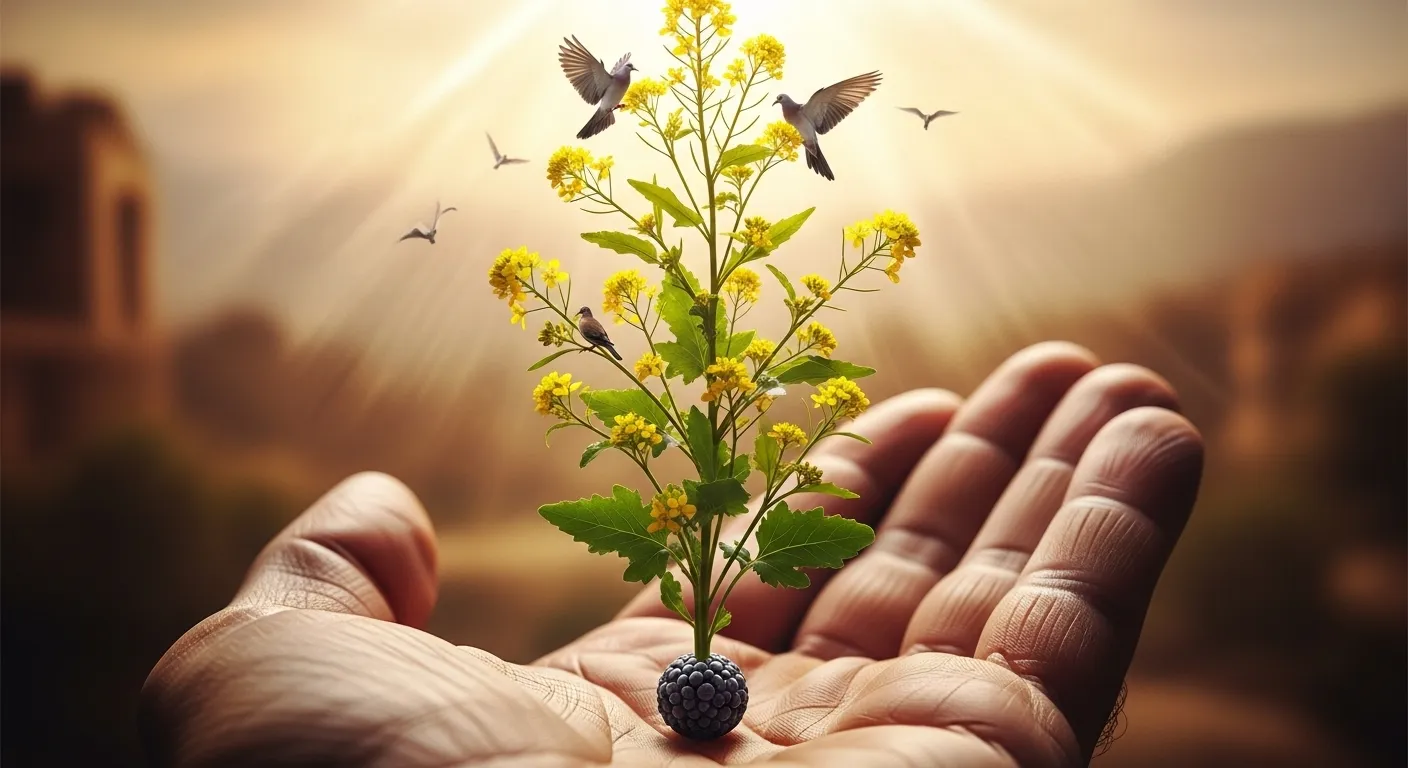
Hold a mustard seed between thumb and forefinger and you will barely feel it — a speck, a dot, something a breath could carry away. In first-century Galilee, it was proverbial: the mustard seed was the smallest seed anyone sowed. Jesus reached for it twice, in two different teachings, and both times He used smallness to detonate a large idea. The mustard seed in the Bible is God’s rebuttal to every theology of bigness — the quiet insistence that the kingdom of heaven does not arrive the way empires do, and that faith does not need to be enormous to be effective. It only needs to be real, and planted.
The Smallest Seed and the Largest Claim
“The kingdom of heaven is like to a grain of mustard seed, which a man took, and sowed in his field: which indeed is the least of all seeds: but when it is grown, it is the greatest among herbs, and becometh a tree, so that the birds of the air come and lodge in the branches thereof” (Matthew 13:31-32). The parable is deliberately disproportionate. Everything about the beginning is tiny; everything about the ending is outsized.
The first hearers would have felt the provocation. They were waiting for a kingdom that looked like David’s — armies, thrones, the nations subdued. Jesus offers them a seed. The kingdom, He says, will not arrive by conquest but by planting. It will look insignificant for a long time. People will walk past it without noticing. And then, slowly, irresistibly, it will become the largest thing in the garden — a tree where birds nest, an image drawn from the Old Testament’s pictures of great kingdoms offering shelter to the nations (Ezekiel 17:23; Daniel 4:12).
The parable is both promise and warning. Promise: do not despise the small beginnings of God’s work — the twelve nobodies, the upper room of 120, the quiet conversions no one reports. Warning: do not mistake unimpressive for unimportant. The seed’s size at planting predicts nothing about its size at harvest. God’s arithmetic has never matched the world’s.
Faith the Size of a Seed
Jesus used the same speck for a second lesson, this time about personal faith. When the disciples failed to cast out a demon and asked why, He answered: “If ye have faith as a grain of mustard seed, ye shall say unto this mountain, Remove hence to yonder place; and it shall remove; and nothing shall be impossible unto you” (Matthew 17:20). Luke records the variant: faith like a mustard seed could command a sycamore tree to uproot itself into the sea (Luke 17:6).
The comfort here is immense, and it cuts against a common misery: the belief that effective faith must be big faith — certain, unshakeable, heroic. Jesus says the opposite. The question is not the size of your faith but its object and its reality. A tiny, trembling trust in a great God moves mountains; a mountain of confidence in oneself moves nothing. Mustard-seed faith is not weak faith — it is small, genuine faith, and genuineness is the whole currency.
Notice also that the seed must be sown. Faith sitting in a packet does nothing. The disciples’ problem in Matthew 17 was not that their faith was small — it was that it stayed in their pockets while the need stood in front of them. Mustard-seed faith is faith planted: prayed, risked, acted on. A speck of trust, put into the ground of obedience, is enough for God to work with. He has never asked for more than that to begin.
Why Jesus Keeps Reaching for the Tiny
The mustard seed is not an isolated image; it is the emblem of God’s entire method. The Messiah arrives as a baby in a feeding trough. The church’s foundation is twelve uneducated men. The resurrection is first announced to grieving women whose testimony no court would accept. Paul summarizes the pattern: “God hath chosen the foolish things of the world to confound the wise; and God hath chosen the weak things of the world to confound the things which are mighty” (1 Corinthians 1:27).
There is a reason for this divine preference, and it is mercy. If the kingdom required greatness — great faith, great resources, great influence — most of humanity would be excluded. By building His work on mustard seeds, God throws the door open to everyone: the poor, the obscure, the trembling, the late starters. Smallness is not a disqualification in God’s economy. It is practically a prerequisite.
It is also a protection. Big, impressive faith is tempted to admire itself; mustard-seed faith has nothing to admire but God. When the mountain moves, no one credits the speck. The smallness of the instrument guarantees that the glory goes to the Gardener.
A Tree for Others: The Birds in the Branches
Do not skip the parable’s ending: the mustard plant “becometh a tree, so that the birds of the air come and lodge in the branches thereof” (Matthew 13:32). The kingdom’s growth is not for the kingdom’s own admiration. It is for shelter. The mature plant becomes a refuge — a place where the vulnerable rest, where the weary find shade, where life nests and is safe.
The image is borrowed from the Old Testament’s portraits of great kingdoms. Ezekiel pictures Assyria — and then, prophetically, Israel’s restored future — as a cedar “of high stature,” under whose branches “all fowls of heaven made their nests” (Ezekiel 31:6); Daniel’s Nebuchadnezzar dreams of a tree in which “the beasts of the field had shadow under it, and the fowls of the heaven dwelt in the boughs” (Daniel 4:12). In that tradition, birds nesting in branches meant the nations finding refuge under a great power’s shelter. Jesus takes the empire’s own imagery and hands it to a mustard bush. The kingdom that shelters the world will not look like Babylon. It will look like a garden plant that got out of hand.
This reframes what spiritual growth is for. The seed does not grow into a monument; it grows into a habitat. Maturing faith is not measured by how impressive the plant looks but by how many others find rest in its shade. The believer whose faith has grown large is the one under whose branches others lodge — the new convert sheltered, the weary traveler rested, the wounded bird safe. Small faith, planted and grown, becomes someone else’s refuge. That is the kingdom’s economics: every mustard seed is sown for the sake of birds the sower will never meet.
What the Seed Asks of Us
The parable ends, as all parables do, with a quiet question aimed at the hearer: where is your mustard seed, and is it in the ground? The teaching offers three practical directives. First, stop despising small beginnings — in your spiritual life, your ministry, your prayers. The seed that looks like nothing may be the largest thing you will ever plant. Zechariah’s question still stands: “Who hath despised the day of small things?” (Zechariah 4:10).
Second, plant what you have. Do not wait until your faith feels mountain-sized. Pray the trembling prayer. Take the small obedient step. Speak the faltering word of witness. God has a long history of doing enormous things with barely-anything offerings — a boy’s lunch, a widow’s coins, a speck of faith.
Third, give it time. Seeds do not argue with the calendar. The mustard plant’s growth is slow, hidden, and then suddenly obvious — which is exactly how kingdom growth usually looks. The believer’s job is planting and watering; “God gave the increase” (1 Corinthians 3:6), in His season, at His scale. Mark’s version of the parable adds that the seed grows “he knoweth not how” (Mark 4:27) — the farmer sleeps and rises, night and day, and the earth brings forth fruit by itself. Much of what God does with our small faith happens beyond our observation and beyond our management. Plant, water, sleep in peace: the growth is His department.
The smallest of seeds, the greatest of herbs; the tiniest of faiths, the mightiest of results. That is the Bible’s mustard-seed mathematics, and it has never failed: God takes specks and grows trees, takes trembling trust and moves mountains, takes nobodies and nests nations in their branches. For the botanical background of the plant behind the parable, the Wikipedia article on the mustard seed describes the seed itself; the parable describes what God does with small things surrendered to Him — and that remains the more astonishing botany.










