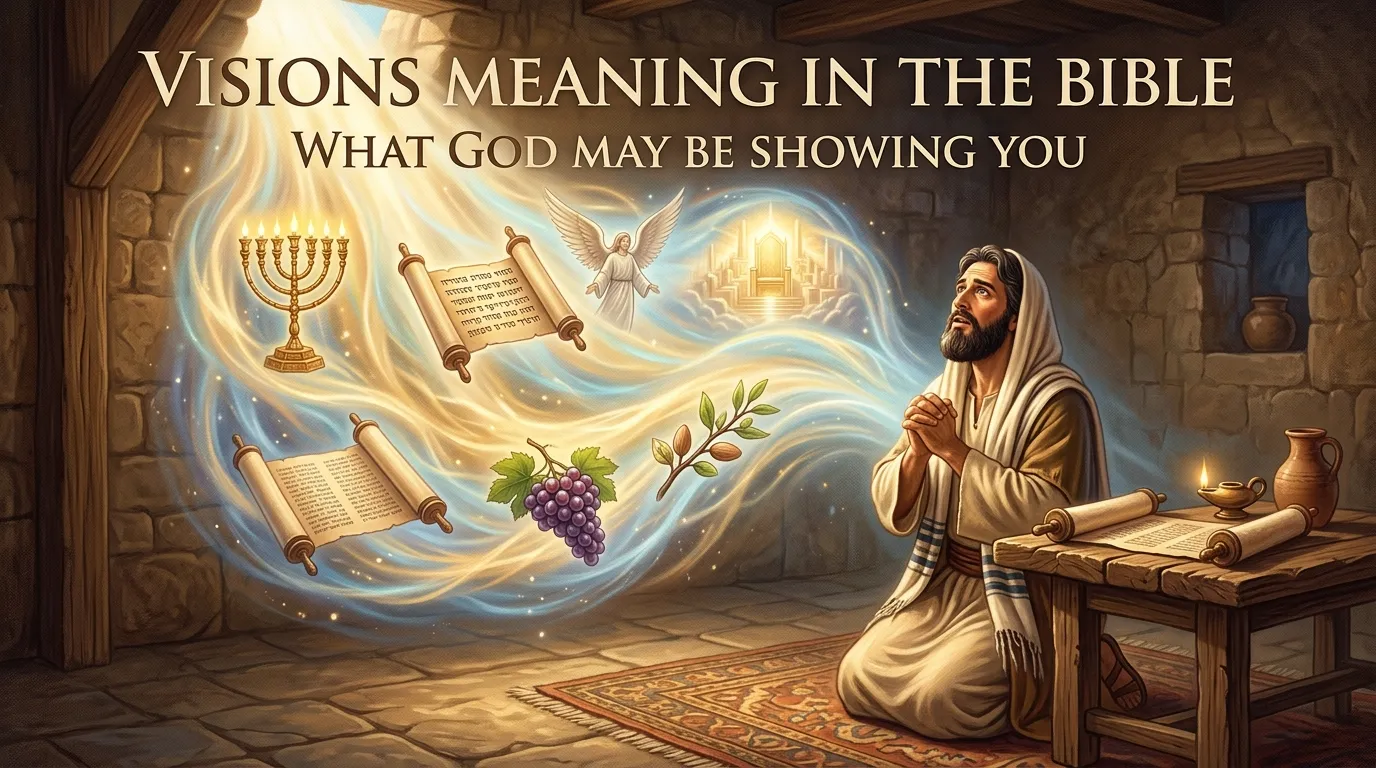
The first time Isaiah saw the Lord, the vision nearly undid him. There was no gentle glow, no comforting image to carry home — only a throne, high and lifted up, seraphim covering their faces, and a voice shaking the foundations of the temple: “Holy, holy, holy is the LORD of hosts; the whole earth is full of his glory!” (Isaiah 6:3). Isaiah’s response was not curiosity. It was confession: “Woe is me! For I am lost; for I am a man of unclean lips” (6:5). That is where biblical visions begin — not with information about our future, but with sight: the sudden, overwhelming apprehension of a holy God. Before visions ever guide, they humble.
Visions run through the whole of Scripture, from Jacob’s ladder at Bethel to John’s apocalypse on Patmos. They are among God’s chosen instruments for revealing Himself — distinct from dreams, distinct from prophecy spoken aloud, carrying their own character and their own dangers. What are they, what did they show, and what should a believer make of them today? The answers are richer, and more sobering, than the common idea that a vision is simply a spiritual daydream.
Visions in Scripture Are Seeing, Not Guessing
The Bible draws a deliberate line between visions and ordinary mental life. When Aaron and Miriam challenged Moses, God Himself defined the terms: “If there is a prophet among you, I the LORD make myself known to him in a vision; I speak with him in a dream” (Numbers 12:6). The vision is listed first — the higher, clearer medium. A dream happens to you in sleep; a vision is something you are shown, often awake, often in prayer or worship, with the unmistakable sense that heaven has opened a window.
Joel’s famous promise sharpens the distinction: “your old men shall dream dreams, and your young men shall see visions” (Joel 2:28). Both are the Spirit’s work, but they are not the same work. Dreams arrive in the night and need interpretation. Visions arrive as seeing — a direct beholding of realities the physical eye cannot reach. Isaiah saw the Lord. Ezekiel saw the glory above the cherubim. Peter saw the sheet let down from heaven. John saw the throne and the Lamb. In every case the verb is deliberate: the seer becomes an eyewitness, not a theorist.
That is why visions carry such authority in Scripture — and such responsibility. They are not impressions to be lightly claimed. When the prophets say “I saw,” they mean something happened to them that rearranged their understanding of reality. The modern believer who speaks of visions should feel the weight of that verb before using it.
What the Great Visions Showed
Biblical visions are not random spiritual cinema. Each one was given to teach something specific, and the pattern across them is instructive.
Ezekiel saw glory in exile. By the river Chebar, far from the ruined temple, the young priest saw the heavens opened: a storm wind, flashing fire, four living creatures, and above them “a likeness with a human appearance” on a sapphire throne, ringed with rainbow brightness (Ezekiel 1:26-28). The message was unmistakable: the glory had not died with the temple. God was not confined to Jerusalem’s ruins. For exiles who believed heaven had gone silent, the vision preached that God’s presence travels with His people — even into Babylon.
Daniel saw kingdoms rise and fall. His night visions — the four beasts from the sea, the Ancient of Days taking His seat, the Son of Man given dominion (Daniel 7) — compressed the whole future of empires into images. Babylon, Persia, Greece, Rome: all of them would have their hour, and all of them would end. The visions were given to a young exile serving pagan kings, and their message was steadying: history has an Author, and the kingdoms of men are footnotes in His story. Daniel’s visions warned, but they also anchored.
Peter saw a sheet — and his prejudices torn open. On a rooftop in Joppa, hungry and waiting for lunch, Peter fell into a trance and saw heaven opened and “something like a great sheet descending” full of unclean animals, with the command: “Rise, Peter; kill and eat” (Acts 10:11-13). Three times the vision repeated before Peter understood: it was not about food. It was about people — God showing him that the gospel was for Gentiles too, that “God shows no partiality” (10:34). Cornelius was already on his way. The vision did not give Peter new theology so much as it broke the old fence around the old theology. Some visions exist to widen the seer’s heart.
John saw the end — and it was worship. The Revelation is the Bible’s longest vision, and its content surprises everyone who expects only doom. Yes, there are seals and trumpets and bowls. But the vision keeps returning to the throne: “Worthy is the Lamb who was slain, to receive power and wealth and wisdom and might and honor and glory and blessing!” (Revelation 5:12). The apocalypse is, at bottom, a worship service — the future shown so that suffering churches could see who wins and start singing early.
See the pattern: glory for the exiled, sovereignty for the oppressed, inclusion for the prejudiced, hope for the persecuted. Biblical visions are never given merely to impress. They are given to form — to make God’s people braver, broader, and more worshipful.
The Macedonian Turn: When a Vision Redraws the Map
Some visions change individual lives. One vision changed the map of the church. Paul, on his second missionary journey, kept hitting closed doors — “forbidden by the Holy Spirit to speak the word in Asia,” then “the Spirit of Jesus did not allow them” to enter Bithynia (Acts 16:6-7). Frustrated, blocked, and sleepless in Troas, Paul received the vision: “a man of Macedonia was standing there, urging him and saying, ‘Come over to Macedonia and help us'” (16:9).
Luke’s next sentence is one of the most quietly momentous in the New Testament: “immediately we sought to go on into Macedonia, concluding that God had called us to preach the gospel to them” (16:10). Note the pronoun — we. This is where Luke joins the story. The gospel crosses into Europe. Philippi, Thessalonica, Berea, Corinth — the churches that would carry the faith westward — all trace back to a night vision in Troas.
Two things about this vision deserve attention. First, it confirmed what the closed doors had already suggested. Paul did not receive the Macedonian call out of nowhere; he received it after God had repeatedly blocked his own plans. Visions in Scripture rarely contradict the direction providence is already pointing — they clarify it. Second, the vision came to a man already in motion. Paul was not waiting for a vision to decide whether to serve; he was serving, blocked, and praying. The vision met obedience in progress. That is the biblical pattern: God guides the moving, not the parked.
Visions Can Be Misread — Even by Apostles
Here the Bible grows wonderfully honest, because it refuses to romanticize the visionary life. Paul himself — the man of the Macedonian vision — was “caught up to the third heaven” and heard “things that cannot be told, which man may not utter” (2 Corinthians 12:2-4). And what did God give him alongside this supreme privilege? “A thorn was given me in the flesh… to keep me from becoming conceited because of the surpassing greatness of the revelations” (12:7).
That sentence should stop every vision-seeker cold. The greatest visionary experience in the New Testament came with a built-in humbler. God knew that visions can inflate as easily as they can instruct. Paul prayed three times for the thorn’s removal and received instead the famous answer: “My grace is sufficient for you, for my power is made perfect in weakness” (12:9). The vision was real. The thorn was also real. God gave both — the ecstasy to show Paul heaven, the affliction to keep him usable on earth.
John learned a related lesson on Patmos. Overwhelmed by the angel who showed him the visions, he “fell down to worship at the feet of the angel” — twice. Twice the angel stopped him: “You must not do that!… Worship God” (Revelation 19:10; 22:9). Even the messenger of a vision must not become its object. A vision that leads to fascination with the vision — with angels, with experiences, with the seer’s own spirituality — has been misread at the most basic level. Every true vision points past itself to Christ. The one on Patmos ends with the church’s cry: “Come, Lord Jesus!” (22:20). That is the test of every vision: does it make Jesus bigger, or the visionary?
Scripture also warns that visions can be counterfeited — manufactured by the human heart or worse. Jeremiah confronted prophets who ran with visions God never gave: “they speak visions of their own minds, not from the mouth of the LORD” (Jeremiah 23:16). Ezekiel condemned those who “see false visions and… utter lying divinations” (Ezekiel 13:6-7). The test was never the vividness of the experience; it was fidelity to God’s revealed Word. A vision that contradicts Scripture, excuses sin, or centers the seer has failed before discussion begins.
Write It Down: Visions Carry Assignments
One of the most practical vision-texts in the Bible is also one of the shortest. Habakkuk, waiting on the watchtower for God’s answer, is told: “Write the vision; make it plain on tablets, so he may run who reads it” (Habakkuk 2:2). The vision was not given to be savored in private. It was given to be written, clarified, and carried — plain enough that a runner could read it at speed.
This reframes the whole subject. In Scripture, visions are not spiritual entertainment; they are commissions. Isaiah’s vision ended with “Here I am! Send me” (Isaiah 6:8). Ezekiel’s visions made him a watchman (Ezekiel 3:17). John’s vision became a book “to show to his servants the things that must soon take place” (Revelation 1:1). The vision is the beginning of an assignment, not the end of an experience.
And note Habakkuk’s honesty about timing: “the vision awaits its appointed time; it hastens to the end — it will not lie. If it seems slow, wait for it” (2:3). Some visions are not for now. They are for then — to be held, prayed over, and waited for. The believer’s job is not to force the fulfillment but to keep the vision plain and keep walking until God’s “appointed time” arrives.
Do Visions Still Happen?
Joel’s promise — quoted by Peter at Pentecost as the charter of the Spirit age (Acts 2:17) — has never been revoked: “your young men shall see visions.” The New Testament gives no expiration date. Church history and the global church today are full of credible testimonies, particularly in places where the gospel is newest and Bibles are scarcest, of Christ revealing Himself in visions to those who have never heard His name.
But the same New Testament that leaves the door open also posts the guards. “Do not believe every spirit, but test the spirits” (1 John 4:1). “Test everything; hold fast what is good” (1 Thessalonians 5:21). And above all: “we have the prophetic word more fully confirmed, to which you will do well to pay attention as to a lamp shining in a dark place” (2 Peter 1:19). Peter — who stood on the Mount of Transfiguration and saw Christ glorified — still points the church to the written Word as the surer light. Visions are lightning; Scripture is the lamp. The wise believer is grateful for lightning but builds the house by lamplight.
If you believe you have received a vision, Scripture’s counsel is steady: pray over it, test it against the Word, share it with mature believers, watch for the fruit, and hold it with open hands. If God showed it, He will confirm it — in His time, in His way. And if the nights stay quiet? You are in good company. Most of the heroes of faith walked far more by the lamp than by the lightning — and the lamp has never once gone out.
For readers who want the wider history of how these experiences have been understood across centuries and traditions, Wikipedia’s overview of visions in spirituality traces the concept from ancient mystics to modern accounts — a helpful backdrop to the biblical picture drawn here.










