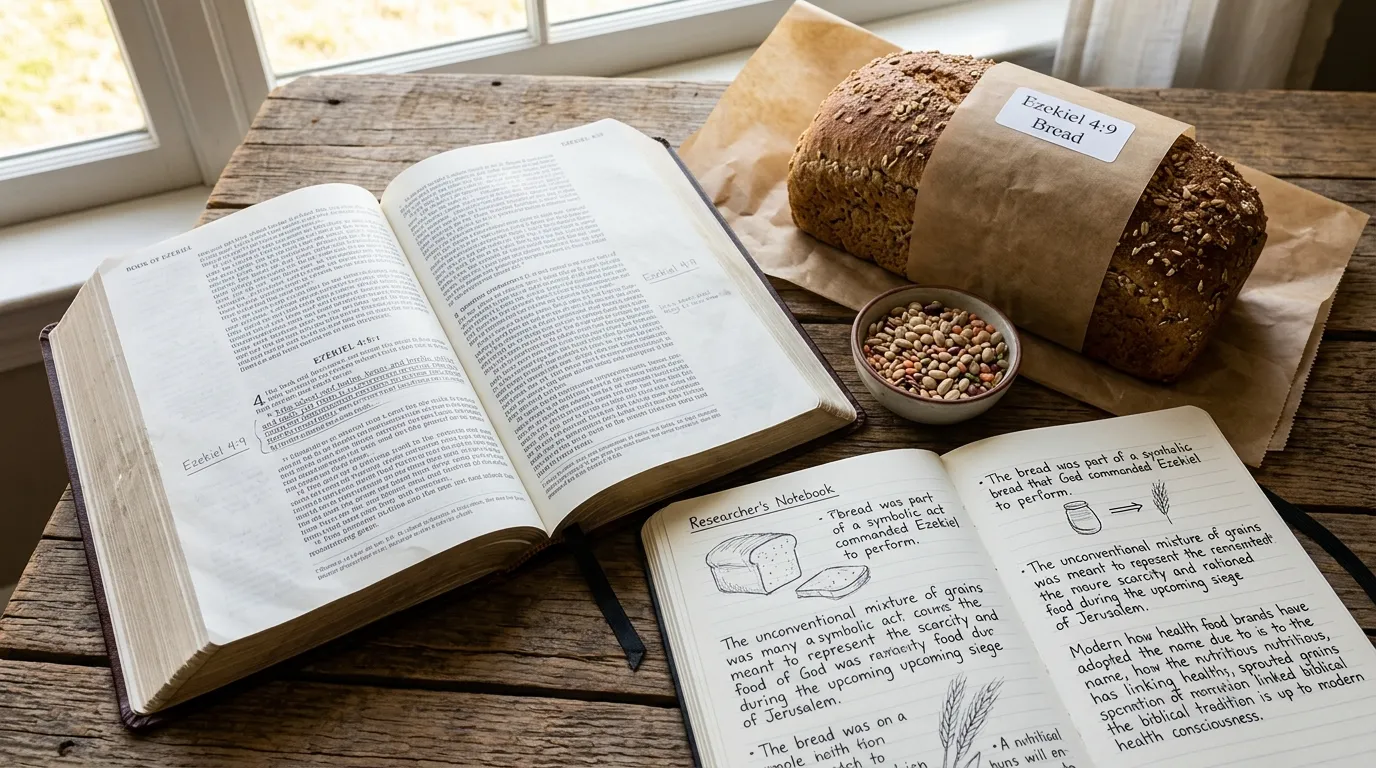
Few verses in the Bible have traveled a stranger road than Ezekiel 4:9. In its original setting, it is part of one of the most disturbing prophetic performances in Scripture: God commands Ezekiel to lie on his side for over a year, to bake bread over human excrement (later mercifully changed to cow dung), and to eat starvation rations — as a living, breathing sermon about the siege of Jerusalem. On grocery shelves today, the same verse appears on packages of premium sprouted-grain bread, marketed as an ancient recipe for health. Both things are real. Only one of them is what the verse is about.
To understand Ezekiel bread biblically, we have to do what the packaging never does: go back to the siege. Because in context, this “recipe” is not a health tip. It is a sign-act of judgment — one of the strangest and most harrowing object lessons any prophet ever performed. And once you see it in its setting, the verse has far more to say to faith than any nutrition label could — about scarcity, obedience, and the God who measures out provision even in judgment.
The Recipe in Its Original Context
The command comes in the opening movement of Ezekiel’s ministry, around 593 BC, among the Jewish exiles in Babylon. God tells the prophet to take “wheat and barley, beans and lentils, millet and emmer” — six ingredients — “and put them into a single vessel and make your bread from them” (Ezekiel 4:9). The quantities are then specified with grim precision: twenty shekels of food per day (about eight ounces — a starvation ration), and a sixth of a hin of water (about a pint). This is the diet for the 390 days he will lie on his left side, bearing the iniquity of Israel, plus 40 days on his right for Judah (Ezekiel 4:4-8).
Every detail is symbolic. The mixed grains signal desperation: in normal times, bread was wheat or barley; mixing in beans, lentils, millet, and emmer meant scraping together whatever could be found — siege food, the diet of a city whose supply lines are cut. The weighed portions (4:10) picture rationing, the end of eating freely. The measured water (4:11) pictures thirst. And the cooking fuel — first human dung, then, at Ezekiel’s horrified protest, cow dung (4:12-15) — pictures defilement: “Thus shall the people of Israel eat their bread unclean, among the nations, to which I will drive them” (4:13). Exile would not only starve them; it would render their food ritually impure, cut off from the clean worship of the temple.
Then comes the detail that makes the whole performance unbearable: Ezekiel is to do all this lying on his side, bound (4:8), in public, day after day, for well over a year. Imagine walking past that every morning — the prophet on his mat, weighing his crumbs, baking over dung, embodying a sermon no one wanted to hear. The exiles could not escape it. Neither can we.
Why God Commanded Something So Strange
Prophets in the ancient world were performers as well as preachers, and God repeatedly used their bodies as billboards. Isaiah walked naked and barefoot for three years as a sign against Egypt and Cush (Isaiah 20:3). Jeremiah smashed a potter’s flask in the Valley of Hinnom (Jeremiah 19:10). Hosea married an unfaithful woman as a living picture of Israel’s adultery (Hosea 1:2). Ezekiel’s repertoire is the most extreme: the side-lying, the shaved head and divided hair (Ezekiel 5), the baggage packed for exile (Ezekiel 12), the forbidden mourning for his dead wife (Ezekiel 24). These are not eccentricities. They are sermons you cannot unsee — designed to lodge in the memory of people who had stopped listening to words.
Why the body? Because the exiles’ problem was not lack of information but lack of imagination. They had heard the warnings for years and filed them away. So God made the warning visible, daily, unavoidable. A sermon can be forgotten by lunch; a man lying bound on the street, baking bread over dung, cannot be unfelt. The sign-acts say what the sermons could not: this is real, this is coming, and you cannot look away.
And there is mercy folded into the horror. Ezekiel’s protest — “Ah, Lord GOD! Behold, I have never defiled myself” (4:14) — is met not with rebuke but with concession: cow dung instead of human (4:15). Even in the sign-act of judgment, God bends toward His servant’s conscience. The God who commands the strange thing also listens to the horrified prophet — a small tenderness inside the terrible picture, and a reminder that the Judge is also the Father.
What the Bread Meant to the Exiles
To the exiles watching, the message was unmistakable: Jerusalem is going to fall, and the fall will be starvation before it is conquest. The weighed bread and measured water were the rations of a besieged city — and Babylon was already on the march. The defilement of the fuel announced that exile would sever them from the purity system that structured their whole religious life. No temple. No clean altar. Bread eaten “unclean, among the nations.” For people whose identity was food, festivals, and temple, this was the announcement of the end of their world.
But the sign-act carried a second, quieter message: God is still measuring. The rations are weighed. The water is measured. The days are counted — 390, then 40. Judgment, in Ezekiel, is never chaos; it is meted, bounded, purposeful. The God who weighs the bread is the God who will weigh the exile’s end and declare it finished. The exiles could not see it yet, but the measuring that announced judgment also promised its limit. What God measures, God finishes.
And that is why the book of Ezekiel, which opens with siege-bread and bound prophets, ends with a river flowing from the temple and trees whose “fruit will be for food, and their leaves for healing” (Ezekiel 47:12). The measured rations give way to the abundant table. The God who starved the city in judgment is the God who will feed it in restoration — and the arc of the book is the arc of the gospel: through judgment, to mercy; through the measured bread, to the feast.
A Note on the Modern Loaf
So what about the bread on the grocery shelf — the sprouted-grain loaf marketed with Ezekiel 4:9 on the package? The honest answer: it is good bread and bad exegesis. The ingredients genuinely resemble the verse’s list, and there is nothing wrong with eating it. But the verse is not a recipe; it is a requiem — a funeral dirge for a city, baked in starvation rations. To treat it as a health tip is to miss the prophet on his side, the bound body, the dung fire, the tears of the exiles who watched. The packaging borrows the verse’s words and ignores its world.
That said, the modern loaf can still preach — if we let it. Every slice is a reminder of the siege: of how seriously God takes sin, of how real judgment is, of how far grace had to reach. And every slice can also remind us of the other bread the Bible offers: “Give us this day our daily bread” (Matthew 6:11) — the Father’s provision, asked for daily, received gratefully. The manna in the wilderness. The loaves multiplied for the five thousand. And finally, the Bread Himself: “I am the bread of life; whoever comes to me shall not hunger” (John 6:35).
Bread as a Bible Theme: From Manna to the Table
See the arc: manna in the wilderness, rations in the siege, daily bread in the prayer, and finally Christ Himself as the bread. Every loaf in the story was pointing somewhere. Ezekiel’s weighed, measured, dung-baked bread pointed to judgment — and judgment, in the Bible, always points beyond itself to the mercy that follows it. The exiles would return. The city would be rebuilt. And one day, the Bread of Life would stand in that rebuilt city’s temple courts and invite the hungry to Himself.
So the next time you see the verse on a package, remember the prophet on his side, the weighed crumbs, the measured water — and the God who would go to such lengths to warn His people, because He was not finished with them. That is the real meaning of Ezekiel bread: not a diet plan, but a love letter written in the language of judgment, from a God who measures out even His discipline — and who, in the end, offers Himself as the bread that truly satisfies.
For the prophet behind the passage — his visions, his sign-acts, and his place in Israel’s story — Wikipedia’s article on the Book of Ezekiel provides a solid historical and literary overview.










