Imagine living with a problem that no doctor, friend, or human solution could fix. Then, one day, Jesus meets you and gives you a simple instruction that requires faith. This is the setting behind one of the most meaningful moments in John’s Gospel.
The Pool of Siloam meaning in the Bible is closely connected with healing, obedience, faith, God’s sending, and spiritual sight. In John 9, Jesus healed a man who had been blind from birth by telling him to wash in the Pool of Siloam. When the man obeyed, he came back seeing.
The story is more than an account of physical healing. It also teaches us how Jesus brings light into lives that have been filled with darkness. At the same time, we should be careful to separate what Scripture clearly says from spiritual ideas Christians may draw from the story.
Let’s explore what the Bible actually teaches about the Pool of Siloam and what its message can mean for believers today.
What Is the Pool of Siloam in the Bible?
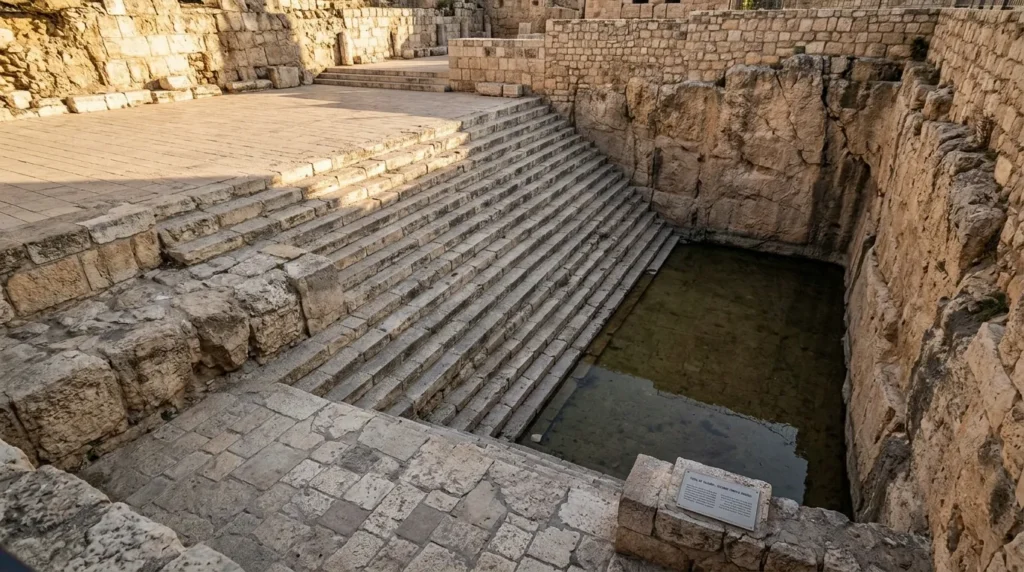
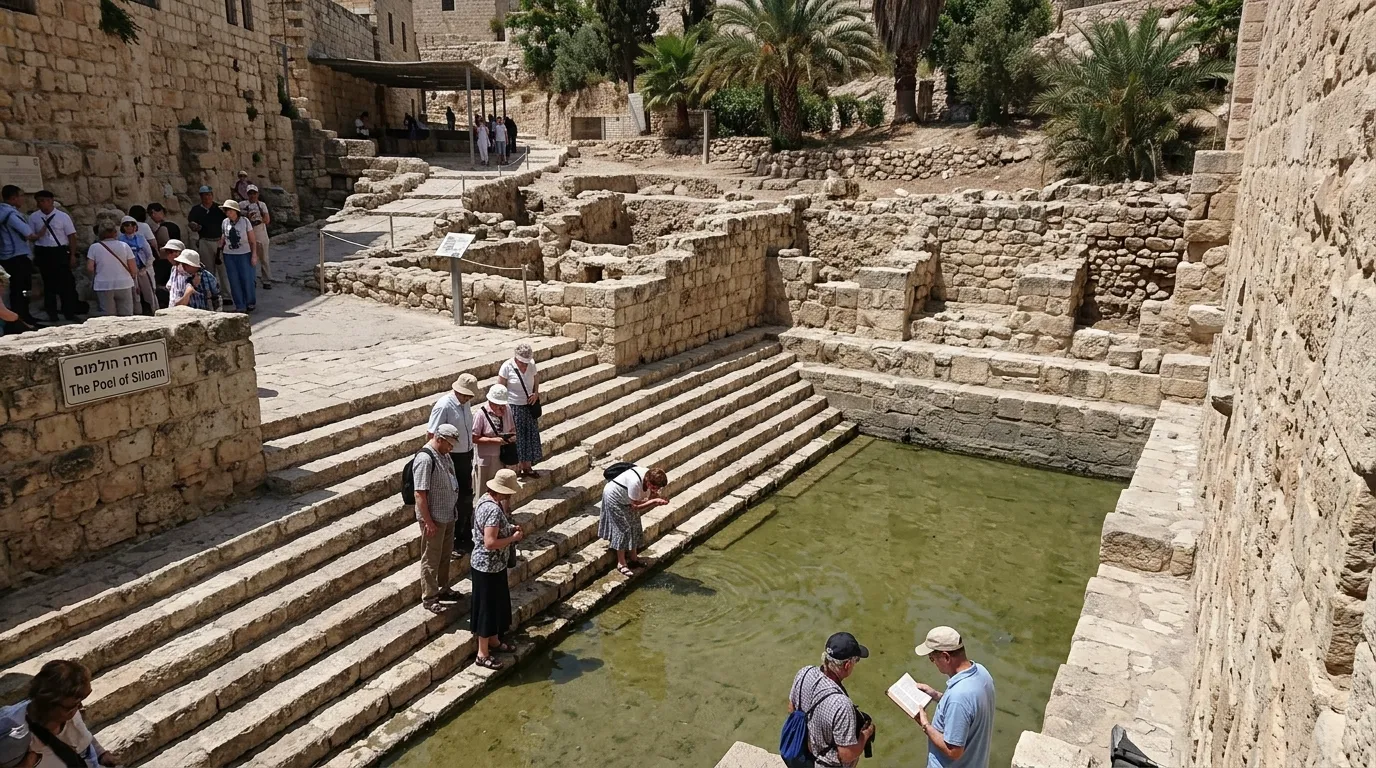
The Pool of Siloam was a water reservoir in Jerusalem. It is especially important in the New Testament because Jesus used it in the healing of a man who had been blind since birth.
John 9:1–7 tells the story. Jesus saw a man who had been blind from birth. His disciples asked whether the man’s blindness was caused by his own sin or the sin of his parents.
Jesus rejected that assumption. He explained that the situation would provide an opportunity for God’s work to be displayed.
Jesus then made mud, placed it on the man’s eyes, and told him:
“Go, wash in the pool of Siloam.” — John 9:7
The man went, washed, and returned seeing.
This is the clearest biblical passage connected with the Pool of Siloam.
Pool of Siloam Meaning in the Bible: Healing and Obedience
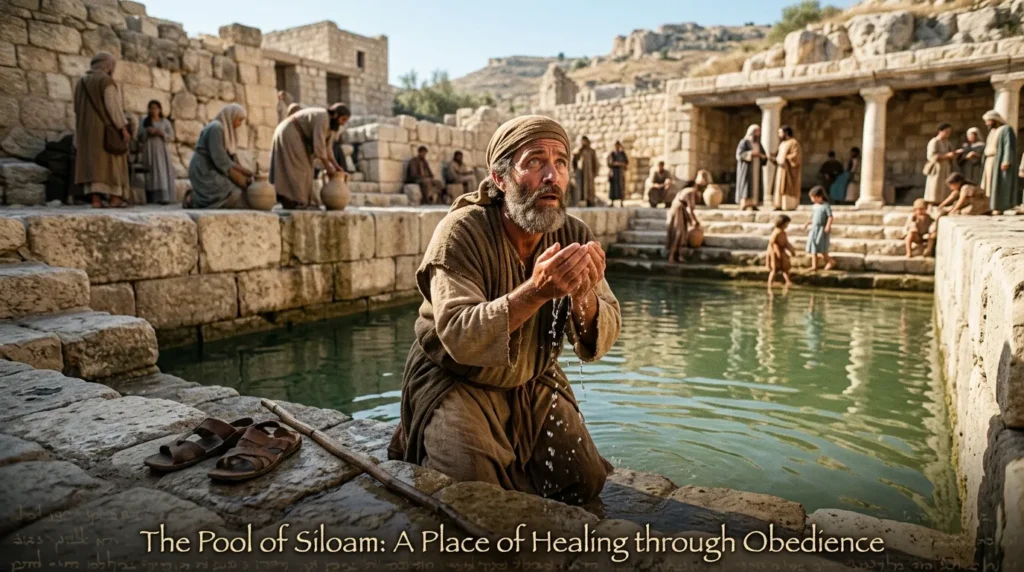
One important lesson from the story is the connection between faith and obedience.
Jesus did not simply tell the blind man that he would see. He gave him an instruction. The man had to go to Siloam and wash.
The Bible does not say that the water itself had magical healing power. Instead, the healing happened through Jesus’ authority and power.
The man’s obedience became part of his response to Jesus.
This gives us an important Christian lesson:
Faith often means trusting God enough to obey Him, even when we do not understand everything He is doing.
Sometimes God’s instruction may seem simple. We may wonder why He wants us to take a certain step. Yet obedience can become an expression of trust.
For example, a Christian may feel called to forgive someone, apologize, serve another person, return to prayer, or make a wise change in life. The step may feel difficult, but obedience can demonstrate trust in God.
Pool of Siloam Meaning in the Bible: Spiritual Sight
The healing in John 9 has a deeper theme: seeing and spiritual blindness.
At first, the man could not physically see. Jesus gave him physical sight.
But as the chapter continues, another kind of blindness becomes clear.
Some religious leaders saw the miracle but refused to accept what Jesus had done. They questioned the healed man and became increasingly hostile toward Jesus.
The man, however, gradually came to recognize who Jesus was.
Eventually, Jesus found him and asked whether he believed in the Son of Man. The man responded by asking who He was so that he could believe. Jesus revealed Himself, and the man worshiped Him (John 9:35–38).
This creates a powerful contrast.
The man who had been physically blind eventually recognized Jesus spiritually, while people who could physically see failed to recognize what God was doing.
Therefore, the Pool of Siloam story points beyond physical eyesight.
Jesus can bring light to the heart as well as healing to the body.
Pool of Siloam Hebrew Meaning
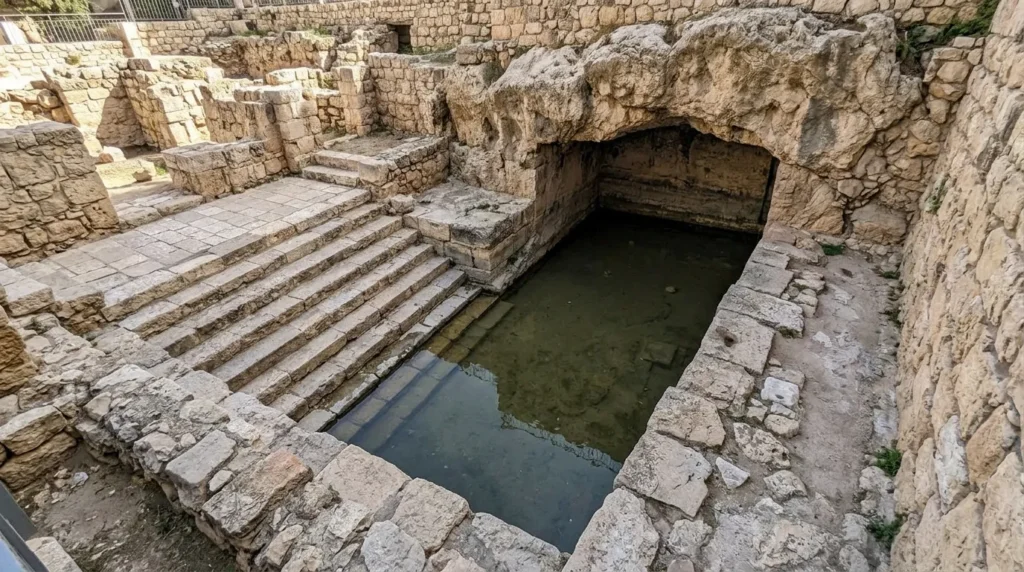
The name Siloam is connected with the idea of sending. John 9:7 specifically explains the name by saying that Siloam means “Sent.”
The Greek word used in John’s explanation is related to the idea of being sent. This fits beautifully with the story because Jesus sent the blind man to the pool.
There is also an Old Testament connection to the waters of Shiloah in Isaiah 8:6. The Hebrew name is associated with the idea of sending or being sent, although discussions of the exact linguistic development of the names can be more complex than a simple one-word translation.
For a Christian reading of John 9, the most important point is clear because John himself explains the name as “Sent.”
This gives the passage a meaningful connection:
- Jesus gave the man an instruction.
- The man was sent to Siloam.
- He obeyed.
- He washed.
- He received sight.
The name therefore fits the action taking place in the story.
However, Christians should not turn the word “Siloam” into a secret code or claim meanings that Scripture does not provide.
What Happened at the Pool of Siloam?
John 9:6–7 gives us the basic sequence.
Jesus made mud with saliva and placed it on the blind man’s eyes. Then He told him to wash in the Pool of Siloam.
The man obeyed.
“So he went and washed, and came back seeing.” — John 9:7
The miracle immediately created controversy.
People who knew the man recognized him as the person who had once been blind. Some were amazed and confused. Others questioned how his eyes had been opened.
The man repeatedly explained what Jesus had done.
The religious leaders eventually investigated the miracle. Instead of celebrating God’s work, many of them focused on the fact that Jesus had healed the man on the Sabbath.
The chapter then moves from the miracle itself to the question of who Jesus really is.
That is important because John does not tell this story simply to teach us about a pool. He uses the miracle to reveal something about Jesus.
Is the Pool of Siloam a Symbol of God’s Healing?
The Bible clearly shows that healing happened at Siloam in John 9.
However, it does not teach that the Pool of Siloam itself became a permanently supernatural healing source.
That distinction matters.
Some Christians may use Siloam as a picture of God’s healing, cleansing, or restoration. Such symbolism can be meaningful when it remains connected to biblical teaching.
But Scripture does not tell believers to travel to Siloam for healing or treat its water as spiritually powerful today.
The power in John 9 came from Jesus, not from the water as a magical substance.
This protects us from superstition while still allowing us to appreciate the spiritual beauty of the story.
What Does the Pool of Siloam Teach Christians Today?
The story contains several practical lessons for everyday Christian life.
Trust Jesus Even When You Do Not Understand
The blind man did not receive a long explanation before obeying.
Jesus told him what to do, and he went.
We sometimes want God to explain every detail before we move forward. Yet faith often requires us to trust God’s character when we cannot see the entire path.
Proverbs 3:5–6 encourages believers to trust the Lord rather than depending completely on their own understanding.
Obedience Can Be an Act of Faith
The man’s journey to Siloam was simple, but it required action.
In the same way, Christian faith is not merely agreeing with ideas about God. Genuine faith affects how we live.
When Scripture teaches us to love, forgive, pray, serve, speak truth, and walk humbly, obedience becomes part of our response to God.
Jesus Brings Light Into Darkness
The man entered the story unable to see.
He left seeing.
John uses this physical miracle to point toward a greater spiritual truth: Jesus is the light of the world.
Earlier in John 9, Jesus said, “I am the light of the world” (John 9:5).
This connects the miracle directly to Jesus’ identity.
Do Not Let Other People’s Opinions Control Your Faith
After his healing, the man faced pressure from religious leaders.
Yet he continued telling the truth about what had happened.
His testimony was simple: he had been blind, Jesus had acted, and now he could see.
Christians today may also face questions or criticism because of their faith. The story encourages believers to remain humble, truthful, and faithful rather than allowing fear to control them.
Does Siloam Mean “Sent” Spiritually?
Yes, John 9 explicitly connects Siloam with the meaning “Sent.”
Christians may also see a beautiful spiritual picture in this.
The man was sent to the pool, and Jesus Himself had been sent by the Father to accomplish His mission.
Throughout John’s Gospel, Jesus speaks about being sent by the Father. For example, John 5:36–37 emphasizes the Father’s sending of Jesus.
Still, we should be careful not to claim that every detail of the Pool of Siloam story represents a hidden spiritual code.
The safest approach is to begin with what John actually says and then draw applications that agree with the wider teaching of Scripture.
What Does Siloam Mean in a Dream?
Some people search for the Pool of Siloam meaning in a dream after dreaming about water, washing, Jerusalem, or the pool.
The Bible does contain examples of God using dreams in certain circumstances. However, Scripture does not give a universal rule saying that dreaming about Siloam always means healing, cleansing, breakthrough, or a specific future event.
Therefore, Christians should be cautious.
A dream about Siloam might cause someone to reflect on biblical themes such as:
- Faith and obedience
- Spiritual sight
- God’s guidance
- Healing and restoration
- Jesus as the Light of the world
- Trusting God when the path is unclear
But these are possible reflections, not guaranteed prophetic meanings.
Every dream should be tested against Scripture rather than treated as an unquestionable message from God.
If a dream encourages something that clearly contradicts God’s Word, it should not be accepted simply because it felt spiritual.
What Does It Mean If You Keep Thinking About the Pool of Siloam?
If the Pool of Siloam keeps coming to mind, it can be a helpful opportunity for prayer and biblical reflection.
Instead of immediately assuming that God is predicting a specific event, ask thoughtful questions.
What part of John 9 stands out to you?
Are you struggling to trust God?
Is there an area where you know the right thing to do but are afraid to obey?
Are you asking God for healing or restoration?
Are you seeking greater spiritual understanding?
These questions can turn curiosity into meaningful reflection.
For example, someone facing an uncertain career decision might reflect on the blind man’s obedience. Someone going through a painful season might focus on Jesus’ compassion. Someone struggling spiritually might consider the difference between physical sight and spiritual sight in John 9.
Is the Pool of Siloam Connected to Baptism?
The story involves washing in water, so some readers naturally wonder whether Siloam represents Christian baptism.
However, John 9 does not say that the man’s washing was baptism.
Christian baptism is taught clearly elsewhere in the New Testament, including Matthew 28:19, Romans 6:3–4, and Acts 2:38.
It is therefore better not to claim that the Pool of Siloam was a baptismal symbol in John 9 unless we clearly identify that as a later Christian interpretation rather than the direct teaching of the passage.
The main point of John 9 is the miracle Jesus performed and the revelation of His identity.
Why Is the Pool of Siloam Important in John 9?
The Pool of Siloam is important because it becomes part of a story about Jesus’ authority and the opening of blind eyes.
But the pool itself is not the main character.
Jesus is.
The miracle demonstrates that Jesus can do what human beings cannot do. It also exposes the spiritual blindness of those who refuse to believe despite seeing evidence of God’s work.
This makes John 9 a story about much more than physical healing.
It asks every reader a deeper question:
Am I willing to see who Jesus truly is?
What Is the Main Spiritual Lesson of the Pool of Siloam?
The central spiritual lesson is that Jesus brings light, calls people to faith, and deserves our trust and obedience.
The blind man’s story also reminds us that God’s work does not always happen in the way we expect.
He was given an unusual instruction.
He obeyed.
Jesus performed the miracle.
Then the man had to deal with questions, opposition, and pressure.
His healing did not mean that every problem in his life immediately disappeared. Instead, his encounter with Jesus gave him something deeper: a growing understanding of who Jesus was.
This is encouraging for Christians today.
Following Jesus does not mean that every difficulty disappears overnight. But it does mean that we do not have to walk through darkness alone.
How Can Christians Apply the Siloam Story to Daily Life?
The story can become a practical guide for faith.
When you are confused, seek God’s wisdom through Scripture and prayer.
When you know what God’s Word teaches, choose obedience even when it is difficult.
When you are hurting, bring your pain honestly to God.
When you cannot see what comes next, trust the One who can.
When others question your faith, remain truthful and humble.
And when God gives you an opportunity to encourage someone else, remember that your testimony can point people toward Christ.
The man in John 9 did not need a complicated speech. He simply told people what Jesus had done.
Sometimes your testimony can be just as simple.
What Does the Pool of Siloam Teach Us About God’s Character?
The story reveals several beautiful truths about God.
God sees people others may overlook. Jesus noticed the blind man.
God cares about suffering. Jesus did not treat the man’s condition as meaningless.
God works through His Son, Jesus. The miracle demonstrated Jesus’ authority.
God brings light. The man moved from physical blindness to sight, while the chapter also challenges spiritual blindness.
God deserves trust. The man’s obedience became part of his response to Jesus.
These truths remain relevant when life feels confusing or painful.
Frequently Asked Questions About the Pool of Siloam
Where is the Pool of Siloam mentioned in the Bible?
The Pool of Siloam is most famously mentioned in John 9:7, where Jesus tells a man born blind to wash there. It is also connected with the waters of Shiloah mentioned in Isaiah 8:6.
What does Siloam mean in the Bible?
John 9:7 explains the name Siloam as meaning “Sent.” The name fits the story because Jesus sent the blind man there to wash.
What happened at the Pool of Siloam?
Jesus told a man who had been blind from birth to wash at the Pool of Siloam. After he obeyed, he returned seeing (John 9:7).
Does the Pool of Siloam have healing power today?
The Bible does not teach that the pool itself possesses magical or permanent healing power. In John 9, the miracle is presented as an act of Jesus’ power and authority.
What does Siloam symbolize spiritually?
The story can point Christians toward themes of faith, obedience, spiritual sight, healing, restoration, and the light of Christ. These applications should remain grounded in Scripture.
What does dreaming about the Pool of Siloam mean?
The Bible does not provide one fixed meaning for dreaming about Siloam. A dream may encourage personal reflection on biblical themes, but it should be tested against Scripture rather than treated automatically as a message from God.
Why did Jesus send the blind man to Siloam?
John tells us what Jesus instructed the man to do but does not give a detailed explanation of why Jesus chose that particular pool. The important result is that the man obeyed and received his sight.
Final Thoughts on the Pool of Siloam Meaning in the Bible
The Pool of Siloam meaning in the Bible is ultimately about much more than a place filled with water. In John 9, it becomes part of a powerful story about Jesus, faith, obedience, healing, and spiritual sight.
The man who could not see obeyed Jesus and came back seeing. His experience reminds us that God’s instructions may sometimes seem simple or unexpected, but trusting Jesus is never wasted.
At the same time, Siloam should not become an object of superstition. The Bible points us away from the water itself and toward the One who gave the command.
If you are walking through a season where you cannot see what comes next, remember the message of John 9. Jesus is still the Light of the world. You may not understand every step, but you can seek Him, pray for wisdom, open His Word, and take the faithful step He has already made clear.
Let the story of Siloam encourage you to trust God with what you cannot see. Pray for spiritual sight, wisdom, courage, and faith. And above all, keep your eyes on Jesus—the One who brings light into darkness and leads His people with grace.