Imagine reading the Bible and coming across the name Rome again and again. You may wonder why this city mattered so much in the early Christian story. You may also ask, “Does Rome have a special spiritual meaning in the Bible?”
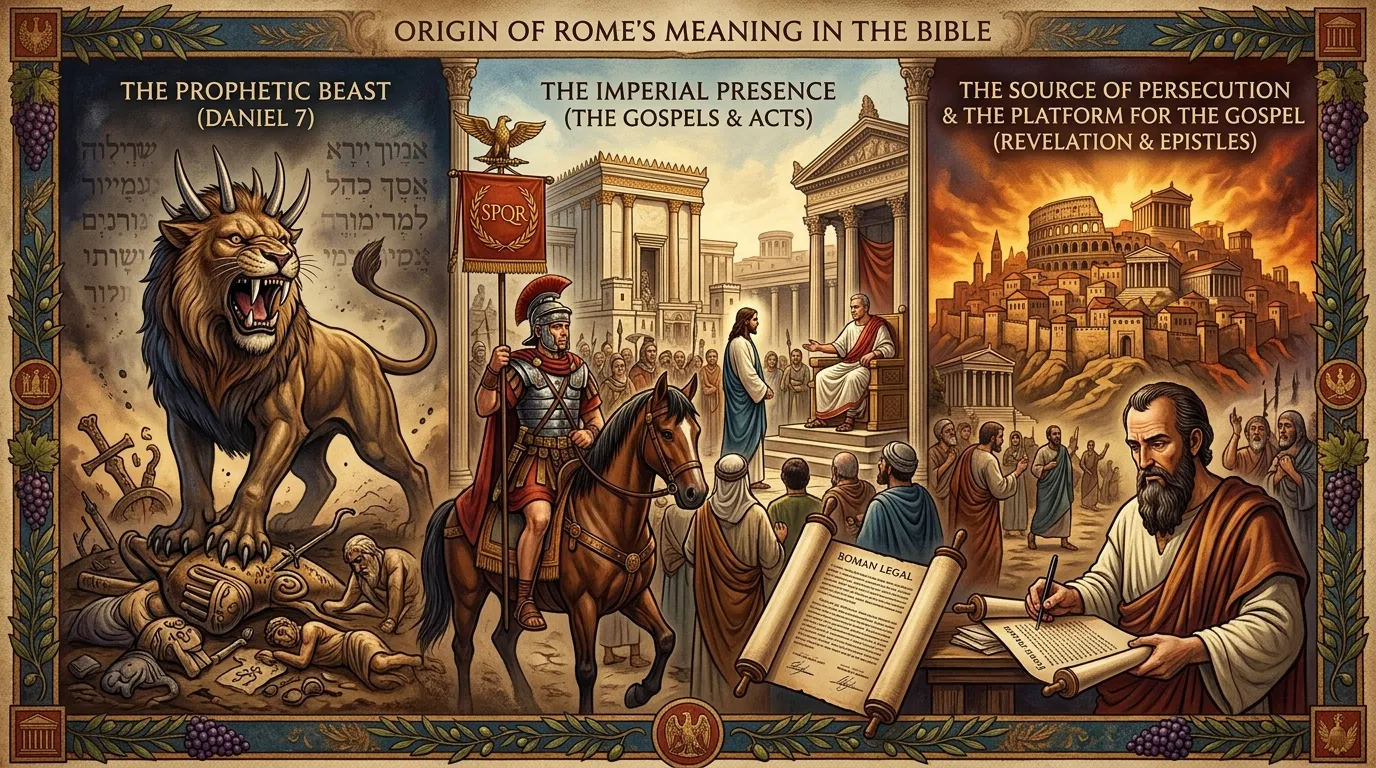
The origin of Rome meaning in the Bible is not given as a hidden name meaning or prophetic code. Rome was a real city and the center of the Roman Empire during the time of Jesus and the apostles. Scripture shows Rome as a place of political power, cultural influence, persecution, travel, and also an important setting for the spread of the gospel.
The Bible does not tell us the exact origin of Rome’s name. It also does not say that the name “Rome” has a special Hebrew meaning. Instead, Scripture helps us understand Rome through its role in biblical history.
For Christians, the most important lesson is this: God is greater than every earthly power. Rome was powerful, but its power did not stop God’s Word from spreading.
What Does Rome Mean in the Bible?
In the Bible, Rome primarily refers to the ancient city that became the capital of the Roman Empire. It was not originally a biblical city like Jerusalem, Bethlehem, or Nazareth. However, Rome became very important in the New Testament because of its connection with the early Christian church.
Paul wrote his famous Letter to the Romans to believers living in Rome. He wanted to encourage them in their faith and explain the gospel clearly.
Paul wrote:
“For I am not ashamed of the gospel of Christ.” — Romans 1:16
This verse gives us an important spiritual lesson about Rome. Even in a powerful city filled with political authority, Christians were called to remain faithful to Christ.
The Bible does not present Rome as automatically evil simply because it was powerful. Instead, Scripture focuses on how people respond to God while living under human authority.
The Origin of Rome in Biblical History
The Bible does not provide a story about how Rome was founded. Ancient Roman tradition connected the city’s founding with Romulus and Remus, but that tradition comes from Roman history and mythology, not from Scripture.
Rome grew into a major political and military power. By New Testament times, the Roman Empire controlled large areas around the Mediterranean, including Judea.
This historical setting explains why Rome appears in the New Testament.
Jesus lived under Roman rule. His crucifixion took place under the authority of Pontius Pilate, the Roman governor of Judea. Later, the apostles traveled through territories controlled by Rome as they preached the gospel.
So, when studying the biblical meaning of Rome, it is important to separate Roman history from biblical teaching.
Origin of Rome Meaning in the Bible Hebrew Meaning
The origin of Rome meaning in the Bible Hebrew meaning requires an important clarification: Rome does not have a special Hebrew name meaning given by Scripture.
Rome is primarily a Greek and Latin historical name. The New Testament was written mainly in Greek, and the Greek form of Rome is Rhōmē (Ῥώμη). The Hebrew Bible does not tell us that the name Rome came from a particular Hebrew word.
In modern Hebrew, Rome is commonly written רוֹמָא (Roma). But this modern Hebrew spelling should not be confused with an ancient biblical Hebrew definition.
Therefore, it would be misleading to claim that Rome has a secret Hebrew spiritual meaning based on wordplay.
The Bible’s message about Rome comes from its historical and spiritual role, not from a hidden Hebrew definition of its name.
Where Is Rome Mentioned in the Bible?
Rome appears in several important places in the New Testament.
Rome in Acts 2:10
On the day of Pentecost, people from many regions were present in Jerusalem. Acts 2:10 mentions visitors from Rome, both Jews and converts to Judaism.
This is significant because the gospel was already reaching people connected with Rome very early in the Christian story.
Some of those people may have later carried the message of Christ back to Rome.
Rome in Acts 18:2
Acts 18:2 mentions Jews who had been expelled from Rome by the Roman emperor Claudius.
This shows the real political and social pressures surrounding the Jewish and Christian communities during the first century.
Paul Travels to Rome
Paul eventually traveled to Rome as a prisoner.
Acts 28 describes Paul’s arrival there. Even though Paul was under guard, he continued teaching about Jesus.
Acts 28:30–31 says that Paul lived in Rome for two years and welcomed people who came to him. He proclaimed God’s kingdom and taught about Jesus Christ.
This is one of the most powerful pictures connected with Rome:
Paul was restricted, but God’s Word was not restricted.
Why Was Rome Important to Paul?
Rome was important because it was the center of a huge empire. A Christian community there could have influence far beyond the city itself.
Paul wrote to the Roman Christians before he visited them. His letter explained major truths about salvation, sin, grace, faith, righteousness, and life in Christ.
Romans 3:23–24 teaches that all have sinned but can be justified freely through God’s grace.
Romans 5 explains the hope believers have through Christ.
Romans 8 gives one of Scripture’s strongest messages about God’s love and the security believers have in Him.
Romans 12 then moves from doctrine to daily Christian living, teaching believers to offer themselves to God and live with transformed minds.
Therefore, Rome becomes part of a larger biblical message:
The gospel is powerful enough to transform people even in the middle of a powerful and imperfect culture.
Is Rome a Symbol of Evil in the Bible?
This question needs a careful answer.
Rome was a pagan empire, and Roman authorities participated in persecution and oppression. However, the Bible does not say that every reference to Rome means evil.
For example, Paul appealed to Caesar and received protection through Roman legal processes. Roman citizenship also affected Paul’s journey and legal treatment.
Acts 25 shows Paul exercising his right as a Roman citizen to appeal to Caesar.
So Rome could represent political authority, government, military strength, and worldly power without every mention being a symbol of wickedness.
Christians should avoid turning every reference to Rome into a symbolic prophecy.
Rome and the Symbolism of Worldly Power
Although Rome is not always presented symbolically, Scripture does give us principles that can help us think about powerful earthly kingdoms.
The Roman Empire appeared extremely strong. It controlled territory, armies, roads, trade, and political systems.
Yet the Roman Empire was still temporary.
God’s kingdom is different.
Daniel 2:21 reminds us that God removes kings and sets up kings. This teaches that human governments may rise and fall, but God remains sovereign.
This can encourage Christians today.
A government may change. A powerful person may rise. A culture may shift. Economies may become unstable.
But God does not lose control when the world looks uncertain.
Rome and the Book of Revelation
Rome is often connected by Christian scholars with the symbolic imagery in Revelation 17 and 18, especially the description of “Babylon.”
However, we should be careful here.
Revelation does not simply say, “Babylon is Rome.” Many Christians throughout history have understood Babylon as representing Rome, particularly because of the political, economic, and persecuting power associated with the Roman world.
At the same time, Babylon can also represent a broader system of human pride, rebellion, luxury, injustice, and opposition to God.
Therefore, it is better to say:
Many Christians interpret Revelation’s Babylon as referring to Rome in its first-century setting, while also seeing a wider picture of worldly systems opposed to God.
We should not present an interpretation as though Scripture explicitly states something it does not.
Rome and 1 Peter 5:13
One interesting passage is 1 Peter 5:13:
“She who is at Babylon, who is likewise chosen, sends you greetings.”
Some early Christian writers understood Babylon here as a symbolic name for Rome.
This interpretation became common because Christians sometimes used “Babylon” as a way of referring to Rome.
However, the verse itself does not directly say, “Babylon means Rome.”
That distinction matters when studying the Bible.
Good Bible study separates what Scripture clearly says from what Christians reasonably infer from historical context.
What Is the Spiritual Meaning of Rome?
Rome does not have one fixed spiritual meaning that applies to every situation.
However, its biblical story can point us toward several important spiritual lessons.
Earthly Power Is Temporary
Rome looked unstoppable in its time. Yet no earthly empire lasts forever.
Psalm 20:7 reminds believers that ultimate confidence should not rest in human strength.
Our security should be in God, not in political or worldly power.
God’s Gospel Can Grow Under Pressure
The early church faced opposition, yet Christianity continued to spread.
Paul preached in Rome even while under house arrest.
This reminds us that difficult circumstances do not automatically mean God has abandoned us.
Christians Can Live Faithfully in Difficult Cultures
The Roman world was very different from the Christian life Paul taught.
Yet Paul did not tell believers to abandon society. He taught them how to live holy lives within it.
Romans 12:2 tells believers not to be shaped by the pattern of the world but to be transformed by the renewing of their minds.
This remains practical today.
God Can Use Unexpected Places
Rome was not the city most people would naturally choose as the center of Christian influence.
Yet God used people there to spread the gospel.
This reminds us that God can work through places and circumstances we may not expect.
What Does Rome Mean in a Dream?
Some Christians search for the biblical meaning of Rome in a dream.
If you dream about Rome, it is important not to assume that the dream contains a guaranteed prophetic message.
The Bible records dreams that God used in specific situations, but Scripture does not teach that every modern dream has a divine interpretation.
A dream about Rome might simply reflect something you have recently seen, read, watched, or thought about.
If a dream feels spiritually important, test it carefully.
Ask:
- Does the interpretation agree with Scripture?
- Does it draw me closer to Christ?
- Am I treating a personal impression as though it were God’s Word?
- Could ordinary thoughts or experiences explain the dream?
- Have I prayed for wisdom instead of rushing to conclusions?
James 1:5 encourages believers to ask God for wisdom.
Scripture should be the foundation of Christian discernment, not dreams, symbols, numbers, or feelings.
What Does Seeing Rome Mean Spiritually?
If you see Rome in real life, in a picture, or repeatedly encounter references to Rome, there is no biblical rule saying that this is automatically a divine sign.
Still, the subject can become an opportunity for reflection.
You might think about Paul’s faithfulness in Rome.
You might remember that God’s gospel continued even when believers faced pressure.
You might reflect on how temporary human power is compared with God’s eternal kingdom.
The safest approach is not to search for secret signs everywhere.
Instead, let ordinary experiences turn your heart toward prayer, Scripture, wisdom, and faithfulness.
Rome and the Christian Life Today
The story of Rome has practical meaning for Christians living in today’s world.
You may work in a company where your faith is not understood. You may live in a culture that has values different from biblical teaching. You may also feel pressure from politics, money, social media, or public opinion.
The early Christians faced their own pressures.
Paul’s example teaches us to remain faithful without losing our love for others.
For example, a Christian employee can work honestly even when others cut corners. A student can remain truthful when friends encourage cheating. A parent can teach biblical values with patience rather than fear.
These choices may seem small, but faithful living matters.
What Can Christians Learn From Rome?
The biblical story of Rome offers several lasting lessons:
- God is greater than every earthly government.
- Human power is temporary, but God’s kingdom is eternal.
- The gospel can spread even during difficult times.
- Christians are called to remain faithful wherever God places them.
- Political power should never become the foundation of our hope.
- Scripture should guide our understanding of spiritual experiences.
- We should distinguish biblical teaching from human speculation.
- God can use ordinary believers to accomplish extraordinary purposes.
These lessons are just as meaningful today as they were in the first century.
Does Rome Have a Negative Meaning in the Bible?
Not always.
Rome is sometimes associated with persecution and worldly power, especially when Christians study Revelation and its imagery. But Rome is also the setting connected with Paul’s ministry, the Roman Christians, and the spread of the gospel.
Therefore, saying simply that “Rome means evil” would be too broad.
A more accurate biblical understanding is that Rome was a real historical center of power that became deeply connected with the early Christian story. In some biblical interpretations, Rome also represents human systems that oppose God.
Context matters.
Is Rome Mentioned in the Old Testament?
Rome is not directly named in the Old Testament.
The Old Testament focuses on earlier kingdoms and nations, including Egypt, Assyria, Babylon, Persia, and others.
The Roman Empire belongs mainly to the historical setting of the New Testament.
Some Christians connect certain Old Testament prophecies about kingdoms with Rome through broader prophetic interpretations, especially when studying Daniel. However, such interpretations should be handled carefully and compared with the full biblical context.
Rome, Faith, and God’s Sovereignty
One of the strongest lessons from Rome is the difference between human control and God’s sovereignty.
Rome had soldiers, laws, wealth, roads, political authority, and military strength.
The apostles had something different: the gospel of Jesus Christ.
Paul could be imprisoned, but he could still preach. Christians could be opposed, but they could still worship. Human rulers could make decisions, but they could not cancel God’s purposes.
This gives believers hope.
When life feels controlled by circumstances, remember that God is never powerless.
When the future looks uncertain, remember that God remains faithful.
When worldly systems seem stronger than truth, remember that God’s Word remains true.
Frequently Asked Questions
What is the biblical meaning of Rome?
Rome was the capital of the Roman Empire and an important city in the New Testament. Biblically, its significance comes from its role in the lives of Paul and early Christians rather than from a secret meaning attached to the city’s name.
Does Rome have a Hebrew meaning in the Bible?
No specific Hebrew meaning for the name Rome is given in Scripture. Rome is a historical name associated with Greek and Latin usage, and the Hebrew Bible does not provide an etymology for it.
Is Rome a symbol of evil?
Not in every biblical reference. Rome was a powerful empire that persecuted Christians at times, and some Christian interpretations connect Rome with the symbolic Babylon of Revelation. However, Scripture does not teach that every mention of Rome means evil.
Is Rome mentioned in the New Testament?
Yes. Rome appears in passages including Acts 2:10, Acts 18:2, Acts 28, and Romans. Paul’s Letter to the Romans was written to Christians living in Rome.
What does Rome represent spiritually?
Rome can remind Christians of the temporary nature of earthly power, the spread of the gospel under pressure, and the importance of remaining faithful to God. These are spiritual lessons drawn from the biblical story rather than a single official definition.
What does seeing Rome in a dream mean biblically?
The Bible does not give a universal meaning for dreaming about Rome. A dream should not automatically be treated as a message from God. Any spiritual interpretation should be tested against Scripture and approached with prayer and wisdom.
Why was Rome important to early Christianity?
Rome was important because it was the center of the Roman Empire and home to a Christian community that received Paul’s letter. Paul also spent time in Rome preaching about God’s kingdom and Jesus Christ.
Final Thoughts
The origin of Rome meaning in the Bible is not a secret Hebrew definition or a guaranteed spiritual code. Rome was a real city and the center of a powerful empire that became deeply connected with the story of the early church.
Its story reminds us that earthly power does not have the final word. Rome was mighty, but God’s purposes continued through ordinary believers, faithful apostles, and the message of Jesus Christ.
If Rome has appeared in your thoughts, studies, dreams, or personal experiences, do not rush into fear or speculation. Bring the question to God in prayer, open His Word, and ask for wisdom.
Above all, remember the lesson Paul demonstrated in Rome: circumstances can limit a person, but they cannot limit God’s truth. Keep your eyes on Christ, trust God’s wisdom, and remain faithful wherever He has placed you. God’s kingdom is greater than every earthly kingdom, and His grace is stronger than every challenge you face.