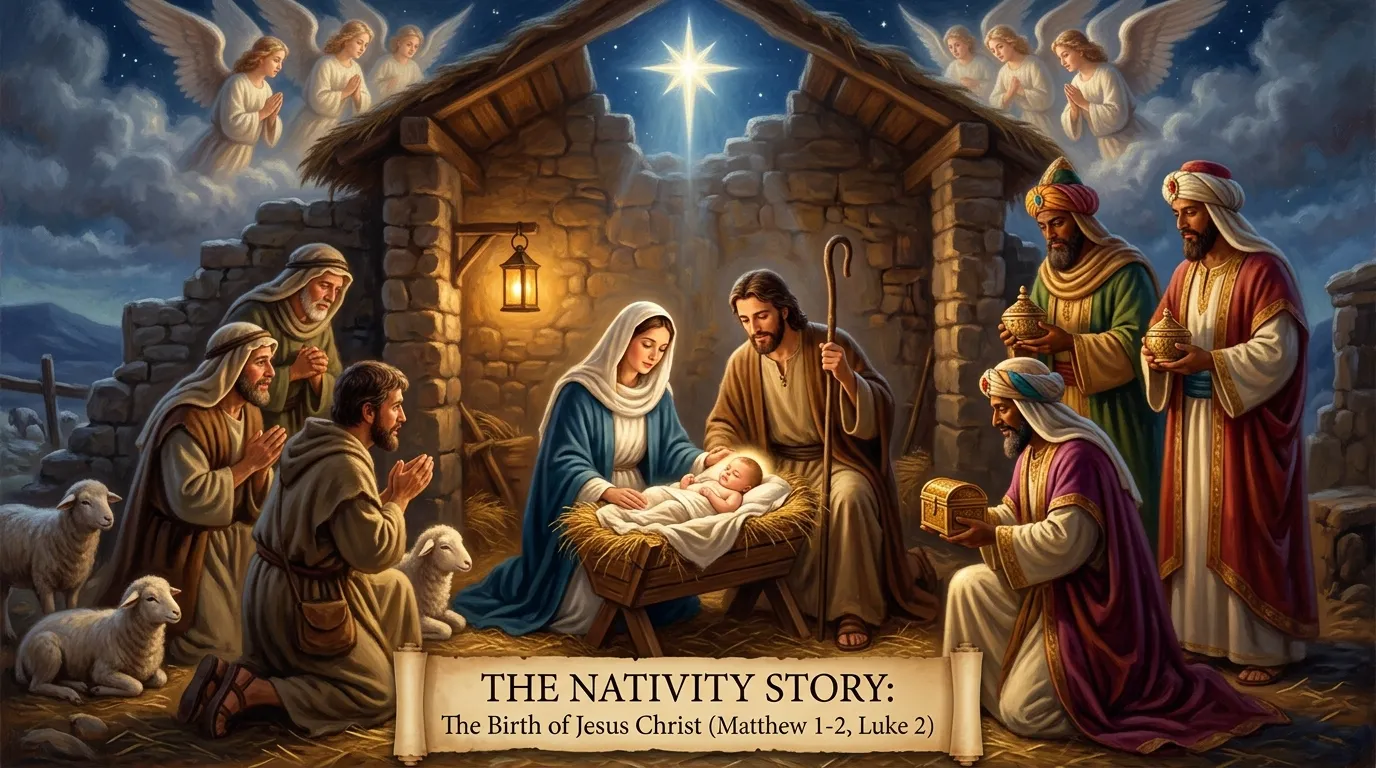
The Nativity story is the most told story in the world — and the most misremembered. Christmas cards show a tidy stable, three kings kneeling beside a glowing baby, a drummer boy, and a star hovering like a streetlamp. The Bible’s account is stranger, harder, and far more beautiful. It is told in only two Gospels, Matthew and Luke, and the two accounts do not match the Christmas-card version. They match each other in the essentials — a virgin birth in Bethlehem, a child named Jesus, a divine identity — but each tells the story from a different angle, with different witnesses and different details. Reading them together, rather than blending them into a single scene, is the key to understanding what the Nativity means.
Two Gospels, two angles
Matthew tells the Nativity from Joseph’s side. His Gospel opens with a genealogy tracing Jesus’ legal lineage through Joseph back to David and Abraham, and then focuses on Joseph’s dilemma: his betrothed is pregnant, and he knows the child is not his. Joseph plans to divorce Mary quietly, until an angel appears in a dream and tells him to take her as his wife, “because what is conceived in her is from the Holy Spirit” (Matthew 1:20). Matthew’s account is full of fulfilled prophecy — the virgin (Isaiah 7:14), Bethlehem (Micah 5:2), the flight to Egypt (Hosea 11:1), the weeping at Ramah (Jeremiah 31:15). His message is that Jesus is the promised King of Israel, and that Israel’s whole story has been pointing to Him.
Luke tells the story from Mary’s side. His Gospel opens with the old priest Zechariah and his wife Elizabeth, then moves to the angel Gabriel’s visit to a young woman in Nazareth. Mary’s response — “I am the Lord’s servant. May your word to me be fulfilled” (Luke 1:38) — is one of the great sentences in Scripture. Luke’s account is full of songs: Mary’s Magnificat, Zechariah’s Benedictus, the angels’ Gloria, Simeon’s Nunc Dimittis. His message is that Jesus is the Savior of the world, and that the poor, the overlooked, and the outsiders are the first to know.
Mark and John do not narrate the birth at all. Mark begins with Jesus’ baptism; John begins before creation: “In the beginning was the Word, and the Word was with God, and the Word was God” (John 1:1). John’s “Nativity” is the statement that “the Word became flesh and made his dwelling among us” (John 1:14). The four Gospels together give us history, prophecy, song, and theology — four witnesses to one event.
The virgin birth: what the Bible actually claims
Both Matthew and Luke are explicit: Mary was a virgin, and Jesus was conceived by the Holy Spirit. Matthew says Joseph “did not consummate their marriage until she gave birth to a son” (Matthew 1:25). Luke records Mary’s question — “How will this be, since I am a virgin?” — and Gabriel’s answer: “The Holy Spirit will come on you, and the power of the Most High will overshadow you. So the holy one to be born will be called the Son of God” (Luke 1:34–35).
The virgin birth is not a decorative detail. It is the Bible’s explanation of how Jesus could be fully human and fully divine at once. He was born of a woman, so He shares our humanity, our weakness, and our mortality. He was conceived by the Spirit, so His identity is not merely human — He is the Son of God, not simply a great teacher or a prophet. The virgin birth also means that Jesus entered the world without inheriting Adam’s guilt in the ordinary way; He is the “second Adam” (1 Corinthians 15:45), the fresh start for the human race.
Christians have sometimes been embarrassed by the virgin birth, treating it as a myth to be explained away. But the early church confessed it from the beginning, and the Gospels present it as straightforward history, not as symbolism. The Nativity means that God did not merely send a message; He sent Himself, in a body, through a mother.
Why Bethlehem? The long road to a small town
Luke explains the Bethlehem setting with a census. Caesar Augustus ordered a registration, and Joseph traveled from Nazareth to Bethlehem, “because he belonged to the house and line of David” (Luke 2:4). The journey was about 130 kilometers on foot through hill country — a hard trip for a pregnant woman in the final weeks of pregnancy. The census was a Roman instrument of control and taxation; God used it to place the birth exactly where Micah had prophesied, seven centuries earlier, that the ruler of Israel would be born.
Bethlehem was small and unimportant — a village of perhaps a few hundred people. But it was David’s town, and the Messiah had to be a son of David. The irony runs through the whole story: the greatest King is born in the smallest town, announced to the lowest workers, and laid in a feeding trough. The world’s power centers — Rome, Jerusalem, Herod’s palace — are all busy with their own affairs, and the center of history shifts to a village nobody was watching.
The manger is the story’s most vivid symbol. Luke mentions it three times (Luke 2:7, 12, 16), which suggests it is not incidental. The King of kings begins His life in the place where animals eat. The manger anticipates the cross: the One who was laid in a borrowed feeding trough would be laid in a borrowed tomb. From beginning to end, Jesus’ life is marked by poverty, humility, and dependence on the generosity of others.
The witnesses: shepherds, Magi, and a frightened king
Luke’s witnesses are the shepherds — local, poor, ritually unclean laborers who receive the angel’s announcement and hurry to see the child. Matthew’s witnesses are the Magi — foreign scholars from the east who follow a star, consult Herod, and arrive with gifts of gold, frankincense, and myrrh. The two groups could not be more different, and that is the point. The birth of Jesus is for the lowly and the learned, for Israel and the nations, for those who are near and those who are far.
The Magi’s gifts carry their own meaning. Gold is the gift for a king. Frankincense is the gift for a priest, burned as incense in worship. Myrrh is the gift for burial — a spice used to anoint the dead. In three gifts, the whole story is told: Jesus is King, Priest, and Sacrifice. Matthew’s readers would have understood the foreshadowing. The child in the house at Bethlehem would grow up to be anointed for burial.
Herod’s reaction is the story’s shadow. The king who hears of a rival is not curious; he is murderous. He asks the chief priests where the Messiah is to be born, sends the Magi to find Him, and then orders the massacre of the boys of Bethlehem (Matthew 2:16). Joseph, warned in a dream, flees with Mary and Jesus to Egypt. The Nativity is not only a story of joy; it is a story of opposition. The world’s powers have resisted Christ from the first night, and they have never stopped.
The Nativity and the rest of the story
The Nativity is the beginning of the story, not the whole story. The baby in the manger grew up to be a man who healed the sick, welcomed sinners, and taught about the kingdom. He was betrayed, crucified, buried, and raised on the third day. The angels’ song of “peace on earth” was not fulfilled by a quiet night in Bethlehem; it was fulfilled by a bloody cross outside Jerusalem and an empty tomb. Christians who celebrate the birth without the cross have only half the gospel. But Christians who remember the cross without the birth miss something too: the God who died for us first lived among us, as one of us, from the very first breath. The Nativity and the crucifixion belong together — the same humility, the same love, the same Savior, from manger to cross to throne.
What the Nativity means
The Nativity means that God keeps His promises. The birth of Jesus is the fulfillment of centuries of prophecy: the seed of the woman (Genesis 3:15), the son of Abraham, the son of David, the virgin’s child, the Bethlehem ruler, the suffering servant. Every thread of the Old Testament is gathered up in a baby in a manger. Christians can trust God’s promises because He has already kept the greatest one.
The Nativity also means that God comes in humility. He did not arrive with an army or a palace. He arrived as a baby, dependent on a teenage mother and a carpenter’s care. The God who made the universe chose to enter it through the most vulnerable possible door. That humility is the pattern of the whole Christian life: “In your relationships with one another, have the same mindset as Christ Jesus: Who, being in very nature God, did not consider equality with God something to be used to his own advantage; rather, he made himself nothing” (Philippians 2:5–7).
Finally, the Nativity means that salvation is for all people. The angels said the good news was “for all the people” (Luke 2:10). The shepherds and the Magi prove it. The gospel does not belong to one nation, one class, or one culture. It belongs to whoever will come and see.
For the historical and cultural background of the Christmas traditions that grew from these accounts, the Wikipedia article on the Nativity of Jesus offers a useful survey.