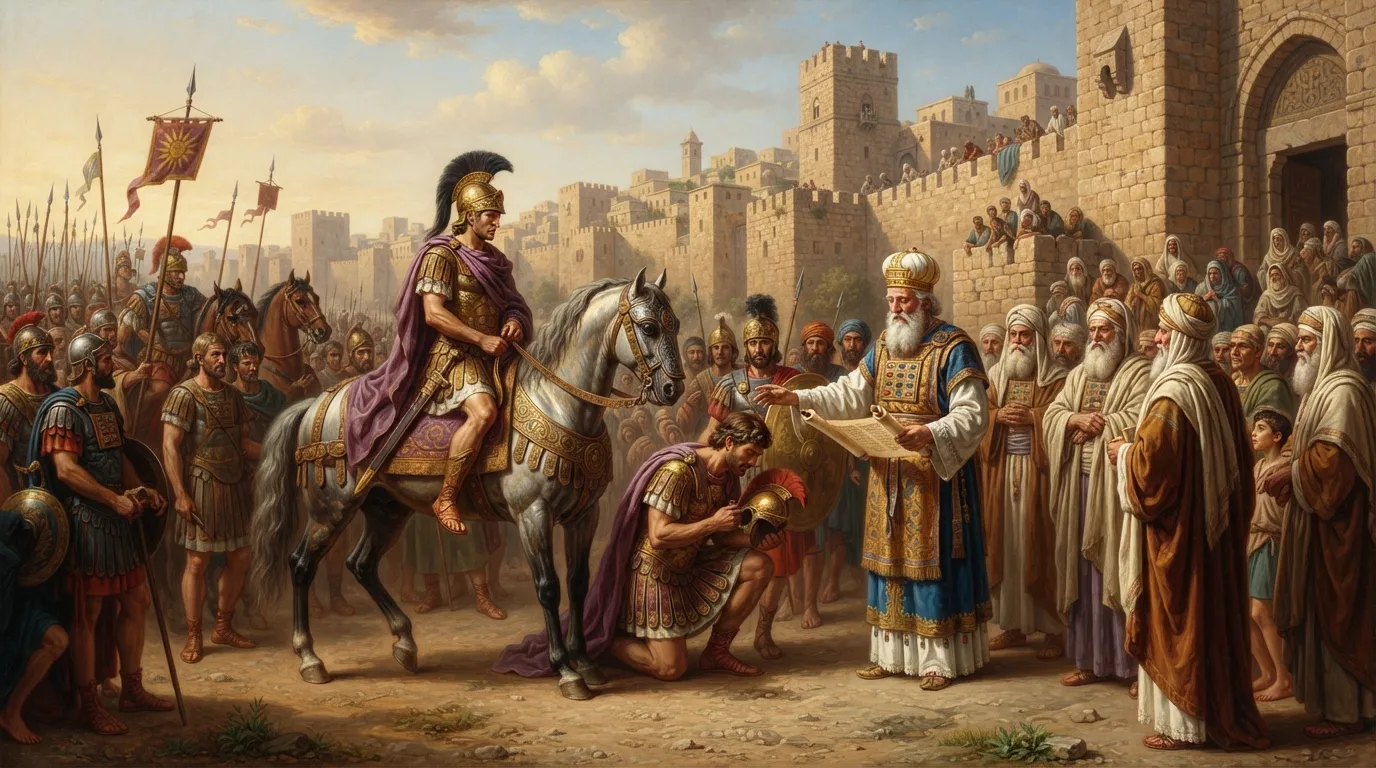
In 332 BC, the most powerful conqueror in the ancient world marched on Jerusalem. Alexander of Macedon had already crushed the Persian Empire’s western armies, taken Tyre after a seven-month siege, and conquered Gaza. Jerusalem was next in his path. The city had no army that could resist him. Its fate seemed sealed — another small city about to be ground under the wheels of the Macedonian war machine.
And then, according to the ancient account, something extraordinary happened. Alexander did not destroy Jerusalem. He spared it. He honored its high priest. He offered sacrifices to its God. The story has been told for more than two thousand years, and it raises a question worth careful study: what really happened, what does the Bible actually say, and what can Christians learn from it?
What the Bible Says — and Does Not Say
Honesty first: the Bible never records Alexander visiting Jerusalem. No biblical book describes his arrival, his meeting with the high priest, or his offering sacrifices. The detailed account comes from Josephus, the first-century Jewish historian, in his Antiquities of the Jews (Book 11). Josephus wrote roughly four centuries after the events, drawing on earlier traditions. His account is vivid, but it is not Scripture, and it should be weighed accordingly.
What the Bible does say about Alexander is prophetic, not narrative. The book of Daniel, written centuries before Alexander’s birth (though some scholars date its final form later), describes the rise of Greece in symbolic visions. Daniel 8 pictures a goat with a conspicuous horn between its eyes, charging from the west and shattering a two-horned ram — interpreted by the angel Gabriel as Greece defeating Media and Persia, with the great horn being “the first king” (Daniel 8:21). That king’s horn is broken, and four horns grow in its place — a striking picture of Alexander’s empire dividing among his four generals after his early death. Daniel 11 continues the story with the wars of the successor kingdoms. Whether one dates Daniel early or late, the correspondence with Alexander’s career is remarkable, and the early church uniformly read these passages as referring to him.
The New Testament also mentions other men named Alexander — an Alexander in Acts 19:33 at Ephesus, an Alexander the coppersmith who opposed Paul (2 Timothy 4:14) — but none of them is Alexander the Great. The Bible’s treatment of the conqueror is indirect: prophecy before, silence during, and consequences after.
Josephus’s Account: The High Priest and the Dream
According to Josephus, when Alexander approached Jerusalem after taking Gaza, the high priest Jaddua — dressed in his priestly robes, accompanied by the priests in their vestments and the people in white — went out to meet him. Alexander, seeing the high priest, did something astonishing: he bowed. He prostrated himself before Jaddua and greeted him with reverence.
His general Parmenion, bewildered, asked why the conqueror of the world was bowing to a Jewish priest. Alexander replied that he was not bowing to the man but to the God whom the man served. He said he had seen this very priest in a dream before he left Macedonia — a figure in priestly robes who had urged him to march against Persia and promised him victory. Seeing Jaddua confirmed the dream, and Alexander took it as a divine sign.
Josephus continues: Alexander entered Jerusalem, offered sacrifices in the temple, and was shown the book of Daniel, where the prophecy of the Greek king who would defeat Persia was read to him. Believing the prophecy referred to himself, Alexander was pleased, granted the Jews freedom to follow their own laws, exempted them from tribute every seventh year (the sabbatical year, when they did not farm), and allowed Jews to serve in his army while keeping their customs.
How much of this is history and how much is legend? Scholars disagree. Some accept the core of the story — that Alexander treated Jerusalem leniently, which fits his general policy of respecting local religions. Others note that Josephus’s account contains elements that look like later embellishment, and that other ancient sources (including the Greek historians) do not mention the visit. The most balanced view: Alexander likely passed through the region and left Jerusalem unharmed, and the story as Josephus tells it may have been shaped by Jewish tradition to emphasize God’s protection. The certainty is not in the details. It is in the outcome: Jerusalem survived Alexander, and the Jewish people continued.
Why Alexander’s Career Mattered for the Gospel
Whether or not Alexander bowed to Jaddua, his conquests changed the world in ways that directly prepared for the coming of Christ. Alexander spread Greek language and culture across the known world — a process called Hellenization. After his death, Greek became the common language of the eastern Mediterranean, the koine Greek in which the entire New Testament would later be written. When the apostles preached the gospel, they preached it in the language Alexander had spread.
Alexander also built cities — Alexandria in Egypt above all — and established trade routes, roads, and a shared culture that made travel and communication easier. The Septuagint, the Greek translation of the Hebrew Scriptures, was produced in Alexandria, making the Old Testament accessible to the Greek-speaking world. When Paul quoted Scripture in his letters and sermons, he quoted the Septuagint. Alexander’s empire was the highway on which the gospel would travel.
There is a profound irony here. Alexander conquered the world for his own glory and died at thirty-two, his empire shattered into four pieces — exactly as Daniel had foreseen. But the language and infrastructure he left behind became the vehicle for a kingdom he never imagined: the kingdom of God, announced not by Macedonian phalanxes but by fishermen and tentmakers preaching in Greek.
God’s Sovereignty Over Empires
The deeper lesson of Alexander’s story is the one Daniel teaches throughout: God rules over the kingdoms of men. “The Most High rules the kingdom of men and gives it to whom he will” (Daniel 4:32). Alexander thought he was the author of his conquests. Daniel’s prophecy says otherwise: Alexander was a horn on a goat in a vision, raised up for a purpose he did not understand, broken at the height of his power, and replaced by four successors — all according to a plan written before he was born.
That is the Bible’s consistent view of empire. Pharaoh, Nebuchadnezzar, Cyrus, Alexander, Caesar — each believed he was shaping history. Each was, in fact, being shaped by it. God uses rulers as instruments — sometimes as judgments, sometimes as builders of roads the gospel will travel — and then removes them when their purpose is served. “He removes kings and sets up kings” (Daniel 2:21).
For believers living under powerful rulers — or powerful cultural forces that seem unstoppable — the message is steadying. The empire that terrifies you is on a leash. The conqueror at the gates may be an instrument of God’s plan, a persecutor God will restrain, or a road-builder God will use. Either way, he is not ultimate. God is.
The Septuagint: Scripture in Alexander’s Language
One of Alexander’s most lasting legacies was indirect but immense: the Greek translation of the Hebrew Scriptures, known as the Septuagint. Produced in Alexandria — the city Alexander founded in Egypt — over the third and second centuries BC, the Septuagint made the Old Testament readable to Jews scattered across the Greek-speaking world who no longer read Hebrew. When the New Testament writers quoted the Old Testament, they usually quoted the Septuagint. When Paul preached in synagogues from Cyprus to Corinth, he opened a Greek scroll. Alexander never intended to serve the gospel, but the language his conquests spread became the language in which the gospel was written, preached, and preserved. God regularly repurposes the tools of empire for the mission of the kingdom.
What to Take from the Story
First, separate Scripture from tradition. The Bible is authoritative; Josephus is informative. Christians can appreciate the story of Alexander and Jaddua without treating it as inspired text. Learning to distinguish “the Bible says” from “tradition says” is one of the most important skills in Bible study.
Second, trust God’s sovereignty over history’s giants. Alexander was the greatest conqueror of the ancient world, and Daniel’s prophecy treats him as a single horn that is broken and replaced. No ruler, no empire, no cultural force is beyond God’s reach or outside His plan.
Third, notice how God prepares the way. Alexander’s conquests, the spread of Greek, the building of roads and cities — none of it looked like gospel preparation at the time. But when “the fullness of time had come” (Galatians 4:4), the stage was set: a common language, safe roads, a unified empire, and Scriptures available in Greek. God prepares long before He reveals.
Alexander came to Jerusalem expecting to conquer. Whether he bowed to a priest or simply passed by, the city survived — and the God of that city would, three centuries later, send His Son into the Greek-speaking world Alexander had created. The conqueror’s empire lasted barely a decade after his death. The kingdom that used his language has lasted two thousand years and counting. For the historical record of Alexander’s campaigns and the succession of his empire, see the Wikipedia article on Alexander the Great.










