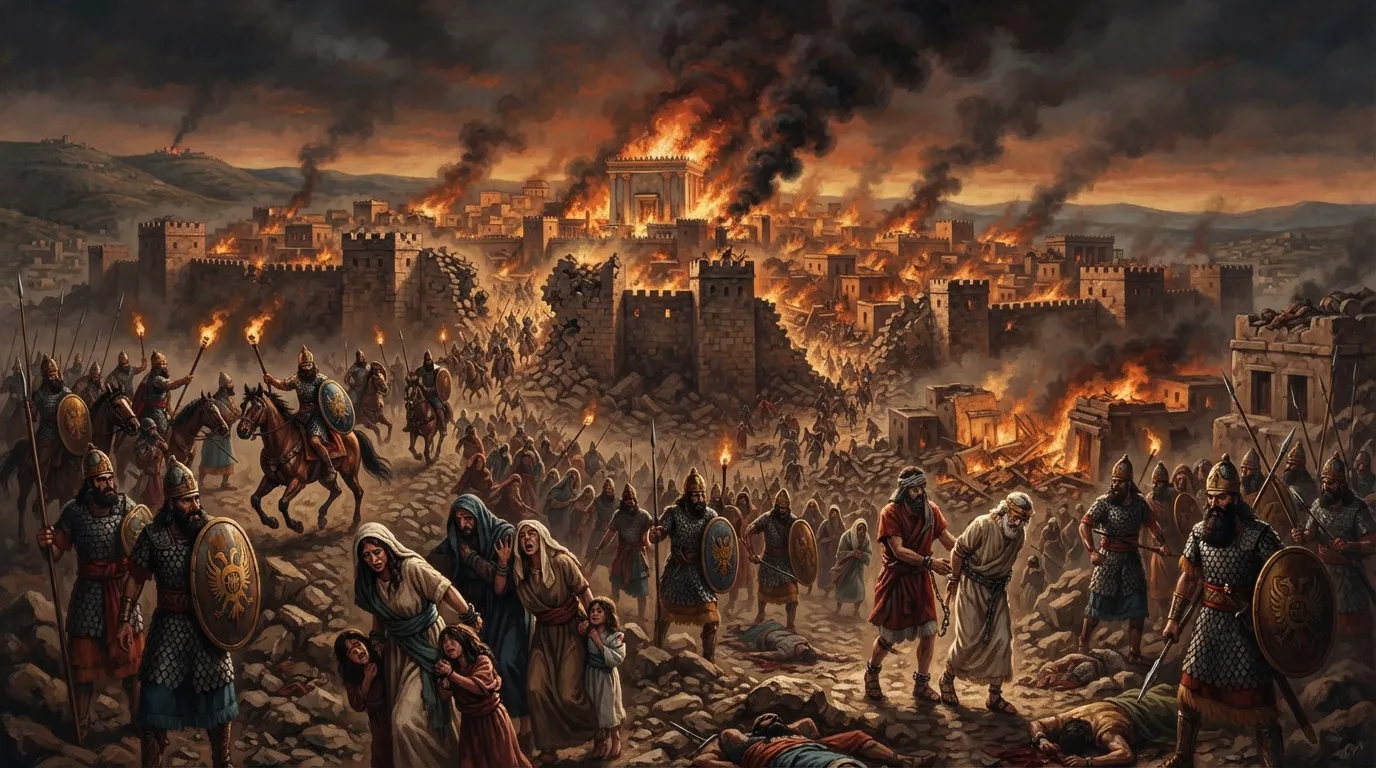
In the summer of 586 BC, the siege of Jerusalem entered its final horror. The Babylonian army had surrounded the city for eighteen months. Food ran out. The prophet Jeremiah records that mothers, driven mad by starvation, resorted to eating their own children (Lamentations 4:10). Then the walls broke. The king, Zedekiah, fled by night and was captured, forced to watch his sons executed, and then blinded. The temple — the house God had filled with glory — was burned to the ground. The palace, the houses, the walls: all destroyed. The survivors were marched eight hundred miles to Babylon. Jerusalem, the city of God, was a smoking ruin.
It was the worst disaster in Israel’s history. And the Bible insists it was not an accident, not a failure of God’s power, and not the end of the story. It was judgment — long warned about, patiently delayed, and finally carried out — followed by mercy that no one in the rubble could yet see.
A Disaster Foretold for Centuries
The destruction of Jerusalem did not surprise God, and it should not have surprised Judah. Moses had warned about it a thousand years earlier: if Israel broke the covenant, “the LORD will bring a nation against you from far away… a nation of fierce countenance” that would besiege their cities “until your high and fortified walls, in which you trusted, come down” (Deuteronomy 28:49–52). The prophets repeated the warning for generations. Isaiah, Micah, Habakkuk, Zephaniah, and above all Jeremiah, who preached for forty years that Babylon would come if Judah did not repent.
Judah did not repent. The nation’s sins, as the prophets catalogued them, were not minor. Idolatry — worshiping Baal and Molech, including child sacrifice in the Valley of Hinnom. Injustice — oppressing the poor, perverting courts, shedding innocent blood. Sabbath-breaking and covenant-breaking. And a false confidence: the belief that because God’s temple was in Jerusalem, the city could never fall. Jeremiah called this “deceptive words”: “This is the temple of the LORD, the temple of the LORD, the temple of the LORD” (Jeremiah 7:4). The people treated the temple like a magic charm. God answered that He would do to His own house what He had done to Shiloh — destroy it — if they continued in evil.
The final king, Zedekiah, made it worse. He rebelled against Babylon after swearing loyalty in God’s name (2 Chronicles 36:13), breaking both a political treaty and a sacred oath. He ignored Jeremiah’s counsel to submit. He listened instead to false prophets who promised peace. When Nebuchadnezzar’s army arrived, Jerusalem’s fate was sealed.
The Fall, in the Words of Those Who Saw It
Second Kings 25 gives the stark historical account: the city breached, the king captured, the temple burned, the walls broken, the people exiled. Second Chronicles 36 adds the theological verdict: “The LORD, the God of their fathers, sent persistently to them by his messengers, because he had compassion on his people and on his dwelling place. But they kept mocking the messengers of God, despising his words and scoffing at his prophets, until the wrath of the LORD rose against his people, until there was no remedy” (2 Chronicles 36:15–16). “Until there was no remedy.” God did not rush to judgment. He sent messenger after messenger, year after year, until the patient mercy of generations was exhausted.
The book of Lamentations is the funeral song for the city. Jeremiah, traditionally its author, weeps over the ruins: “How lonely sits the city that was full of people! How like a widow has she become, she who was great among the nations!” (Lamentations 1:1). The book does not flinch from the horror — the starvation, the corpses, the desecration. And it does not flinch from the cause: “The LORD is in the right, for I have rebelled against his word” (Lamentations 1:18). The most devastating line in the book is also its most honest: Jerusalem’s suffering was deserved. The city had sinned, and God had judged.
Yet Lamentations also contains the most famous hope in the Old Testament, placed deliberately at the center of the book: “The steadfast love of the LORD never ceases; his mercies never come to an end; they are new every morning; great is your faithfulness” (Lamentations 3:22–23). In the middle of the rubble, the prophet found the character of God unchanged. Judgment was real. Mercy was more real.
Exile: Punishment and Preservation
The exile to Babylon is often described as pure punishment. It was also preservation. In Babylon, away from the temple, the sacrifices, and the land, the Jews were forced to reckon with who they were without their institutions. Synagogues — gatherings for prayer and Scripture reading without sacrifice — likely emerged during this period. The people who had been casual about the law became serious about it. The idolatry that had plagued Israel for centuries was cured in exile; after the return, Israel never again worshiped Baal or Molech.
God also spoke in exile. Ezekiel received his visions by the Chebar canal in Babylon. Daniel rose to high office in the Babylonian court and testified to God’s sovereignty over empires. The exiles learned what Jeremiah had told them in his letter: to seek the welfare of the city where God had sent them, to build houses, plant gardens, and pray for Babylon’s peace (Jeremiah 29:4–7). Exile was not abandonment. It was discipline with a purpose.
And the exile had a time limit. Jeremiah prophesied seventy years (Jeremiah 29:10). When the seventy years were complete, God stirred Cyrus, king of Persia, to let the Jews return and rebuild the temple (Ezra 1:1–4). The judgment had a clock on it. God’s discipline is never aimless and never endless. It is measured, purposeful, and temporary — “for the moment all discipline seems painful rather than pleasant, but later it yields the peaceful fruit of righteousness” (Hebrews 12:11).
The Destruction That Points to the Cross
Jerusalem’s destruction in 586 BC was not the last time the city fell. In AD 70, the Romans destroyed it again, burning the Second Temple. Jesus wept over the city and predicted it: “The days will come upon you, when your enemies will set up a barricade around you and surround you and hem you in on every side… and they will not leave one stone upon another in you, because you did not know the time of your visitation” (Luke 19:43–44). The pattern repeated because the underlying problem repeated: God visited His people, and they rejected Him.
But the deeper connection is this: the judgment that fell on Jerusalem in 586 BC — the wrath for sin, the burning, the exile — is the judgment Jesus bore on the cross. The temple was destroyed because of the people’s sin. On the cross, Jesus became the temple destroyed for sin. The exile separated the people from God’s presence. On the cross, Jesus experienced the ultimate exile — “My God, my God, why have you forsaken me?” — so that no believer would ever be exiled from God again. The destruction of Jerusalem shows what sin deserves. The cross shows what Christ endured so we would not receive it.
The Return: Seventy Years Later
The exile did not last forever. Jeremiah had prophesied that after seventy years, God would bring His people back (Jeremiah 29:10), and in 538 BC, Cyrus of Persia conquered Babylon and issued a decree allowing the Jews to return to Jerusalem and rebuild the temple (Ezra 1:1–4). The first returnees came under Zerubbabel, and the temple was rebuilt — smaller and less glorious than Solomon’s, but rebuilt. The prophets Haggai and Zechariah encouraged the work, and the people learned that God’s promises survive even the destruction of the buildings that symbolized them. The exile ended because God’s discipline always has a horizon. Judgment is real, but mercy has the last word.
What the Ruins Teach
First, God takes sin seriously — even the sin of His own people. Judah was the chosen nation, the temple was God’s house, Jerusalem was the holy city. None of that protected them from judgment when they persisted in rebellion. Privilege does not exempt anyone from accountability. If anything, it increases it.
Second, God warns before He judges. A thousand years of warnings preceded 586 BC. Forty years of Jeremiah’s preaching preceded it. No one in Jerusalem could say they were not told. God’s judgments are never sudden in the sense of being unannounced. They are the end of a long road of ignored mercy.
Third, even in judgment, God preserves a remnant and a promise. The exile ended. The temple was rebuilt. The Messiah came from the line that survived. The story of Jerusalem’s destruction is not a story of God giving up. It is a story of God purifying, preserving, and promising — through the ruins — that He would come Himself to save His people.
Fourth, discipline is not the end. If you are living in the rubble of your own choices — a marriage, a career, a life that has fallen apart — the message of Lamentations is for you: His mercies are new every morning. The ruins are not the last word. The God who brought His people home from Babylon can bring you home too. For the historical record of the siege, the Babylonian conquest, and the exile, see the Wikipedia article on the siege of Jerusalem.










