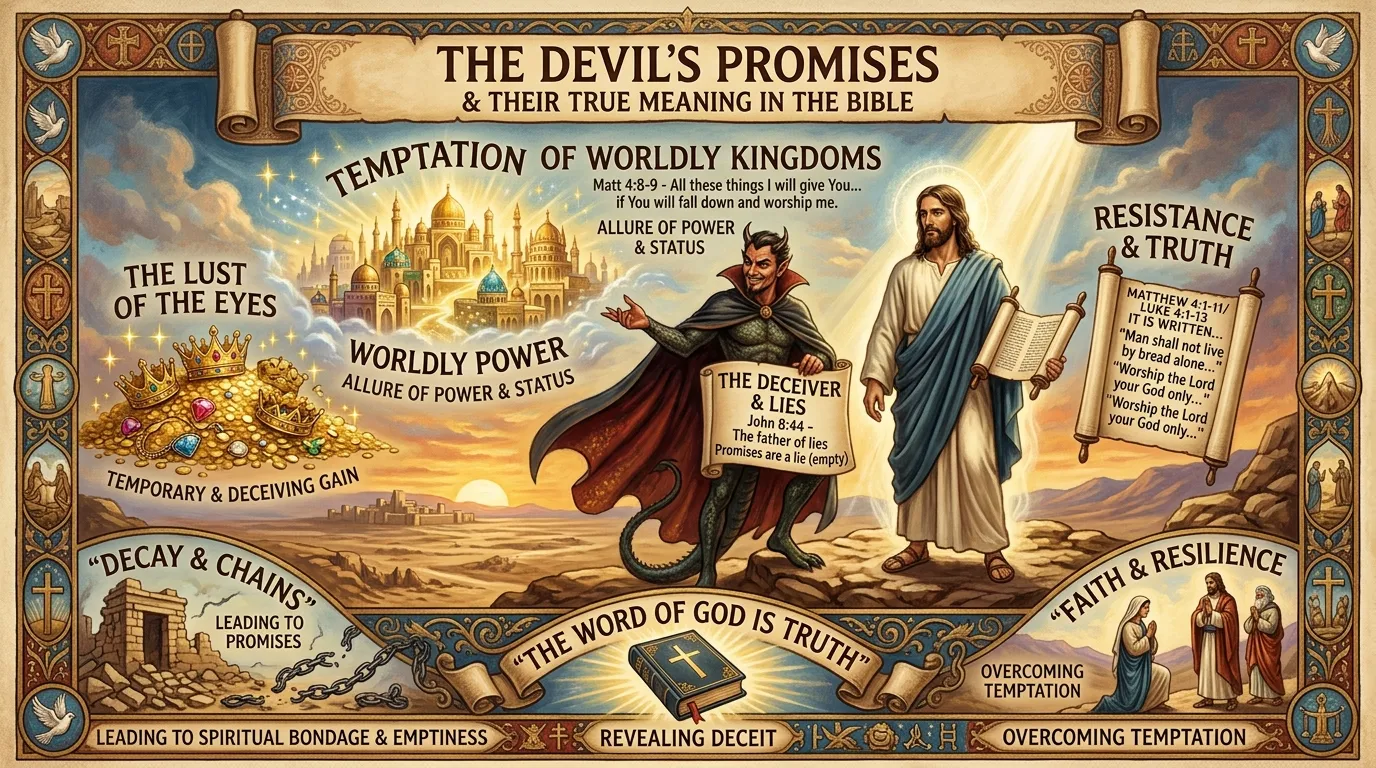
Read the fine print. Every contract has it, and the devil’s contracts have the finest print of all. In Matthew 4, Satan offers Jesus the kingdoms of the world and their glory — a breathtaking offer — and the price is tucked into a single clause: “if you will fall down and worship me.” The offer sounds like a gift. It is a transaction. And the currency is worship.
The Bible does not contain a formal list called “the devil’s promises.” But it shows, again and again, the same pattern: Satan makes offers that look like shortcuts to good things — bread, power, knowledge, security, pleasure — and every offer carries a hidden cost. His promises are not promises at all. They are bait. And the way to see through them is to compare them with the promises of God, which are the only ones that ever pay out.
Exhibit A: The Wilderness Offer
Jesus had fasted forty days. He was hungry, alone, and at the start of His ministry. Satan came with three offers, each aimed at a real need.
Bread. “If you are the Son of God, command these stones to become loaves of bread” (Matthew 4:3). The need was legitimate — Jesus was genuinely hungry. The shortcut was the problem. Jesus answered, “Man shall not live by bread alone, but by every word that comes from the mouth of God.” The devil’s offer was: meet your need your way, on your timetable, apart from the Father’s will. God’s way was: trust the Father, and the need will be met in His time.
Spectacle. “Throw yourself down” from the temple, and the angels will catch You (Matthew 4:6). The offer was public proof — a miracle that would make everyone believe. Jesus answered, “You shall not put the Lord your God to the test.” The devil’s offer was: force God’s hand, manufacture a sign, and skip the slow road of faithful obedience. God’s way was: no shortcuts, no stunts, no manipulating the Father.
Kingdoms. “All these I will give you, if you will fall down and worship me” (Matthew 4:9). The offer was the world — everything Jesus had come to win — without the cross. Jesus answered, “Be gone, Satan! For it is written, ‘You shall worship the Lord your God and him only shall you serve.'” The devil’s offer was the crown without the cross. God’s way was the crown through the cross.
Every one of Satan’s offers had the same structure: a real good, offered the wrong way, at the wrong time, for the wrong price. The devil does not usually offer evil. He offers good things by evil means. That is what makes his promises so effective.
Exhibit B: The Garden Offer
The pattern began in Eden. The serpent told Eve that eating the forbidden fruit would make her “like God, knowing good and evil” (Genesis 3:5). The offer was knowledge — a good thing. The fine print was distrust: God is holding out on you, His command is restrictive, His goodness is a lie. Eve ate, and the knowledge she gained was not the godlike wisdom she was promised. It was the knowledge of shame, nakedness, and exile. The devil’s promise delivered the opposite of what it advertised. It always does.
The same fine print appears in every temptation since. The affair promises intimacy and delivers isolation. The fraud promises security and delivers fear. The addiction promises escape and delivers slavery. The compromise promises success and delivers a conscience that will not let you sleep. Satan’s promises are written in disappearing ink. God’s are written in blood.
How to Read the Fine Print
Because the devil’s offers are disguised as good things, believers need a way to test them. Scripture supplies the questions. Does it agree with God’s Word? If a promise contradicts Scripture, it is not from God — no matter how spiritual it sounds. Does it require sin or compromise? Any offer that requires you to lie, steal, betray, or disobey is disqualified, however large the reward. Does it appeal to pride, greed, lust, or impatience? The devil’s offers almost always target one of these four. Does it promise something without faithfulness? The shortcut — success without character, intimacy without commitment, influence without service — is the devil’s signature. Does it draw you toward God or away from Him? That is the ultimate test. God’s promises draw you to God. The devil’s draw you to yourself.
There is also a timing test. The devil’s offers are urgent: decide now, act now, don’t think, don’t pray, don’t tell anyone. God’s promises are patient. They can survive scrutiny, counsel, and waiting. If an offer cannot survive a night of prayer and a conversation with a wise friend, it is not from God.
The Promises That Actually Pay
Against the devil’s counterfeit offers, Scripture sets God’s promises — and the contrast is total. The devil offers bread; God offers “the bread of life” (John 6:35). The devil offers kingdoms; God offers “an inheritance that is imperishable, undefiled, and unfading” (1 Peter 1:4). The devil offers knowledge; God offers wisdom to all who ask (James 1:5). The devil offers pleasure; God offers “fullness of joy” and “pleasures forevermore” at His right hand (Psalm 16:11).
The difference is not only in the goods. It is in the guarantor. Satan’s promises are backed by a liar. Jesus said of him, “He is a liar and the father of lies” (John 8:44). A promise is only as good as the one who makes it, and the devil’s word is worthless. God’s promises are backed by God’s character, God’s oath, and God’s Son. “For all the promises of God find their Yes in him” (2 Corinthians 1:20). Every promise God has made is guaranteed by the cross and the resurrection.
And God’s promises cost the right things. The devil’s offers cost your worship, your integrity, and your soul. God’s promises cost your pride, your self-sufficiency, and your sin — and they give you everything in return. The exchange is not even close.
When You Have Already Signed
Many readers will recognize their own story in the devil’s offers — the shortcut taken, the compromise made, the contract signed. The good news is that the devil’s contracts are voidable. The blood of Christ cancels every debt, breaks every chain, and releases every captive. The thief on the cross had nothing to offer and everything to gain, and Jesus told him, “Today you will be with me in paradise” (Luke 23:43). No deal with the devil is final while grace is available.
Modern Offers, Ancient Pattern
The devil’s offers did not stop with Jesus. They appear in every generation, dressed in the fashions of the age. The offer of success without integrity: cut this corner, lie on this form, betray this friend, and the promotion is yours. The offer of intimacy without commitment: no vows, no covenant, just pleasure without responsibility. The offer of influence without character: build a platform on outrage, controversy, or deception, and the followers will come. The offer of comfort without God: numb the pain with drink, drugs, scrolling, or spending, and never face the wound underneath.
Each modern offer follows the ancient pattern: a real good, offered the wrong way, at the wrong time, for the wrong price. The success is real, but the price is your conscience. The intimacy is real, but the price is your soul. The influence is real, but the price is your integrity. The comfort is real, but the price is your freedom. And the fine print is always the same: worship me. Not with bended knee, necessarily — with bended will. Every compromise is a small act of worship, offered to the wrong god.
The defense has not changed either. Name the offer for what it is. Compare it with Scripture. Ask the five questions: does it agree with God’s Word, does it require sin, does it appeal to pride or greed or lust or impatience, does it promise something without faithfulness, does it draw you toward God or away from Him? And then do what Jesus did: refuse it, answer with Scripture, and worship God alone. The devil’s offers lose their power the moment they are exposed to the light.
There is a final test worth applying to any offer that sounds too good to be true: look at the one making it. Satan’s promises come from the one Jesus called the father of lies. God’s promises come from the One who cannot lie. A promise is only as reliable as its maker, and the makers could not be more different. The devil promises the world and delivers bondage. God promises Himself and delivers everything. When the offers compete, the choice is not really between two deals. It is between two gods. Choose the One whose promises have never failed, and let the counterfeit offers fall where they belong — unanswered, in the dust of the wilderness.
The way out is the way Jesus modeled: answer with Scripture, refuse the shortcut, and worship God alone. Temptation loses its power when it is named. The offer that seemed irresistible in the dark looks flimsy in the light of God’s Word. So bring it into the light. Tell a trusted believer. Pray honestly. And remember: the One who resisted every offer in the wilderness is the One who now intercedes for you. His promises are the only ones that have never been broken. For the story and interpretation of the temptation itself, see the article on the Temptation of Christ in the Gospels and Christian tradition.










