Stand on the Mount of Olives today and you look across the Kidron Valley at the Temple Mount, the Old City, and the same view Jesus saw. The mountain has been a witness to the whole biblical story: David weeping as he fled his son, Zechariah prophesying God’s return, Jesus teaching about the future, Jesus praying in Gethsemane, Jesus ascending to heaven. No other mountain in Scripture covers so much ground — from the monarchy to the Messiah to the end of the age. To understand the Mount of Olives is to trace a single ridge through the entire Bible, and to see how one place can hold sorrow, prayer, prophecy, and hope at once.
The ridge east of Jerusalem
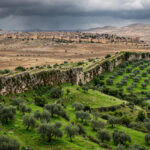
The Mount of Olives is not a single peak but a ridge of hills running north-south along the eastern side of Jerusalem, separated from the city by the Kidron Valley. It rises about 800 meters above sea level, roughly 60 meters above the Temple Mount across the valley. Its western slopes are covered with olive groves — hence the name — and its summit offers the classic view of Jerusalem: the Dome of the Rock, the Old City walls, and the towers of the Church of the Holy Sepulchre.
The ridge has three main summits, and its southern end connects to the Mount of Corruption, where Solomon built shrines for his foreign wives (1 Kings 11:7–8). The Mount of Olives was also the route by which travelers from Jericho and Bethany approached Jerusalem — the road Jesus took on Palm Sunday. It was, in short, Jerusalem’s eastern gate, the first thing pilgrims saw when they arrived from the desert, and the last thing they saw when they left.
David’s tears: the mountain’s first scene
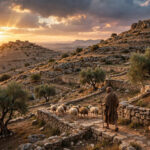
The Mount of Olives first appears in the Bible in a scene of heartbreak. When Absalom rebelled and seized Jerusalem, David fled the city on foot, “going up the Mount of Olives, weeping as he went; his head was covered and he was barefoot” (2 Samuel 15:30). The king who had conquered Jerusalem now left it in disgrace, climbing the eastern ridge while his son occupied the palace. His followers wept with him. On the summit, David prayed that God would frustrate the counsel of Ahithophel, Absalom’s adviser.
The scene sets the mountain’s emotional tone. The Mount of Olives is a place of sorrow and prayer — a place where God’s people weep, pray, and trust God when the situation looks hopeless. David’s flight was not the end of his story; he returned, and Absalom’s rebellion failed. But the mountain remembers the tears. It is fitting that the greater Son of David would also weep and pray on this same ridge.
Zechariah’s promise: the mountain that will split
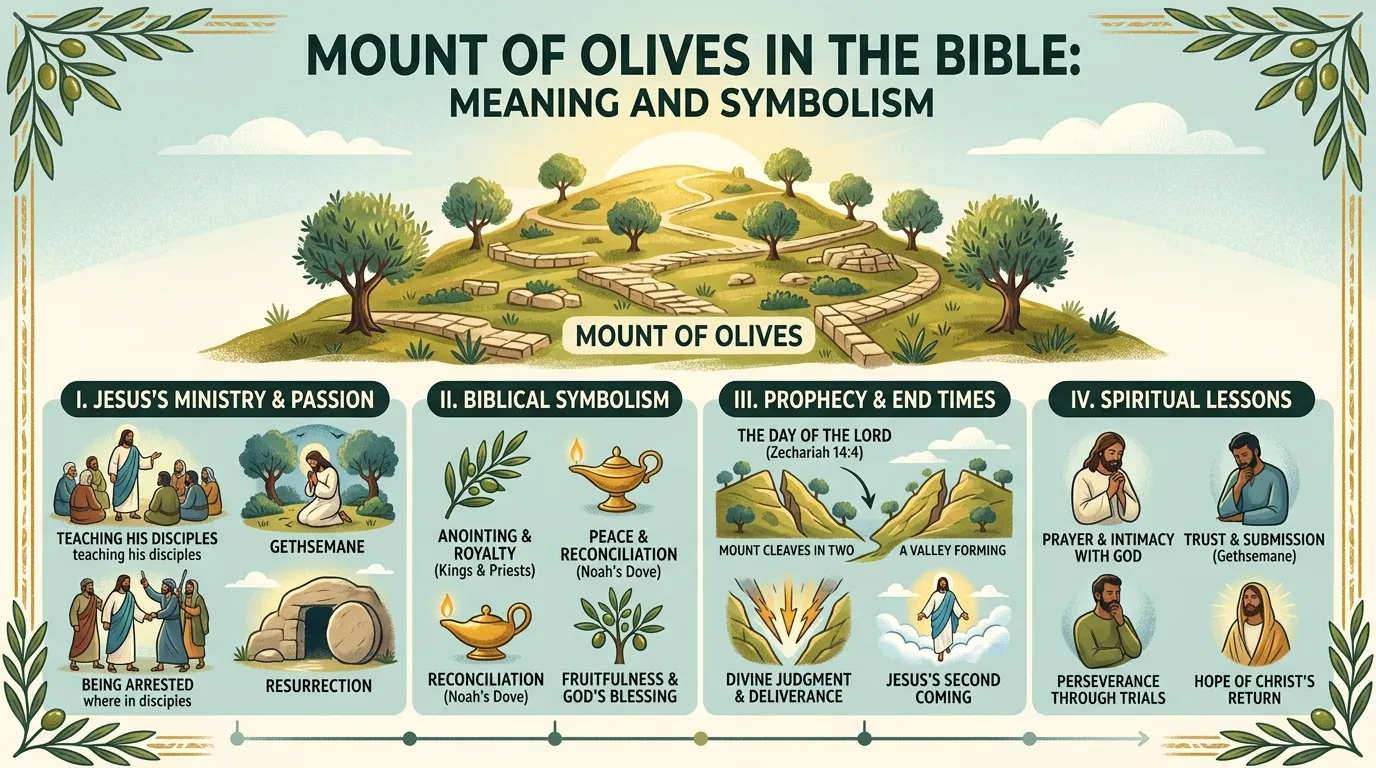
The prophet Zechariah gave the mountain its most dramatic prophecy: “On that day his feet will stand on the Mount of Olives, east of Jerusalem, and the Mount of Olives will be split in two from east to west, forming a great valley, with half of the mountain moving north and half moving south” (Zechariah 14:4). The context is the Day of the Lord, when God will fight for Jerusalem against the nations, and “the LORD will be king over the whole earth” (Zechariah 14:9).
Christians have interpreted Zechariah 14 in different ways. Some see it as a literal prophecy of the Second Coming, when Christ will descend on the Mount of Olives just as He ascended from it. Others see it as symbolic of God’s decisive intervention. What is clear is that the Mount of Olives is bound up with the Bible’s hope for the future. It is not only a place of past events but a place of future expectation. The mountain that saw the Ascension is the mountain that looks toward the Return.
Jesus on the mountain: teaching and weeping
Jesus’ ministry is woven into the Mount of Olives. He taught there — the Olivet Discourse (Matthew 24–25), His longest teaching on the future, was delivered on the mountain, in answer to the disciples’ question about the end of the age. He wept there — approaching Jerusalem on Palm Sunday, He saw the city and wept over it, predicting its destruction (Luke 19:41–44). He prayed there — in Gethsemane, at the mountain’s foot, on the night before the cross.
The Olivet Discourse is often read as a timetable for the end times, but its main point is pastoral: be ready. Jesus warns of wars, famines, persecution, and false messiahs, and He urges His followers to watch, to endure, and to be faithful with what they have been given. The discourse ends with parables of readiness — the ten virgins, the talents, the sheep and the goats. The mountain’s message is not “decode the future” but “live faithfully in the present.”
The Ascension: the mountain’s farewell
After the resurrection, Jesus led His disciples “out to the vicinity of Bethany” — on the Mount of Olives — and “he lifted up his hands and blessed them. While he was blessing them, he left them and was taken up into heaven” (Luke 24:50–51). Acts adds that a cloud hid Him from their sight, and two angels appeared with a promise: “This same Jesus, who has been taken from you into heaven, will come back in the same way you have seen him go into heaven” (Acts 1:11).
The Ascension from the Mount of Olives is the mirror image of the Incarnation. The One who came down from heaven in Bethlehem goes back up to heaven from the Mount of Olives. The mountain that saw David flee in sorrow sees the greater King depart in glory. And the angels’ promise ties the mountain to the future: the same Jesus, the same place, the same visible return. The Mount of Olives is where heaven and earth touched at the beginning of the church age, and where they will touch again at its end.
Palm Sunday: the mountain and the King’s entrance
The Mount of Olives is also the stage of Palm Sunday. Jesus began His triumphal entry from Bethphage and Bethany, on the mountain’s eastern slopes, riding a donkey down toward Jerusalem while the crowds spread their cloaks and palm branches and shouted, “Blessed is he who comes in the name of the Lord!” (Matthew 21:9). The donkey was deliberate: Zechariah had prophesied that Jerusalem’s king would come “righteous and victorious, lowly and riding on a donkey” (Zechariah 9:9). The mountain that had seen David flee in sorrow now saw the greater Son of David enter in triumph — not on a warhorse, but on a donkey, as the Prince of Peace. The crowds wanted a conqueror; Jesus came as a servant. Within a week, the same crowds would demand His death. The mountain remembers both shouts.
Between the entry and the arrest, Jesus spent His nights on the Mount of Olives. Luke says, “Each day Jesus was teaching at the temple, and each evening he went out to spend the night on the hill called the Mount of Olives” (Luke 21:37). The mountain was His retreat, His classroom, His prayer room, and the place of His arrest. No other location is so closely tied to the final week.
The mountain also appears in the story of the widow’s offering and the temple’s treasury, which Jesus observed from across the valley. The Mount of Olives was the vantage point from which Jesus surveyed the temple and pronounced its doom: “Not one stone here will be left on another” (Matthew 24:2). The mountain gave Him the view — and the view gave Him the sermon. Prophecy often comes from a vantage point, a place where you can see the whole picture. The Mount of Olives was that place for Jesus.
What the Mount of Olives means for Christians
The Mount of Olives teaches that God meets His people in sorrow. David wept there. Jesus wept there. The mountain is not a place of triumph only; it is a place of tears, prayer, and wrestling. Christians who weep, who pray in gardens at midnight, who face betrayal and loss — they are on the Mount of Olives, and they are in good company.
The mountain also teaches that hope is directional. The Ascension points forward. The angels’ promise points forward. Zechariah’s prophecy points forward. The Mount of Olives is a place that looks to the future — to the day when the King will return, when sorrow will end, and when God’s people will see Him face to face. Christians who stand on the mountain today look across at Jerusalem and remember that the story is not finished.
Finally, the mountain teaches that prayer and mission go together. Jesus prayed in Gethsemane and then went to the cross. He taught on the mountain and then sent His disciples to the nations. The Mount of Olives is where prayer becomes mission — where the agony of the garden and the glory of the Ascension meet in the life of every believer who prays, “Not my will, but yours,” and then rises to follow.
For the ridge’s geography, history, and the sites associated with it, the Wikipedia article on the Mount of Olives offers a helpful guide.