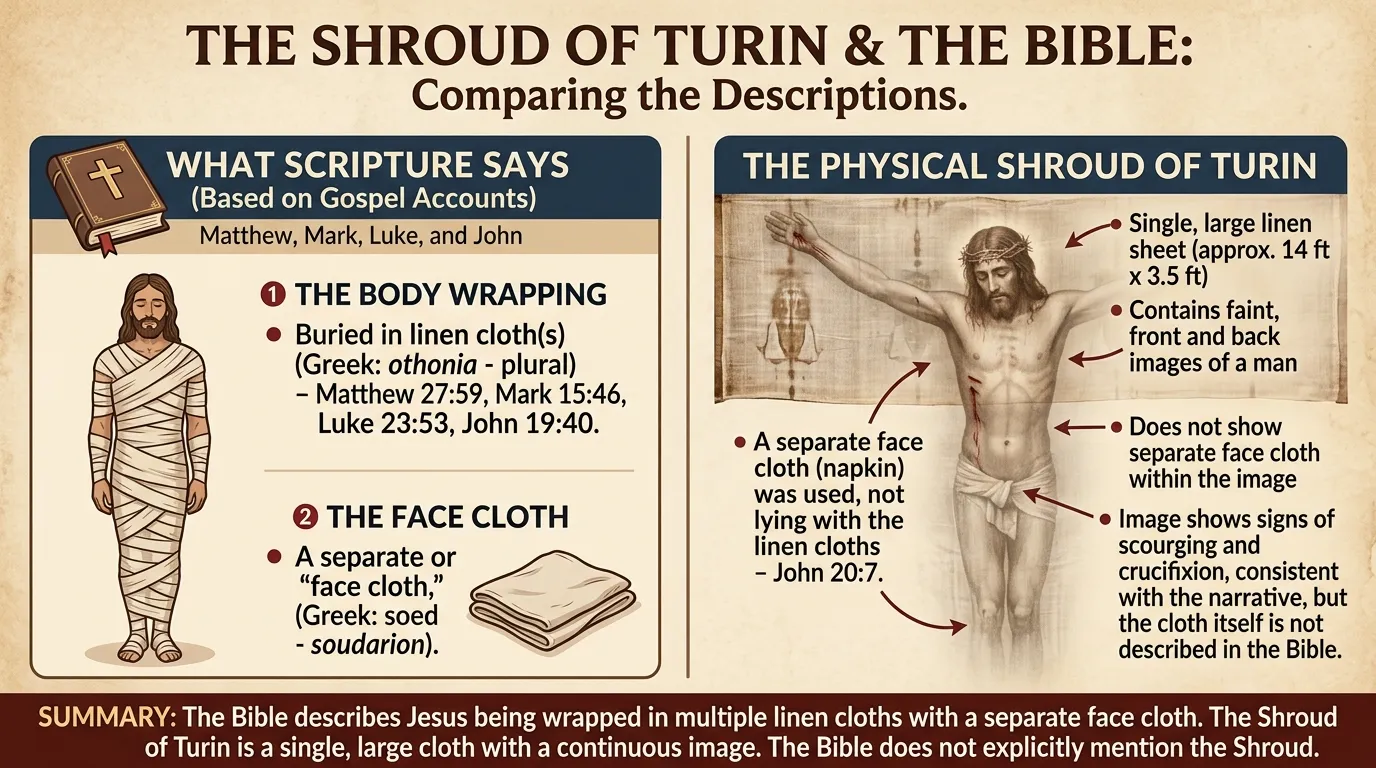
In the Cathedral of Saint John the Baptist in Turin, Italy, a linen cloth is kept in a sealed case. It is about 4.4 meters long and 1.1 meters wide, and it bears the faint image of a man — front and back — with wounds that correspond to crucifixion. Millions of people believe it is the burial cloth of Jesus Christ. Millions of others believe it is a medieval forgery. Scientists have tested it, theologians have debated it, and the debate has not ended. The Shroud of Turin is one of the most studied artifacts in history, and it is also one of the most misunderstood. To approach it honestly, Christians need to separate three questions: What does the Bible say about Jesus’ burial cloths? What is the Shroud? And what does the evidence actually show?
What the Bible says about the burial cloths
The Gospels give careful details about Jesus’ burial. After His death, Joseph of Arimathea asked Pilate for the body, wrapped it in a clean linen cloth, and laid it in a new tomb (Matthew 27:57–60). John adds that Nicodemus brought about thirty-four kilograms of myrrh and aloes, and that the two men wrapped the body “with the spices in strips of linen,” following Jewish burial customs (John 19:39–40). The Gospels also mention a separate cloth for the head — a “face cloth” or soudarion — that was folded and set apart (John 20:7).
On the morning of the resurrection, Peter and John ran to the tomb and found the linen cloths lying there, with the face cloth folded up by itself (John 20:3–8). Luke says Peter “went away, wondering to himself what had happened” (Luke 24:12). The empty cloths are part of the resurrection evidence: the body was gone, but the wrappings remained, as if the body had passed through them.
What the Bible does not say is equally important. It does not describe an image on the cloths. It does not say the cloths were preserved, venerated, or passed down. It does not name the Shroud of Turin. The Bible’s silence about the Shroud is not proof that the Shroud is fake — but it is a reminder that Christian faith does not rest on the Shroud. The apostles preached the resurrection without mentioning a cloth with an image. The earliest Christians did not need one.
What the Shroud is — and what it shows
The Shroud of Turin is a linen cloth with a faint, straw-colored image of a bearded man, front and back, as if the cloth had been draped over a body. The image shows wounds consistent with crucifixion: marks on the wrists and feet, scourge marks across the back, a wound in the side, and punctures on the scalp consistent with a crown of thorns. The image is a negative — like a photographic negative — which was not fully appreciated until the first photographs of the Shroud in 1898 revealed the positive image in the negative plate. That discovery launched the modern scientific study of the Shroud.
The Shroud’s documented history begins in the fourteenth century, when it appears in the possession of a French knight, Geoffroy de Charny, in Lirey, France. Before that, its history is uncertain. Some researchers trace it to the Image of Edessa, a cloth with the face of Christ venerated in the ancient city of Edessa, and from there to Constantinople, where a cloth with the image of Christ was reportedly displayed before the city’s sack in 1204. Others argue that the pre-fourteenth-century history is speculative and that the Shroud first appears, fully formed, in the medieval record. The gap in the record is one of the central problems in Shroud research.
The 1988 radiocarbon test and the medieval dating
In 1988, three independent laboratories in Oxford, Zurich, and Arizona radiocarbon-dated a small sample of the Shroud. All three dated the linen to between 1260 and 1390 AD — squarely in the medieval period, not the first century. The results were published in the journal Nature and widely reported as settling the question: the Shroud was a medieval artifact.
The radiocarbon dating remains the strongest evidence against the Shroud’s authenticity as Jesus’ burial cloth. Radiocarbon dating is a well-established method, and the three laboratories reached consistent results. For many scientists and historians, the case was closed. If the linen was made in the thirteenth or fourteenth century, it cannot have wrapped a first-century body.
The counter-arguments: contamination, repair, and the image
Supporters of the Shroud’s authenticity have raised several objections to the 1988 test. The most important is the claim that the sample was taken from a corner of the cloth that had been repaired in the Middle Ages — a patch woven with newer threads, possibly by medieval nuns repairing fire damage from 1532. If the sample contained repaired material, the dating would reflect the repair, not the original cloth. Chemical analyses by some researchers have suggested that the sample area differs from the rest of the cloth, though this claim is contested.
Other counter-arguments involve contamination. The Shroud has been handled, displayed, kissed, and exposed to fire, smoke, and water over the centuries. Critics of the 1988 test argue that such contamination could have skewed the results. However, radiocarbon dating laboratories use rigorous cleaning protocols, and most scientists consider the contamination argument insufficient to shift the date by thirteen centuries.
The image itself is the deepest mystery. Despite decades of study, no one has fully explained how the image was formed. It is not paint, ink, or dye — at least not in any conventional sense. The image resides only on the outermost fibers of the linen, and it has three-dimensional properties that no known medieval technique reproduces. Some researchers have proposed that the image was formed by a burst of radiation or energy. Others argue that a medieval artist could have produced it by an unknown method. The image’s formation remains unexplained, but an unexplained image is not proof of a supernatural origin.
The history of the cloth: from Lirey to Turin
The Shroud’s documented journey is itself a story. After its appearance in Lirey, France, in the 1350s, it passed through the hands of the Savoy family, who brought it to Chambéry in 1453 and then to Turin in 1578, where it has remained. In 1532 a fire in the Chambéry chapel damaged the cloth, burning holes and scorching the linen; Poor Clare nuns repaired it with patches, and water used to douse the fire left stains. The 1988 sample was cut from a corner near those repairs — the detail at the heart of the contamination debate. In 1898, an amateur photographer named Secondo Pia took the first photographs of the Shroud and discovered that the negative plate revealed a clear, positive image of a man. The discovery transformed the Shroud from a devotional object into a scientific puzzle. In 1978, the Shroud of Turin Research Project (STURP) conducted the most extensive scientific examination of the cloth, and its findings — that the image was not painted, that the blood was real blood, and that the image formation was unexplained — remain the baseline for serious research.
The Catholic Church has never officially declared the Shroud authentic or a forgery. Popes have spoken of it with reverence as an icon of Christ’s suffering, while stopping short of claiming it is the actual burial cloth. That restraint is wise. The Church’s position mirrors the biblical one: the Shroud may be venerated as a devotional aid, but it is not a foundation of faith. Christians are free to study it, to be moved by it, and to draw either conclusion about its origin — as long as they do not make it a test of orthodoxy.
What should Christians conclude?
Honesty requires admitting that the evidence is genuinely disputed. The radiocarbon dating points to a medieval origin. The image formation remains unexplained. The pre-fourteenth-century history is uncertain. The wound details are consistent with crucifixion, but they are also consistent with a medieval artist who knew the Gospels and had seen crucifixion imagery. Reasonable, faithful Christians have reached different conclusions.
What Christians should not do is make the Shroud a test of faith. The resurrection does not depend on the Shroud, and the Shroud cannot prove the resurrection. If the Shroud were proven authentic tomorrow, it would not make the resurrection more true. If it were proven a forgery tomorrow, it would not make the resurrection less true. The resurrection rests on the testimony of the apostles, the empty tomb, and the transformation of the disciples — not on a cloth in Turin.
Christians should also avoid using the Shroud as an evangelistic shortcut. The gospel is not “believe in this artifact.” It is “repent and believe in Jesus Christ.” The Shroud may be a fascinating subject for study, and it may prompt reflection on Christ’s suffering. But it must never replace the Scriptures as the ground of faith.
The Shroud can still teach us something. It reminds us that Jesus truly died — that the crucifixion was a real, physical, bloody event, not a myth or a metaphor. The wounds on the Shroud, whether they are the wounds of Christ or a medieval artist’s depiction of them, point to the same truth: the Savior suffered. That truth is worth remembering, whatever the cloth’s origin.
For the scientific studies, the radiocarbon results, and the ongoing debate, the Wikipedia article on the Shroud of Turin presents the evidence from both sides in detail.