Have you ever wondered why the lineage of Abraham is so important in the Bible? When we read the names of Abraham, Isaac, Jacob, David, and Jesus, we are not simply reading a family tree. We are seeing the story of God’s covenant, faithfulness, promise, and salvation unfold across generations.
The lineage of Abraham meaning in the Bible points to the family line connected to God’s promises to Abraham. God called Abraham from his homeland and promised to make him a great nation. He also promised that through his offspring, all the families of the earth would be blessed (Genesis 12:1–3).
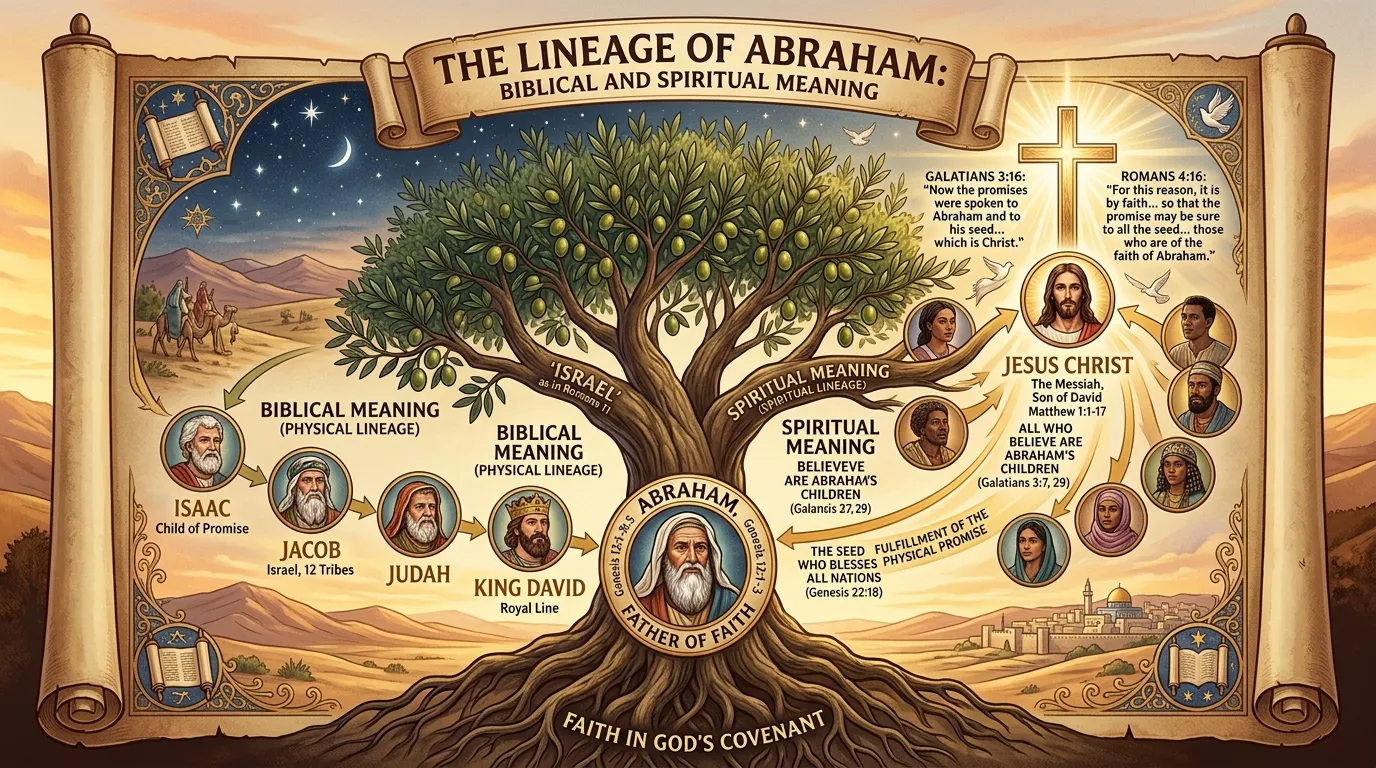
This family story begins with Abraham and Sarah, continues through Isaac and Jacob, and develops through the nation of Israel. In the New Testament, the story reaches its greatest fulfillment in Jesus Christ, who is presented as a descendant of Abraham (Matthew 1:1).
So, what does Abraham’s lineage mean spiritually?
It reminds Christians that God keeps His promises, even when fulfillment takes many years. It also teaches that faith is not only about one person. God can use one faithful life to bless generations.
The biblical meaning becomes clearer when we look at Abraham’s covenant, his descendants, and the way Scripture connects his family line to Christ.
Biblical Meaning of the Lineage of Abraham
The lineage of Abraham in the Bible is closely connected to God’s covenant promises. Abraham was first called Abram. God told him to leave his country and family and go to a land God would show him.
God then gave him a powerful promise:
“I will make of thee a great nation, and I will bless thee, and make thy name great” (Genesis 12:2, KJV).
God also said:
“In thee shall all families of the earth be blessed” (Genesis 12:3, KJV).
This promise became a major part of the Bible’s story.
Abraham, Isaac, and Jacob
Abraham had a son named Isaac, whom God had promised through Sarah. Isaac became the next major person in the covenant family.
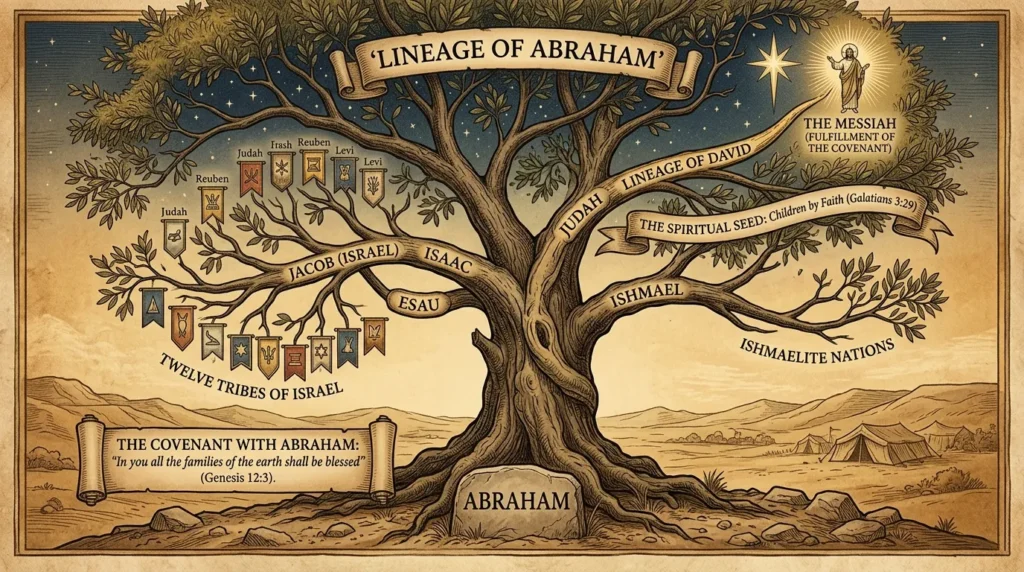
Isaac had twin sons, Esau and Jacob. God’s covenant story continued through Jacob, whose name was later changed to Israel (Genesis 32:28).
Jacob had twelve sons. Their families became the twelve tribes of Israel.
This gives us an important pattern:
Abraham → Isaac → Jacob → Twelve Tribes of Israel
The lineage does not mean that every descendant of Abraham had exactly the same covenant role. Abraham also had Ishmael and other sons (Genesis 16:15; 25:1–6). The Bible distinguishes between Abraham’s wider physical descendants and the particular covenant line through which God continued His promise.
Abraham’s lineage and God’s covenant
The story of Abraham is mainly about God’s covenant, not simply ancestry.
In Genesis 17:4–7, God established His covenant with Abraham and promised that he would become the father of many nations.
God later repeated the promise to Isaac (Genesis 26:2–5) and Jacob (Genesis 28:13–15).
This shows that God’s plan continued from one generation to another.
The lineage of Abraham therefore carries the biblical themes of:
- Promise
- Covenant
- Faith
- Blessing
- Generational purpose
- God’s faithfulness
- Hope
Abraham’s lineage and Jesus Christ
The New Testament gives Abraham’s lineage even greater meaning.
Matthew begins the genealogy of Jesus with these words:
“The book of the generation of Jesus Christ, the son of David, the son of Abraham” (Matthew 1:1, KJV).
This is very important.
Jesus is presented as being connected to the promises given to Abraham. Matthew traces the family line through Abraham, Isaac, Jacob, Judah, David, and eventually Jesus.
Paul also explains the promise in relation to Christ. Galatians 3:16 says that the promises were made to Abraham and to his “seed,” and Paul connects their ultimate fulfillment with Christ.
This means the lineage of Abraham is part of the larger biblical story of salvation.
God’s promise to Abraham was not only about one ancient family. Through Christ, the blessing promised to Abraham reaches people from many nations.
Galatians 3:7 teaches that those who have faith are connected with Abraham’s faith. Galatians 3:29 adds that those who belong to Christ are Abraham’s offspring and heirs according to the promise.
The Christian meaning, therefore, goes beyond physical ancestry. It points toward faith in God and belonging to Christ.
Lineage of Abraham Hebrew Meaning
There is no single Hebrew phrase in the Bible that exactly means lineage of Abraham as a modern keyword phrase. However, several Hebrew words help explain the biblical idea.
One important Hebrew word is זֶרַע (zeraʿ), commonly transliterated as zera. It can mean seed, offspring, descendants, or posterity.
This word appears often when God speaks about Abraham’s descendants.
For example, Genesis 12:7 says:
“Unto thy seed will I give this land” (KJV).
The Hebrew idea of zera can describe descendants collectively. It is important because God’s promises to Abraham repeatedly concern his offspring.
Another useful Hebrew word is תּוֹלְדוֹת (toledot), often translated as generations, descendants, genealogy, or account of descendants. The word appears in Genesis as part of the structure used to introduce family histories and generations.
Abraham’s own name is אַבְרָהָם (Avraham). The Bible records that God changed his name from Abram to Abraham in Genesis 17:5.
Abram is commonly understood as exalted father, while Abraham is traditionally explained in the context of Genesis 17:5 as father of a multitude.
These words help us see that Abraham’s biblical lineage is about more than a list of names. It is about generations connected to God’s covenant promises.
Spiritual Significance and Symbolism of Abraham’s Lineage
The spiritual meaning of the lineage of Abraham centers on faith, promise, and God’s faithfulness.
Abraham did not know every detail of the future. Yet he followed God.
Hebrews 11:8 says Abraham obeyed God and went out “not knowing whither he went.”
That is a powerful lesson for Christians today.
Sometimes you may not know what comes next. You may be waiting for an answer, facing a change, or praying for something that seems far away.
Abraham’s story reminds you that faith can move forward without knowing every detail.
A symbol of faith
Abraham is strongly associated with faith.
Genesis 15:6 says:
“And he believed in the LORD; and he counted it to him for righteousness.”
His faith was not perfect. Abraham made mistakes. He sometimes tried to solve problems in his own way. Yet God continued working through his life.
This gives hope to imperfect people.
Your mistakes do not mean God has abandoned His purpose.
A symbol of generational blessing
Abraham’s lineage can also symbolize the way one life can affect future generations.
God’s promise to Abraham extended beyond Abraham himself.
This teaches an important Christian truth: faithfulness today can influence people tomorrow.
A parent who teaches a child to pray, a grandparent who shares Scripture, or a Christian who shows kindness may plant seeds that grow for years.
A symbol of transformation
Abraham began as Abram, and his story involved major changes.
He left his homeland. He waited for a promised son. He faced tests of faith. He experienced moments of fear and doubt. Yet God continued shaping him.
His story shows that spiritual growth is often a journey.
God may lead you through changes that you do not understand at first. Like Abraham, you may need to trust God one step at a time.
Abraham’s Lineage in Dreams or Real Life
If the lineage of Abraham appears in a dream, Bible study, sermon, family discussion, or personal reflection, it may naturally draw your attention to themes such as faith, family, promise, ancestry, and spiritual heritage.
However, the Bible does not teach that every dream has a special divine message.
Scripture contains examples of dreams that carried meaning, but Christians should test spiritual impressions against God’s Word rather than assuming every dream is prophetic.
If you dream about Abraham, his descendants, or a family tree, you might reflect on questions such as:
- Am I being called to trust God more deeply?
- Is there something in my family history I need to understand or heal from?
- Am I thinking about my spiritual legacy?
- Is God reminding me to be patient?
- Am I trying to control something that I need to place in His hands?
The safest approach is to pray, read Scripture, and seek wise Christian counsel.
A dream can prompt reflection, but Scripture remains the foundation of Christian faith.
What Does Abraham’s Family Line Teach Christians Today?
The lineage of Abraham teaches several simple but powerful lessons.
God keeps His promises
Abraham waited many years for God’s promise concerning his son.
His story teaches us that God’s timing may be slower than our timing.
Waiting does not always mean that God has forgotten you.
Faith requires trust
Abraham had to act before he knew everything that would happen.
Faith often means taking the next faithful step without seeing the whole road.
God can work through imperfect people
Abraham was a man of faith, but he was not without faults.
This gives Christians hope. God does not require people to be flawless before He can work through them.
Your life can bless others
The promise to Abraham involved many generations.
Your choices can also affect your family, friends, church, and community.
A life shaped by love, prayer, truth, and faith can leave a lasting spiritual influence.
Bible Verses About the Lineage of Abraham
Several Bible passages are especially helpful when studying Abraham’s descendants and covenant.
Genesis 12:1–3 — God calls Abram and promises blessing and a great nation.
Genesis 15:5–6 — God promises Abraham descendants as numerous as the stars, and Abraham believes Him.
Genesis 17:4–7 — God establishes His covenant with Abraham and speaks about many nations and generations.
Genesis 22:17–18 — God promises that Abraham’s offspring will be multiplied and that blessing will come through his offspring.
Genesis 26:3–5 — God confirms the covenant promise to Isaac.
Genesis 28:13–15 — God repeats His promise to Jacob.
Matthew 1:1 — Jesus is identified as the son of David and the son of Abraham.
John 8:56 — Jesus speaks of Abraham rejoicing to see His day.
Romans 4:16–17 — Paul describes Abraham as the father of those who have faith.
Galatians 3:7–9 — Paul connects people of faith with the blessing given to Abraham.
Galatians 3:16 — Paul points to Christ in explaining the promise concerning Abraham’s offspring.
Galatians 3:29 — Those who belong to Christ are described as Abraham’s offspring and heirs according to the promise.
Together, these passages show that Abraham’s story is woven deeply into the biblical message of faith and redemption.
Is the Lineage of Abraham Important to Christians?
Yes, but its importance should be understood correctly.
Christian faith is not based on having Abrahamic ancestry. The New Testament emphasizes faith in Christ rather than physical ancestry as the basis for sharing in the spiritual promise.
John the Baptist warned people not to depend simply on being descendants of Abraham (Matthew 3:9).
Paul likewise explains that the children of God are not defined merely by physical descent. Faith and God’s promise are central to the biblical story (Romans 9:6–8).
Therefore, studying Abraham’s lineage helps Christians understand God’s plan of redemption, but it does not teach that a person is spiritually accepted by God simply because of family bloodline.
The greater message is that God calls people to faith, obedience, and trust.
Abraham’s Lineage and Spiritual Heritage
Family history can be meaningful.
Many people wonder where they came from and what their ancestors believed. The Bible shows that generations matter, but it also reminds us that each person has a relationship with God.
Abraham’s lineage can encourage Christians to think about their own spiritual heritage.
What faith lessons did you receive from your family?
What kind of example are you giving others?
Are you passing on love, truth, prayer, forgiveness, and hope?
You do not need a famous family tree to have a meaningful spiritual legacy.
A quiet life of faith can influence another person in ways you may never see.
This is one of the beautiful lessons found in Abraham’s story.
What Is the Deeper Christian Meaning of Abraham’s Lineage?
At its deepest level, Abraham’s lineage points to God’s faithfulness across generations.
God made promises to Abraham long before their full significance became clear.
The Old Testament follows that promise through Isaac, Jacob, Israel, Judah, and David. The New Testament then presents Jesus as the Messiah connected to this story.
This gives the lineage a powerful place in Christian belief.
It shows that the Bible is not a collection of unrelated stories. The story of Abraham belongs to a larger story of creation, covenant, redemption, and salvation.
For Christians, the greatest hope is not found in ancestry itself. It is found in Jesus Christ.
Through Him, people from every nation can come to God in faith.
Practical Lessons and Faith Insights
If Abraham’s lineage speaks to your heart, take time to pray and read Genesis 12–22, then study Matthew 1 and Galatians 3.
Ask God to help you trust His timing.
Remember that you do not need to understand the whole journey before taking the next faithful step.
God sees the generations you cannot see.
Your life matters. Your faith can encourage others. And even when you cannot see how a promise will unfold, you can choose to trust the One who made it.
Conclusion
The lineage of Abraham meaning in the Bible is deeply connected to covenant, faith, promise, blessing, and God’s plan of salvation. Abraham’s family line leads through Isaac, Jacob, Israel, and ultimately to Jesus Christ in the biblical genealogy. Spiritually, his story reminds us that God is faithful across generations.
If you are waiting, changing, or seeking direction, remember Abraham’s example: walk by faith, stay close to Scripture, pray, and trust God’s timing. Your story may become part of a blessing that reaches farther than you can see.