Imagine feeling like your past is too heavy for God to use. Maybe you have made serious mistakes, hurt others, or taken a path you now regret. Then you read about a man named Paul and see something amazing: God did not waste his past. God transformed his life and used him to spread the gospel.
The facts about Apostle Paul meaning in the Bible show us a powerful story of grace, repentance, faith, suffering, and obedience. Paul was once known as Saul, a strong opponent of the early Christians. Yet Jesus met him on the road to Damascus, and his life changed forever.
Paul later became one of the most important missionaries in the New Testament. He preached Christ, helped establish churches, and wrote many New Testament letters.
His story reminds us that God’s grace can change a person completely. It also teaches us that following Christ does not mean life will always be easy. Faith may bring trials, but God can give strength to remain faithful.
Who Was the Apostle Paul in the Bible?
The Apostle Paul was a Jewish man who became a devoted follower and messenger of Jesus Christ. Before his conversion, he was known as Saul of Tarsus.
Acts 22:3 gives important details about his background. Paul said that he was Jewish, born in Tarsus of Cilicia, and educated in Jerusalem under Gamaliel, a respected teacher of Jewish law.
Paul was also a Roman citizen. Acts 22:28 records that he had Roman citizenship by birth.
These details help us understand his unique position. Paul knew Jewish Scripture and traditions, but he also understood the wider Greco-Roman world. God later used these experiences in his missionary work.
Paul Was a Pharisee
Paul described himself as a Pharisee and a son of Pharisees in Acts 23:6. In Philippians 3:5–6, he explained that he had been deeply committed to Jewish religious traditions.
Before following Christ, Paul believed he was serving God by opposing the followers of Jesus.
Acts 8:3 says Saul entered houses and dragged believers away. Acts 9:1–2 shows that he was actively seeking to arrest Christians.
This makes his later transformation even more remarkable.
The man who once persecuted Christians became a man who preached Christ.
Apostle Paul Meaning in the Bible
The biblical story of Paul points strongly to God’s grace, redemption, transformation, and faithful service.
The Bible does not present Paul as a perfect hero. Instead, Scripture openly tells us about his past and his struggles. This makes his testimony deeply encouraging.
In 1 Timothy 1:13–16, Paul remembered that he had once been a blasphemer, persecutor, and violent man. Yet he received mercy through Christ.
Paul called himself an example of Christ’s patience and grace.
This teaches an important biblical truth:
Your past does not have to be the end of your story when you surrender your life to God.
God’s grace does not approve of sin. Instead, God’s grace can rescue people from sin and lead them into a new life.
Paul Shows the Power of God’s Grace
One of the clearest themes in Paul’s life is grace.
In 1 Corinthians 15:9–10, Paul said he was the least of the apostles because he had persecuted God’s church. Yet he added that by the grace of God he was what he was.
Paul did not take credit for his transformation.
He gave the glory to God.
This is an important lesson for Christians today. Your abilities, ministry, testimony, or spiritual growth should lead you toward gratitude rather than pride.
The Conversion of Paul on the Road to Damascus
One of the most important facts about Apostle Paul in the Bible is his dramatic encounter with Jesus.
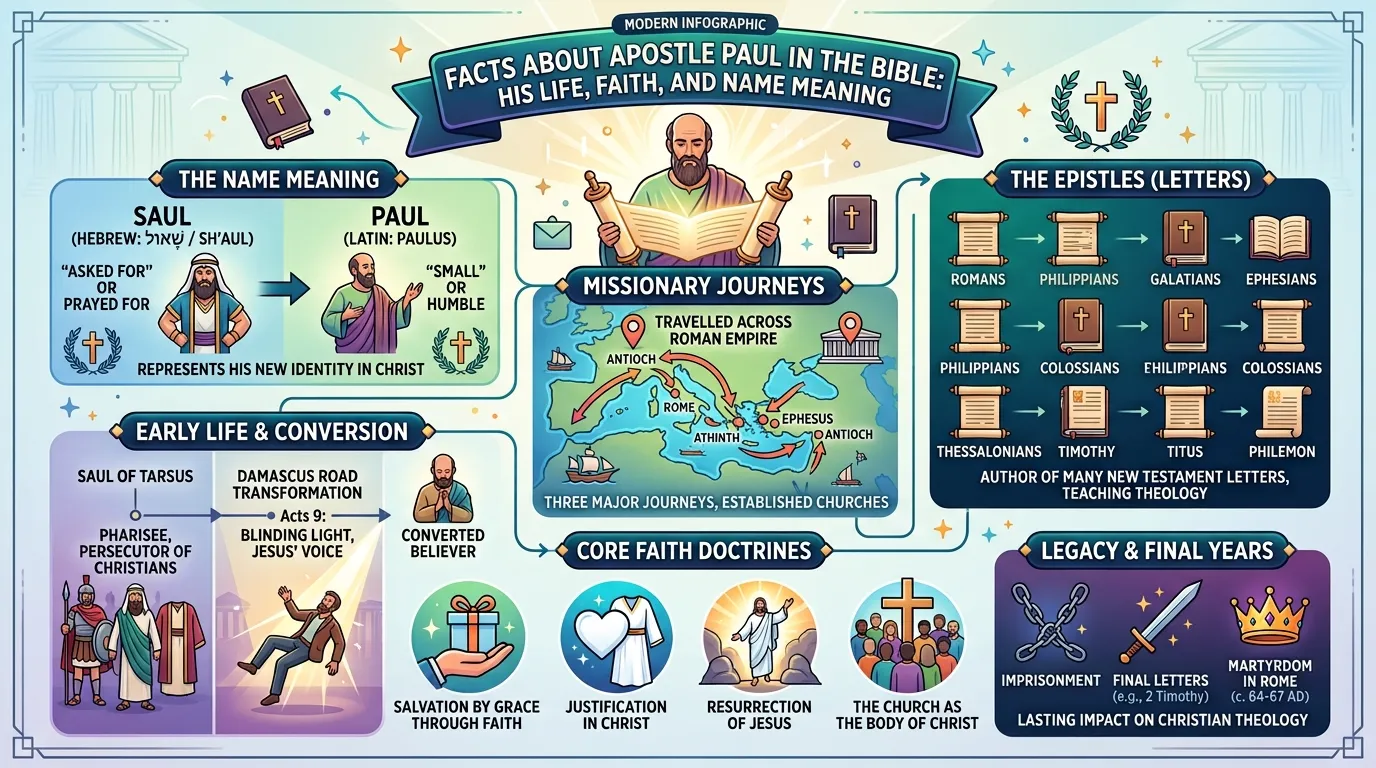
Acts 9 tells the story. Saul was traveling to Damascus with authority to arrest followers of Jesus. Suddenly, a light from heaven surrounded him.
He fell to the ground and heard Jesus asking, Why are you persecuting Me?
Saul asked who was speaking. Jesus identified Himself.
After the encounter, Saul was temporarily unable to see. God then sent a disciple named Ananias to him.
Ananias was understandably afraid because he knew Saul’s reputation. But God told him that Saul was a chosen instrument who would carry Christ’s name before Gentiles, kings, and the children of Israel (Acts 9:15).
Saul’s life changed.
He was baptized and began proclaiming Jesus as the Son of God.
What Does Paul’s Conversion Teach Christians?
Paul’s conversion teaches several powerful lessons:
- Jesus can confront us with truth.
- God’s mercy can reach people with painful pasts.
- Real faith produces a changed direction.
- God can use unlikely people for His purposes.
- Christian transformation begins with Christ, not human achievement.
Paul’s story is not a promise that every Christian will experience a dramatic vision. Instead, it is a biblical account of how Christ personally called Paul to his mission.
Facts About Apostle Paul: Saul and Paul
A common question is whether Saul and Paul were two different people.
They were the same man.
Acts 13:9 says, Saul, who also is called Paul.
The name Saul was his Jewish name, while Paul was a Roman name. Scripture does not say that Jesus changed his name at conversion in the same way that Abram became Abraham or Jacob became Israel.
This distinction matters because many popular explanations say that Saul’s name was changed to Paul because he became a Christian. The Bible does not actually make that claim.
From Acts 13 onward, Luke mainly uses the name Paul as the story follows his ministry among the Gentiles.
Focus Keyword + Hebrew Meaning
The Hebrew meaning connected with Apostle Paul is especially interesting because Paul was born Jewish and was originally known as Saul.
The Hebrew form of Saul is Shaul (שָׁאוּל). The name is commonly understood as meaning asked for, requested, or prayed for.
The name Paul, however, is not a Hebrew name. Paul comes from the Latin Paulus, commonly associated with the meaning small or humble.
The Bible does not teach that the meaning of Paul’s name predicts his ministry or spiritual destiny. Therefore, Christians should be careful not to turn a name meaning into a prophecy.
Still, Paul’s life beautifully reflects humility.
In 1 Corinthians 15:9, he called himself the least of the apostles. In Ephesians 3:8, he described himself as less than the least of all saints.
These verses show that Paul understood his ministry as an undeserved gift of grace.
What Does Saul Mean in Hebrew?
Saul (Shaul) is a Hebrew name found throughout the Old Testament. King Saul is one well-known example.
The name is connected with the idea of something being asked for or requested.
Paul’s Hebrew name, therefore, gives us useful information about his Jewish heritage. However, Scripture does not connect the meaning of the name Saul with Paul’s later ministry in a symbolic way.
That distinction keeps our interpretation grounded in Scripture.
Paul as an Apostle of Jesus Christ
Paul repeatedly identified himself as an apostle of Jesus Christ.
Romans 1:1 describes him as a servant of Jesus Christ, called to be an apostle, separated unto the gospel of God.
Galatians 1:15–16 explains that God had set Paul apart and called him by grace so that Christ could be revealed through him and preached among the Gentiles.
Paul understood his calling as something received from God.
He did not simply choose a religious career.
Paul Preached the Gospel of Grace
Paul’s teaching centered on Jesus Christ.
In 1 Corinthians 2:2, he wrote that he determined to know nothing among the Corinthians except Jesus Christ, and Him crucified.
His message emphasized salvation through faith in Christ.
Ephesians 2:8–9 teaches that people are saved by grace through faith, not by boasting in their own works.
Paul also taught that believers are created in Christ Jesus for good works (Ephesians 2:10). Good works are therefore a response to God’s grace, not a way to purchase salvation.
Paul Faced Great Suffering for His Faith
Paul’s story was not easy after his conversion.
He experienced imprisonment, beatings, rejection, danger, hunger, and many other hardships.
In 2 Corinthians 11:23–28, Paul described many of the sufferings he endured as a servant of Christ.
Yet he continued preaching.
Acts 20:24 gives a powerful picture of his attitude. Paul said that his life was not something he considered more important than completing the ministry he had received from the Lord Jesus.
This teaches us that faithfulness is not measured by how comfortable life is.
Sometimes following God requires courage during difficult seasons.
Paul Learned Contentment
Paul also learned to trust God in changing circumstances.
In Philippians 4:11–13, he explained that he had learned to be content whether he had much or little.
His famous words about being able to do all things through Christ are best understood in this context. Paul was speaking about receiving strength from Christ to remain faithful through different circumstances.
This is different from saying that Christians will receive everything they want.
Christ gives strength to remain faithful, even when circumstances are hard.
Paul’s Spiritual Meaning for Christians Today
The Bible does not give Paul a secret spiritual code. However, his life provides several clear lessons that Christians can apply today.
Grace Can Redeem Your Past
Paul’s past was serious, but God’s mercy was greater.
If you feel ashamed of your past, Paul’s story can remind you that repentance and grace are real.
The Christian message is not that your past never happened. It is that Christ can forgive, restore, and give you a new direction.
God Can Use Ordinary People
Paul had education and skills, but his ministry depended on God.
He planted churches, taught believers, traveled across difficult regions, and endured suffering.
Yet he repeatedly pointed back to God’s grace.
Your own gifts may look ordinary to you. A kind word, faithful prayer, Bible study, act of service, or simple testimony may become meaningful in God’s hands.
Faith Requires Perseverance
Paul did not stop serving Christ whenever trouble appeared.
His life teaches Christians to keep trusting God when answers are slow.
Hebrews 12:1–2 encourages believers to run with endurance while looking to Jesus.
Paul’s life gives us a real New Testament example of that endurance.
Paul and the Meaning of Dreams or Real-Life Experiences
Some Christians may dream about Apostle Paul or notice Paul’s story during an important season of life. They may wonder whether it has a special spiritual meaning.
The Bible allows us to learn from Paul’s life, but we should not automatically assume that a dream is a message from God.
Scripture teaches believers to test spiritual claims. First John 4:1 tells Christians to test the spirits rather than believe every spiritual claim.
If someone dreams about Paul, a wise response is to compare any perceived lesson with Scripture.
For example, a dream about Paul might cause someone to reflect on:
- forgiveness and grace
- repentance
- serving Christ
- courage during suffering
- sharing the gospel
- letting go of a painful past
- trusting God’s direction
These are biblical themes found in Paul’s life. But the dream itself should not be treated as equal to Scripture.
The Bible remains the standard for testing spiritual beliefs and teachings.
What Can We Learn From Apostle Paul in Everyday Life?
Paul’s life is not only for Bible study. His example can shape ordinary Christian decisions.
Imagine a Christian who has failed at work and feels useless. Paul’s story can remind that person that failure does not automatically cancel God’s ability to work through a life.
Imagine someone being treated unfairly because of their faith. Paul’s endurance can encourage them to respond with wisdom and courage rather than revenge.
Imagine someone who feels called to serve but thinks they are not important enough.
Paul’s example points them back to God’s grace.
Simple Ways to Follow Paul’s Example
You can apply Paul’s biblical lessons by:
- Praying before making important choices.
- Studying Scripture instead of relying only on feelings.
- Serving others with humility.
- Sharing your faith with kindness.
- Remaining faithful during difficult seasons.
- Giving God credit for your gifts and successes.
- Forgiving others while seeking biblical wisdom.
- Remembering that spiritual growth takes time.
Important Bible Verses About Apostle Paul
Several passages give a clear picture of Paul’s life and message.
Acts 9:15 — God called Saul a chosen instrument to carry Christ’s name to Gentiles, kings, and Israel.
Acts 13:9 — This verse identifies Saul as Paul and shows the transition in the name used during his ministry.
1 Corinthians 15:9–10 — Paul openly remembered his past persecution and credited God’s grace for his transformed life.
Galatians 1:15–16 — Paul explained that God called him by grace and revealed Christ to him so that he could preach among the Gentiles.
Philippians 3:7–8 — Paul considered his former earthly achievements as loss compared with the surpassing value of knowing Christ.
2 Timothy 4:7 — Near the end of his ministry, Paul wrote that he had fought the good fight, finished the race, and kept the faith.
These verses show a consistent theme: Paul’s life was centered on Christ, grace, faithfulness, and the gospel.
How Many Books of the Bible Did Paul Write?
Paul is traditionally recognized as the author of 13 New Testament letters:
- Romans
- 1 Corinthians
- 2 Corinthians
- Galatians
- Ephesians
- Philippians
- Colossians
- 1 Thessalonians
- 2 Thessalonians
- 1 Timothy
- 2 Timothy
- Titus
- Philemon
Hebrews has sometimes been associated with Paul in Christian history, but the letter itself does not name its author. Therefore, it is better not to state that Paul definitely wrote Hebrews.
Paul’s letters continue to teach Christians about salvation, grace, faith, the church, Christian living, spiritual gifts, suffering, and hope in Christ.
Was Paul One of the Original Twelve Apostles?
No. Paul was not one of the original twelve disciples chosen by Jesus during His earthly ministry.
However, Paul was genuinely called and commissioned as an apostle of Christ.
In Galatians 1:1, Paul described himself as an apostle not of men, neither by man, but by Jesus Christ, and God the Father.
His apostleship was therefore distinct from the calling of the Twelve.
This helps explain why the New Testament can speak about Paul as an apostle while also distinguishing him from the original Twelve.
What Is the Main Lesson of Apostle Paul?
The main lesson of Paul’s life is not that Christians should become famous missionaries or have dramatic experiences.
The deeper lesson is that Jesus Christ changes lives, God’s grace is greater than our past, and faithful service matters even during suffering.
Paul went from persecuting believers to preaching the faith he once tried to destroy.
His life shows the depth of God’s mercy.
It also teaches humility. Paul did not present his transformation as proof that he was naturally better than others. He repeatedly gave credit to God’s grace.
Frequently Asked Questions
What is the meaning of Apostle Paul in the Bible?
Paul’s biblical story is strongly connected with grace, transformation, repentance, faith, perseverance, and gospel ministry. He demonstrates how Christ can transform someone who once opposed the church into a faithful servant.
What was Paul’s real name?
Paul was also called Saul. Acts 13:9 directly says, Saul, who also is called Paul. Saul was his Jewish name, while Paul was his Roman name.
What does Saul mean in Hebrew?
The Hebrew name Shaul (שָׁאוּל) is commonly understood to mean asked for, requested, or prayed for. The Bible does not say that this meaning had a prophetic connection to Paul’s ministry.
What does Paul mean in Hebrew?
Paul is not originally a Hebrew name. It comes from the Latin Paulus, commonly associated with the meaning small or humble.
What does Paul teach us about God’s grace?
Paul teaches that God’s grace can reach people with deeply troubled pasts. In 1 Timothy 1:15–16, he presented his own life as an example of Christ’s patience and mercy.
Did Jesus change Saul’s name to Paul?
The Bible does not explicitly say that Jesus changed Saul’s name. Acts 13:9 identifies him as Saul, also called Paul. Luke then increasingly uses Paul as the account focuses on his Gentile mission.
What does dreaming about Apostle Paul mean?
A dream about Paul does not automatically have a divine meaning. Christians should test spiritual impressions against Scripture. Paul’s biblical themes of grace, courage, repentance, service, and perseverance can provide useful areas for prayer and reflection.
Conclusion
The facts about Apostle Paul meaning in the Bible reveal one of the New Testament’s strongest stories of grace and transformation.
Paul was not chosen because his past was perfect. His life shows what God can do through a person who encounters Christ and responds in faith.
He faced suffering, rejection, and hardship, yet he continued to serve.
His story also reminds us to stay humble. Paul knew that his strength and ministry were gifts of God’s grace.
If you are struggling with your past, feeling weak, or wondering whether God can still use your life, Paul’s story offers hope. God’s grace is not limited by the chapter you are currently living.
Take Paul’s example to prayer. Ask God for wisdom, courage, humility, and faithfulness.
And remember his final testimony in 2 Timothy 4:7: I have fought a good fight, I have finished my course, I have kept the faith.
May your own journey with Christ lead you to trust God’s grace more deeply, walk faithfully through every season, and keep your eyes on Jesus.