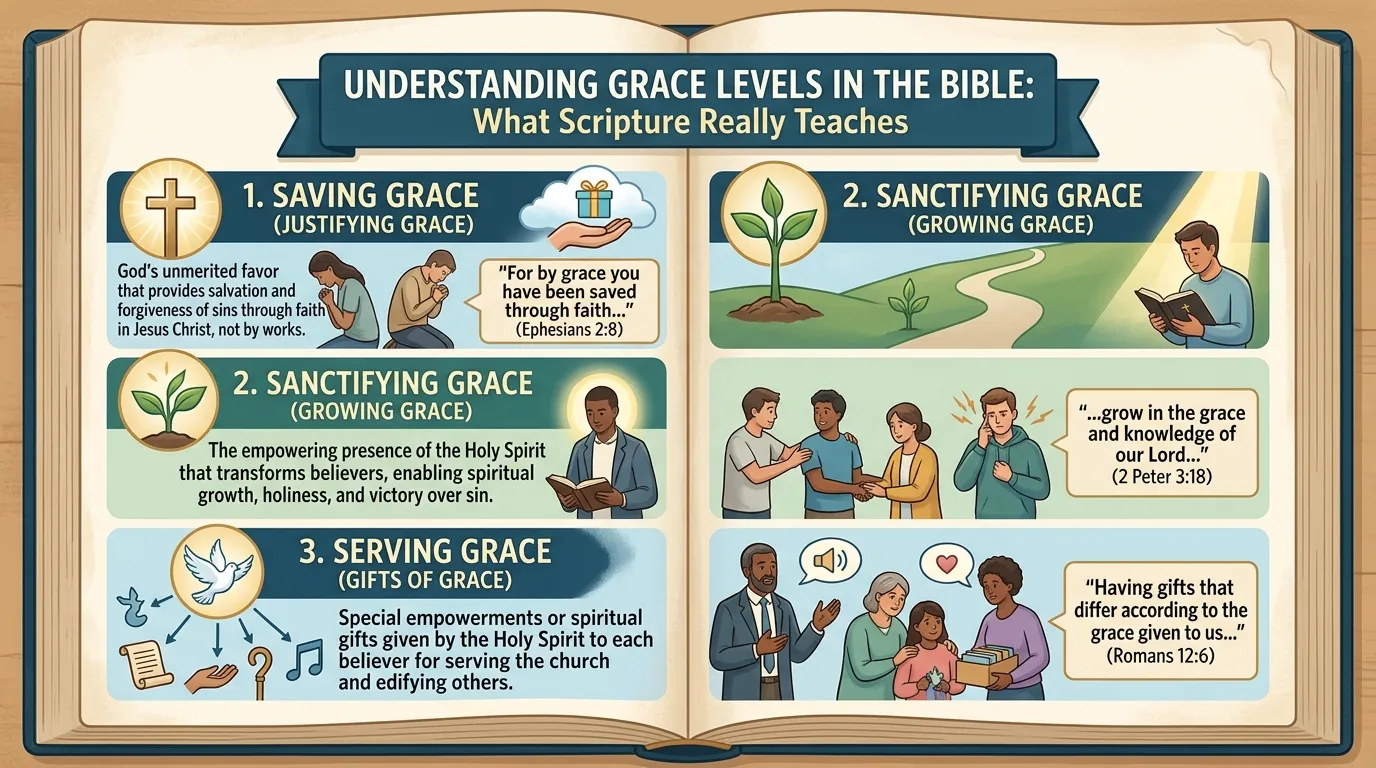
Grace is the most beloved word in the Christian vocabulary — and one of the most misunderstood. People speak of “grace” as if it were a single thing: forgiveness, or kindness, or a vague sense of God being nice. The Bible’s picture is richer. Grace is not one flat note. It is a chord. Scripture speaks of grace that saves, grace that sustains, grace that equips, grace that disciplines, and grace that will one day complete what it started. Some teachers have described these as “levels” or dimensions of grace. The word “levels” is not itself a biblical term, and it can mislead if it suggests that some Christians graduate beyond needing grace. But used carefully, it captures something real: grace meets us at every stage of the Christian life, and it does different work at each stage.
This article traces grace through the Bible as a journey — from the grace that finds us, to the grace that forms us, to the grace that sends us, to the grace that finishes us. The same grace runs through every stage. It never stops being grace.
First: The Grace That Saves
Everything begins here. “For it is by grace you have been saved, through faith — and this is not from yourselves, it is the gift of God — not by works, so that no one can boast” (Ephesians 2:8–9). Saving grace is the grace of the cross: Christ died for sinners, and God credits His righteousness to all who believe. It is entirely unearned. It cannot be earned by good works, religious effort, moral improvement, or spiritual experiences. It is received by faith, and even the faith is a gift.
The Bible insists on this because human nature resists it. We want to contribute. We want to pay something, prove something, or at least feel that we deserved it. Saving grace demolishes that instinct. The tax collector who beat his breast and said, “God, have mercy on me, a sinner,” went home justified (Luke 18:14). The thief on the cross, who had nothing to offer but a plea, heard, “Today you will be with me in paradise” (Luke 23:43). Saving grace is the grace that finds us when we have nothing left to bring.
Second: The Grace That Sustains
Salvation is not the end of grace. It is the beginning. Paul discovered this when he pleaded three times for a “thorn in the flesh” to be removed. God’s answer was not removal but grace: “My grace is sufficient for you, for my power is made perfect in weakness” (2 Corinthians 12:9). Sustaining grace is the grace that carries believers through suffering, weakness, temptation, and ordinary exhaustion. It does not always change the circumstance. It changes the person in the circumstance.
Sustaining grace shows up in the Psalms as the God who is “our refuge and strength, an ever-present help in trouble” (Psalm 46:1). It shows up in the promise that God’s mercies are new every morning (Lamentations 3:22–23). It shows up in the daily bread of the Lord’s Prayer. Many believers testify that the grace they needed most was not the dramatic grace of conversion but the quiet grace of Tuesday — the strength to keep going, to forgive again, to endure a difficult marriage, to survive grief, to get out of bed and trust God one more day.
Third: The Grace That Forms
Grace does not merely pardon. It transforms. Paul writes that “the grace of God has appeared that offers salvation to all people. It teaches us to say ‘No’ to ungodliness and worldly passions, and to live self-controlled, upright and godly lives” (Titus 2:11–12). Grace is a teacher. The same grace that forgives sin trains us to resist it. This is the answer to the old accusation that grace encourages sin. Real grace never does. Cheap grace — grace without transformation — is not grace at all. It is permission. Biblical grace is a power that changes what we want.
Forming grace works through the ordinary means: Scripture that renews the mind, prayer that aligns the heart, the church that corrects and encourages, suffering that refines, and the Spirit who produces fruit. It is slow work. The believer who expects instant perfection will be disappointed. The believer who trusts the slow grace of formation will look back after a decade and be astonished at how much has changed.
Fourth: The Grace That Equips
Grace also gives gifts. “We have different gifts, according to the grace given to each of us” (Romans 12:6). Equipping grace is the grace that fits believers for service: teaching, serving, leading, giving, encouraging, showing mercy. Peter says, “Each of you should use whatever gift you have received to serve others, as faithful stewards of God’s grace in its various forms” (1 Peter 4:10). Grace is not only what God gives to us. It is what God gives through us.
Equipping grace is humbling because it reminds us that our abilities are not our own. The gifted preacher, the generous giver, the wise counselor, the faithful servant — all are stewards of grace. And equipping grace is liberating, because it means God does not call us to tasks He has not equipped us for. If He has called you, He has graced you. The task and the grace arrive together.
Fifth: The Grace That Completes
Finally, there is the grace that finishes the story. Peter writes of “the grace to be brought to you when Jesus Christ is revealed” (1 Peter 1:13) — a future grace, a grace still coming. Paul writes that “he who began a good work in you will carry it on to completion until the day of Christ Jesus” (Philippians 1:6). The grace that saved you will not abandon you halfway. The God who started the work will finish it. The final grace is the grace of glorification: a new body, a new heaven and earth, a face-to-face vision of Christ, and the end of sin, sorrow, and death forever.
This future grace is the anchor of present hope. When believers grow weary, when progress feels slow, when the same sins recur, the promise of completing grace says: God is not finished with you. The story is not over. The grace that found you in your worst moment will carry you to your best one.
One Grace, Many Works — and One Warning
The danger of talking about “levels” of grace is the suggestion that we climb a ladder and leave the lower rungs behind. The Bible’s picture is the opposite. The believer never outgrows saving grace. The mature Christian does not need less grace; they need more of it, and they know it. Paul, near the end of his life, called himself “the worst of sinners” and said he was shown mercy so that Christ might display His patience (1 Timothy 1:15–16). Growth in grace is growth in the awareness of how much grace we need.
So the levels are not rungs to climb and discard. They are rooms in one house, and the believer lives in all of them at once: saved by grace, sustained by grace, formed by grace, equipped by grace, and headed toward the grace that completes. The same grace, the same God, the same cross — working in every room.
Grace in the Old Testament
Grace is not a New Testament invention. The Old Testament is full of it, beginning with Noah: “Noah found favor [grace] in the eyes of the LORD” (Genesis 6:8). The Hebrew word is chen — favor, grace, kindness. God chose Noah not because Noah was perfect but because God was gracious. The same grace runs through the whole Old Testament: God calling Abraham, delivering Israel from Egypt, forgiving David after his adultery and murder, restoring the exiles, and promising a new covenant.
The Old Testament’s most concentrated statement of grace is Exodus 34:6–7, where God describes Himself as “compassionate and gracious, slow to anger, abounding in love and faithfulness.” Grace is not an attribute God acquired at the incarnation. It is who He has always been. The Old Testament saints were saved by grace through faith, just as we are — they looked forward to the promised Messiah, and we look back to the crucified and risen one. The grace is the same. The promise is the same. The God is the same.
Recognizing grace in the Old Testament corrects a common distortion: the idea that the Old Testament is law and the New Testament is grace. The law itself was given as grace — a gift to a redeemed people, showing them how to live in freedom. “I am the LORD your God, who brought you out of Egypt” comes before “You shall have no other gods.” Redemption precedes command. Grace precedes law. That is the pattern of the whole Bible.
For a theological survey of how grace has been understood across the Christian tradition, the Wikipedia article on divine grace is a good place to start.










