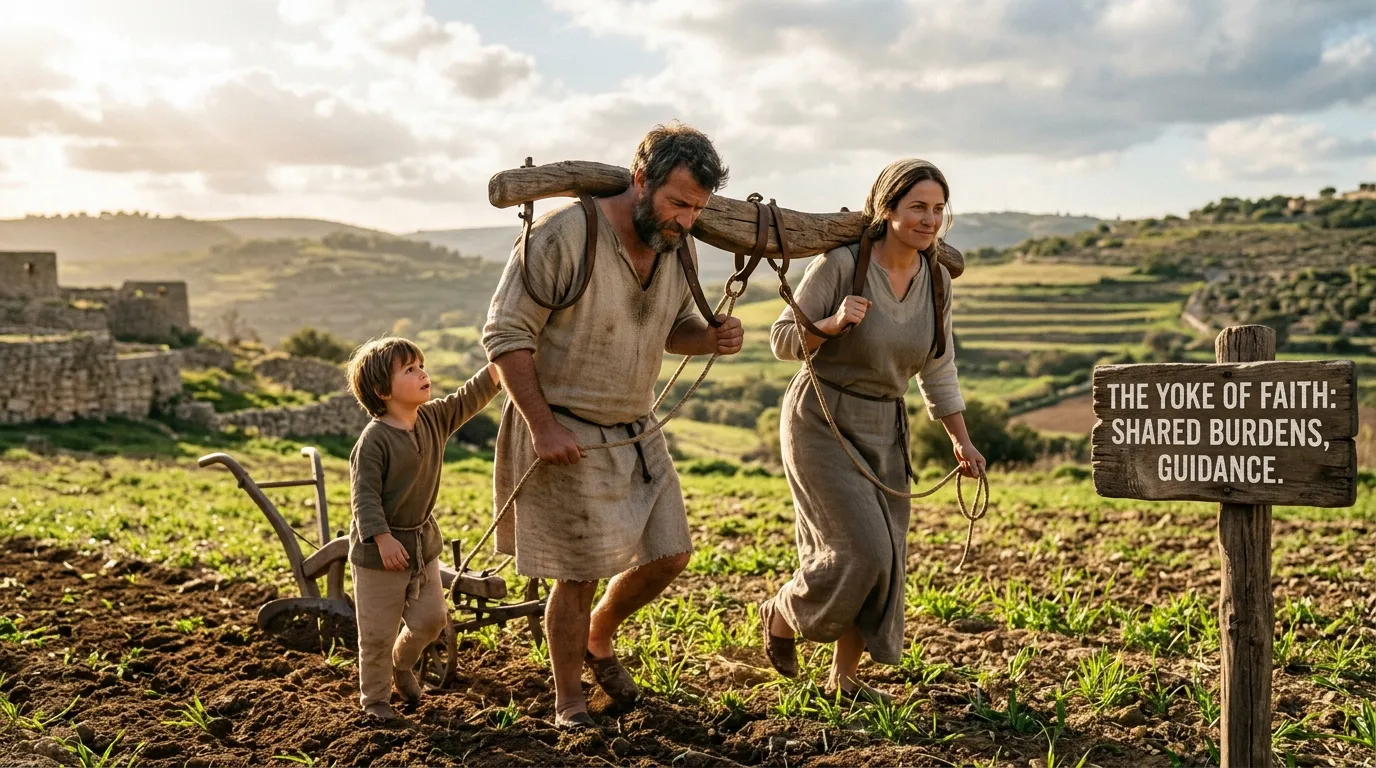
The brick pits of Egypt are where the Bible’s yoke story begins. Israel is not yet a nation — it is a labor force, “and the Egyptians… made their lives bitter with hard service, in mortar and brick, and in all kinds of work in the field” (Exodus 1:13–14). Four hundred years of that. When Moses finally confronts Pharaoh, God’s message frames the entire exodus in yoke language before the word is even spoken: “I will bring you out from under the burdens of the Egyptians, and I will deliver you from slavery to them” (Exodus 6:6). The Bible’s yoke is, first and last, about bondage — and about the God who breaks it.
The Iron Yoke: Bondage as Judgment
Moses warns Israel, on the plains of Moab, what rebellion will cost — and the image he reaches for is a yoke of iron: “you shall serve your enemies… and he will put a yoke of iron on your neck until he has destroyed you” (Deuteronomy 28:48). An ordinary yoke was wood — heavy but bearable. An iron yoke is unbreakable by human strength: bondage with no way out, servitude as the settled condition.
The prophets pick up the image and apply it to history. When Babylon carries Judah into exile, Jeremiah sees the iron yoke fulfilled. But the prophets also insist on the theology behind it: the yoke is never meaningless suffering. It is discipline — “I will punish you… and I will break the bars of your yoke” (Leviticus 26, Ezekiel 34:27). God uses foreign yokes the way a farmer uses a plow: to break up hard ground. The bondage is real, and it is also purposeful — which is why it can be ended when the purpose is served.
Jeremiah’s Wooden Yoke
No prophet embodied the yoke like Jeremiah. God commands him: “Make yourself straps and yoke-bars, and put them on your neck” (Jeremiah 27:2). Picture it — the prophet walking through Jerusalem wearing an ox’s harness, preaching without words: submit to Babylon; the yoke is God’s appointment; resistance will only forge it into iron.
Then comes the confrontation. The false prophet Hananiah — smooth, popular, patriotic — snatches the wooden yoke off Jeremiah’s neck, smashes it, and proclaims: “Thus says the LORD: Even so will I break the yoke of Nebuchadnezzar king of Babylon from the neck of all the nations within two years” (Jeremiah 28:10–11). The crowd must have cheered. Jeremiah walks away, receives God’s word, and returns with the devastating correction: “You have broken wooden bars, but you will make in place of them bars of iron” (28:13). False hope does not lighten the yoke; it upgrades it to iron.
The lesson endures wherever comfortable lies compete with hard truths. Hananiah’s broken yoke is every promise that suffering can be avoided by positive thinking, every theology that edits out the cross. Jeremiah’s intact yoke is the harder, kinder truth: some burdens are God’s appointment, and the way through is through — “it is good for a man that he bear the yoke in his youth” (Lamentations 3:27).
Broken Yokes: Isaiah’s Promise
But the yoke is never the last word. Isaiah, preaching to a people crushed by Assyria, delivers the Bible’s great yoke-breaking promise: “the yoke of his burden, and the staff for his shoulder, the rod of his oppressor, you have broken as on the day of Midian” (Isaiah 9:4) — and again, “his burden will be removed from your shoulder, and his yoke will be destroyed from your neck… because of the anointing” (Isaiah 10:27, NKJV).
Because of the anointing — the Hebrew suggests the yoke breaks because the neck has grown too strong, anointed and fat with God’s blessing, for the harness to hold. It is a startling image: God does not merely slip the yoke off; he makes his people un-yoke-able. The growth of grace outgrows the harness of bondage. What once fit now shatters.
Jeremiah, the yoke-prophet himself, gets to preach the reversal: “I will break his yoke from off your neck, and will burst your bonds” (Jeremiah 30:8) — spoken to exiles who had watched the iron yoke descend. And Ezekiel, to the same exiles: “they shall know that I am the LORD, when I break the bars of their yoke, and deliver them from the hand of those who enslaved them” (Ezekiel 34:27). The God who appoints the yoke is the God who breaks it. Bondage is his tool; freedom is his goal.
The Exodus Pattern: From Burden to Freedom
Step back and the whole Old Testament runs on this rhythm: bondage → cry → deliverance → song. Egypt to the Red Sea to Miriam’s tambourine (Exodus 15). Babylon to Cyrus’s decree to the return (Ezra 1). The yoke descends; the people groan; “their cry for rescue from slavery came up to God. And God heard their groaning, and God remembered his covenant” (Exodus 2:23–24); the sea parts, the oppressor drowns, the freed sing.
This pattern is not just history; it is theology’s skeleton key. Every later deliverance in Scripture is an exodus retelling — including the greatest one. Jesus’ death and resurrection happen at Passover, the feast of the exodus, because his cross is the ultimate yoke-breaking: “you were ransomed… not with perishable things such as silver or gold, but with the precious blood of Christ” (1 Peter 1:18–19). Pharaoh’s brick pits become sin’s bondage; the Red Sea becomes the empty tomb; Miriam’s song becomes the church’s eternal hymn.
Paul states the transfer plainly: “For freedom Christ has set us free” (Galatians 5:1) — exodus language applied to the soul. The yoke that once was Egypt, then Babylon, then Rome, is finally sin itself — and it is broken not by human uprising but by divine intervention, “having canceled the record of debt… nailing it to the cross” (Colossians 2:14).
Joseph’s Yoke: From Pit to Palace
No Old Testament life traces the bondage-to-freedom arc more completely than Joseph’s. Betrayed by his brothers, sold to traders, resold in Egypt, falsely accused, imprisoned — “his feet were hurt with fetters; his neck was put in a collar of iron” (Psalm 105:18). The iron collar is literal before it is metaphorical: Joseph wore the yoke in his body before he wore the signet ring on his hand.
Thirteen years pass between the pit and the palace. And when Joseph finally names his sons, the names preach the yoke theology: Manasseh — “God has made me forget all my hardship” — and Ephraim — “God has made me fruitful in the land of my affliction” (Genesis 41:51–52). Forgetting the hardship, fruitful in the affliction — not after it, in it. Joseph’s verdict on his own yoke years, spoken to the brothers who forged it: “you meant evil against me, but God meant it for good” (Genesis 50:20).
Joseph is the Old Testament’s proof that the yoke years are not wasted years. The pit taught him the prison; the prison taught him the palace. Every link in the chain was preparation, though none of it felt like preparation at the time. If you are in the middle of your own thirteen years, Joseph’s story is God’s advance testimony: the collar comes off, the ring goes on, and the very brothers who sold you will one day bow — not for your revenge, but for your provision of their bread.
When You Are Under the Yoke Now
The Old Testament’s yoke theology speaks to present bondages — not only sin’s, but suffering’s: the oppressive job, the crushing debt, the chronic illness, the relationship that harnesses and chafes. A few truths from the pattern:
- God sees the yoke. “I have surely seen the affliction of my people… and have heard their cry” (Exodus 3:7). Bondage is never invisible to heaven.
- Cry; don’t just endure silently. Israel’s deliverance began when “their cry… came up to God” (Exodus 2:23). Lament is not faithlessness; it is the appointed trigger of divine action.
- Discern the yoke’s purpose. Some yokes are Pharaoh’s — to be broken by God’s power. Some are Babylon’s — appointed discipline to be borne in faith until God’s time. Wisdom knows the difference; prayer asks for it.
- Expect the song. Every biblical yoke-breaking ends in singing — Miriam (Exodus 15), Deborah (Judges 5), Mary (Luke 1). “Weeping may tarry for the night, but joy comes with the morning” (Psalm 30:5). The yoke is a chapter, not the book.
From Egypt’s brick pits to Babylon’s iron bars to the cross’s broken curse, the Bible tells one yoke story with many chapters: bondage is real, God sees it, God breaks it, and the freed sing. Whatever harness chafes your neck today, it has an expiration date known to heaven. The God of the exodus has not retired.
The exodus itself — the founding event behind all this yoke imagery — is narrated in full in the encyclopedia’s article on the Book of Exodus. But the theology needs no supplement: the God who broke Pharaoh’s yoke is still in the yoke-breaking business.










