It began as a fortress the Israelites could not take. When David became king, the Jebusites still held the hilltop city, and they taunted him: “You will not come in here, but the blind and the lame will ward you off” (2 Samuel 5:6). David took it anyway — by the water shaft, in a daring ascent — and renamed it: “David took the stronghold of Zion, that is, the City of David” (5:7). A military stronghold became a capital; a capital became a temple mount; a temple mount became, in the Bible’s imagination, the address of God himself. No place-name in Scripture travels farther than Zion.
From Jebus to the City of David
Zion’s literal referent shifts as the story grows. First it is the specific hill — the southeastern ridge of Jerusalem, the Jebusite stronghold David captures. Then David brings the ark of the covenant there, pitching a tent for it (2 Samuel 6:17), and Zion becomes the place of God’s presence. Then Solomon builds the temple on neighboring Mount Moriah, and “Zion” expands to cover the whole temple mount, then the whole city of Jerusalem, then the whole people of God.
This expansion is not sloppiness; it is theology. Places in Scripture grow to fit the realities they house. Zion starts as geography and ends as identity — shorthand for everything God has chosen, dwells in, and will never abandon. By the prophets’ time, “Zion” can mean the city (Isaiah 1:27), the temple (Psalm 132:13), the people (Isaiah 51:16 — “you are my people… I… say to Zion, ‘You are my people'”), or the coming kingdom (Obadiah 21). The word breathes; it refuses to stay small.
The Mountain God Chose
The Psalms return obsessively to one fact about Zion: God chose it. “For the LORD has chosen Zion; he has desired it for his dwelling place: ‘This is my resting place forever; here I will dwell, for I have desired it'” (Psalm 132:13–14). Not the tallest mountain — Hermon dwarfs it. Not the most strategic — it has no river, no harbor. God chose it the way he chose Israel, David, and the disciples: not for impressiveness but for his own purposes.
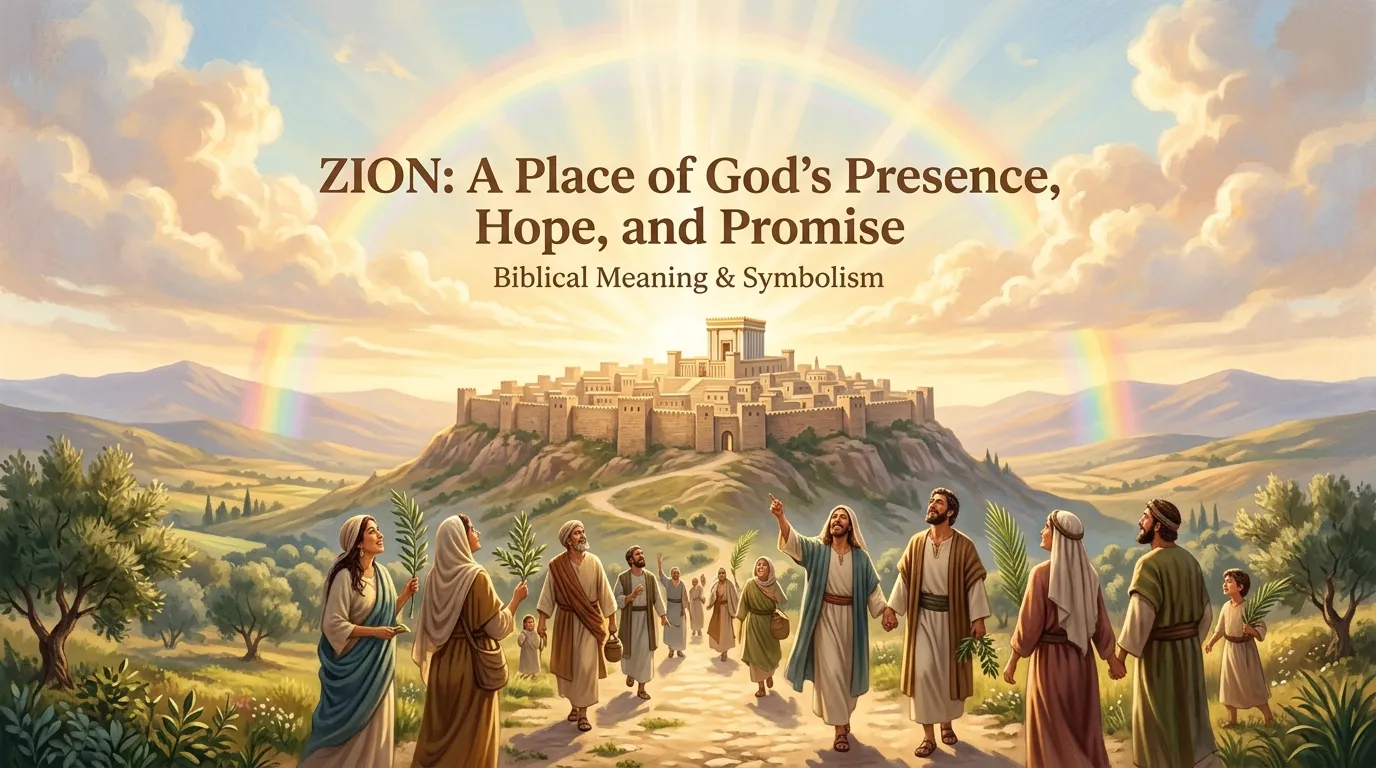
The pilgrim psalms — Psalms 120–134, the “Songs of Ascents” sung by travelers climbing to Jerusalem’s feasts — make Zion the destination of desire itself. “I was glad when they said to me, ‘Let us go to the house of the LORD!'” (Psalm 122:1). “Those who trust in the LORD are like Mount Zion, which cannot be moved, but abides forever” (125:1). The mountain becomes a metaphor for stability: to trust God is to become Zion-like — unmoved, abiding. Geography becomes character.
And the coronation psalms give Zion its cosmic dimension: “I have set my King on Zion, my holy hill” (Psalm 2:6). The hill David captured becomes the throne of the Davidic king — and then, in the prophets’ widening vision, the throne of the final King, before whom “the kings of the earth” rage in vain (2:1–2). Every earthly coronation on Zion was a rehearsal; the real one is still coming.
Zion in the Prophets: Judgment and Hope
The prophets hold Zion’s glory and Zion’s failure in unbearable tension. Because God dwells there, judgment begins there: “Zion shall be plowed as a field; Jerusalem shall become a heap of ruins” (Micah 3:12) — spoken to leaders who assumed the temple’s presence guaranteed safety. “Do not trust in these deceptive words: ‘This is the temple of the LORD, the temple of the LORD, the temple of the LORD'” (Jeremiah 7:4). Chosenness is not a talisman; it is a responsibility, and neglected responsibility invites the plow.
Yet the same prophets who pronounce Zion’s ruin proclaim its restoration in the next breath — often the very next verse. Isaiah 1:27: “Zion shall be redeemed by justice.” Isaiah 2:3: “out of Zion shall go forth the law, and the word of the LORD from Jerusalem” — the mountain becomes missionary, the law going out to the nations. Isaiah 35 paints the return: “the ransomed of the LORD shall return and come to Zion with singing; everlasting joy shall be upon their heads” (35:10). Judgment is the dark valley; restoration is the far side. The prophets never leave Zion in ruins. They always rebuild it — bigger, brighter, more inclusive than before.
Zechariah, preaching to the returned exiles staring at a modest second temple, gives the promise its most tender form: “I will return to Zion and will dwell in the midst of Jerusalem… and the streets of the city shall be full of boys and girls playing in its streets” (Zechariah 8:3, 5). God’s vision of restored Zion is not just glory and worship — it is children playing in the streets. The mountain God chose is, finally, a neighborhood.
“Daughter of Zion”: The People as a Person
The prophets love to personify Zion as a woman — “daughter of Zion” — and the personification carries the whole emotional range of the covenant. In judgment, she is the humiliated daughter: “the daughter of Zion is left like a booth in a vineyard” (Isaiah 1:8), exposed and alone. In exile, she is the grieving mother: “Zion said, ‘The LORD has forsaken me'” (Isaiah 49:14) — and God’s answer is among the tenderest in Scripture: “Can a woman forget her nursing child?… Even these may forget, yet I will not forget you. Behold, I have engraved you on the palms of my hands” (49:15–16).
In restoration, she becomes the bride: “as the bridegroom rejoices over the bride, so shall your God rejoice over you” (Isaiah 62:5). And at the climax of the story, the daughter of Zion gets the announcement she was made for: “Rejoice greatly, O daughter of Zion! Shout aloud, O daughter of Jerusalem! Behold, your king is coming to you; righteous and having salvation is he, humble and mounted on a donkey” (Zechariah 9:9) — the verse Matthew quotes as Jesus rides into Jerusalem on Palm Sunday (Matthew 21:5). The King does come to Zion, exactly as promised — only humbler than anyone expected, riding the foal rather than the warhorse. Daughter of Zion, your King has arrived; he just didn’t come the way the fortress-builders imagined.
The Heavenly Zion
The New Testament takes the expanding word and expands it once more — beyond geography entirely. Hebrews tells believers: “you have come to Mount Zion and to the city of the living God, the heavenly Jerusalem” (Hebrews 12:22). Not “you will come” — you have come. By faith, the church already stands on the mountain. Worship on earth is attendance at heaven’s assembly: “innumerable angels in festal gathering, and… the spirits of the righteous made perfect” (12:22–23).
Revelation completes the ascent: “I looked, and behold, on Mount Zion stood the Lamb” (Revelation 14:1) — with 144,000 redeemed, singing a new song no one else can learn. The fortress David captured by the water shaft has become the Lamb’s mountaintop, ringed with the redeemed. And the final vision outgrows even heaven’s Zion: “I saw the holy city, new Jerusalem, coming down out of heaven from God” (Revelation 21:2) — Zion descending to a renewed earth, “the dwelling place of God… with man” (21:3). The mountain God chose comes down to stay.
Walking Toward Zion Today
What does Zion ask of pilgrims who will never climb its physical hill? The Songs of Ascents suggest a spirituality of direction:
- Set your face toward God’s presence. The pilgrims literally walked uphill to Jerusalem three times a year (Exodus 23:14–17). The Christian equivalent: orient your life — calendar, money, attention — toward God’s presence, not away from it.
- Travel in company. “I was glad when they said to me” (Psalm 122:1) — pilgrimage was communal. Zion is not a solo destination; “we” go up together. The church is the traveling party.
- Trust like the mountain. “Like Mount Zion, which cannot be moved” (Psalm 125:1) — stability is not the absence of storms but the presence of foundation. Build on the rock (Matthew 7:24–25).
- Sing on the way. The ascent psalms are songs — joy was the travel music. “Sing to the LORD… sing praises to him” is the pilgrim’s soundtrack, in the valley as on the heights.
From Jebusite fortress to heavenly city, Zion’s story is the Bible’s story in miniature: God chooses the unlikely, dwells in the chosen, judges the unfaithful, restores the repentant, and finally brings the mountain down to a renewed earth where he will dwell with his people forever. “Great is the LORD and greatly to be praised in the city of our God! His holy mountain, beautiful in elevation, is the joy of all the earth, Mount Zion” (Psalm 48:1–2). The joy of all the earth — that was always the destination.
The name’s long journey — from Bronze Age fortress to theological symbol to heavenly city — is traced in the encyclopedia’s article on Zion. But Scripture’s own arc needs no supplement: the hill David took became the hill God chose, became the city the Lamb will fill — and the pilgrims are still singing on the way up.