Say the name “Damien” in a crowded room and watch what happens. Someone will smile nervously. Someone else will make a joke about horror movies. A few people will look genuinely uneasy — as if the name itself carried something dark. No other modern name labors under quite this shadow, and the reason has a release date: 1976, when the film The Omen introduced the world to Damien Thorn, the antichrist child with “666” on his scalp. Fifty years later, the association lingers, and parents considering the name — or people bearing it — still ask the question: is there something wrong with this name? Does the Bible say anything about it?
The short answer is no — and the longer answer is one of the most liberating lessons Scripture teaches about names, fear, and the difference between Hollywood theology and biblical truth.
Damianos: What the Name Actually Means
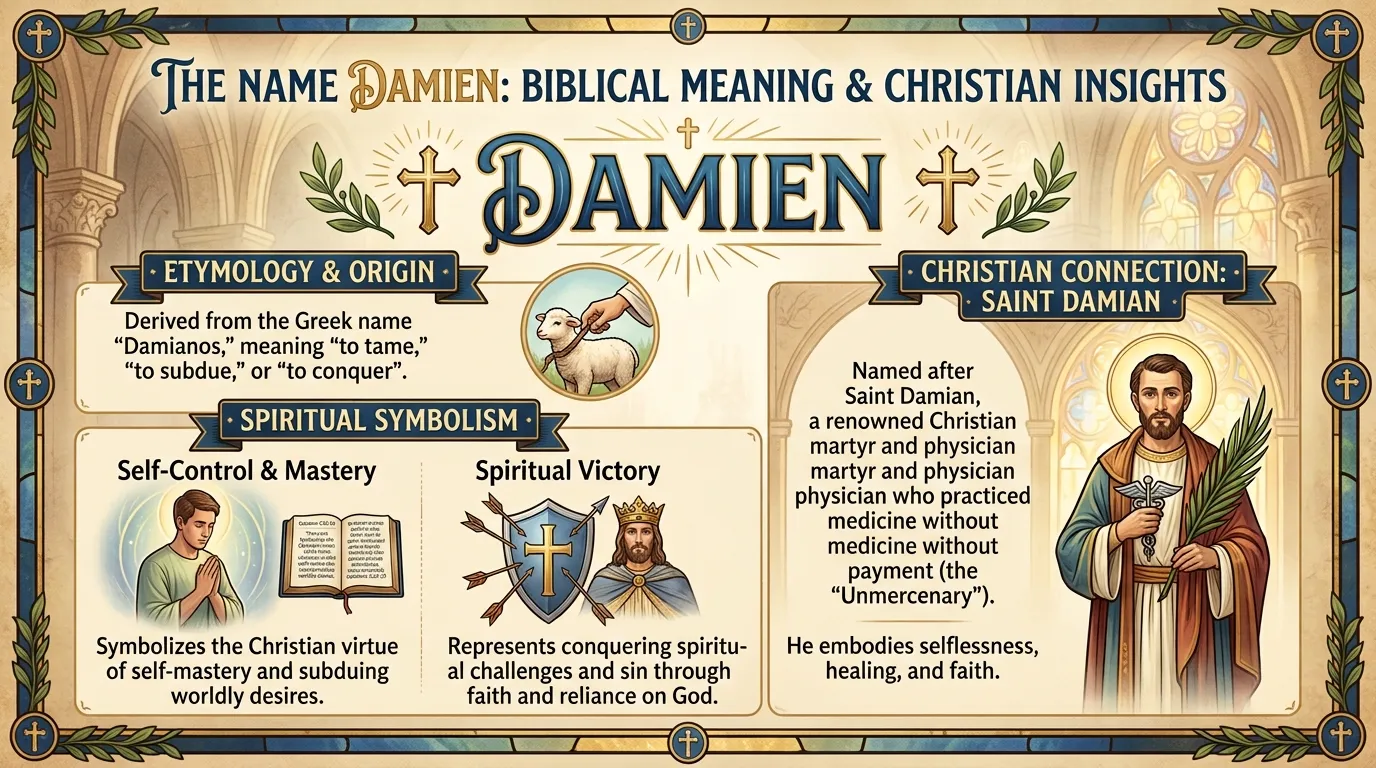
Strip away the movies and you are left with an ordinary, ancient, respectable name. Damien comes from the Greek Damianos, derived from the verb damazo — “to tame, to subdue, to bring under control.” It is the same root found in James 3:7-8, where the tongue is described as untamable by human power. The name’s original sense is something like “the tamer” or “the subduer” — one who brings order, who masters what is wild.
There is nothing sinister in that etymology. If anything, it is noble: the one who subdues chaos, who brings the wild under control. It is the meaning a farmer would love — taming the field — or a teacher, or a peacemaker. Folk etymologies sometimes try to darken it further, linking it to words for “spirit” or even “demon” (daimon), but linguists are clear: Damianos and daimon are different words with different roots. The similarity is coincidence, not conspiracy.
And the name has a distinguished Christian pedigree. Saint Damian — paired with his twin brother Cosmas — was a third-century Christian physician, martyred under Diocletian around 303 AD. Cosmas and Damian were known as the “moneyless ones” because they treated the sick without charge, and they are venerated as patron saints of doctors, surgeons, and pharmacists across Catholic, Orthodox, and Anglican traditions. For seventeen centuries before Hollywood, “Damian” meant healer, not horror. Churches, hospitals, and countless Christian boys have carried the name with honor.
The Omen Effect: When Hollywood Writes Theology
So how did a saint’s name become scary? Entirely through fiction — and fiction of a specific, theologically sloppy kind. The Omen (1976) needed a name for its antichrist child that sounded vaguely European, slightly aristocratic, and unfamiliar enough to feel ominous. “Damien” fit the casting call. The film’s success — followed by sequels and a 2006 remake — welded the association into popular culture.
Here is what Christians need to grasp: The Omen is not theology; it is entertainment built on theological set-dressing. Its version of the antichrist, its use of “666,” its jackals and omens — these are cinematic inventions draped over biblical vocabulary. Revelation’s actual teaching about “the beast” and its number (Revelation 13:18) is about imperial idolatry and economic coercion in the first century, not about sinister toddlers. Treating a horror film as a source of spiritual information is like treating a medical drama as a source of medical advice: the vocabulary is real, the content is fiction.
Yet the fear persists, and it reveals something important about how superstition works. Superstition attaches spiritual power to words, names, and symbols as though they were magic spells. The Bible consistently refuses this. A name has the meaning its bearer and its community give it — nothing more, nothing less. “Damien” frightens people only because a movie told them to be frightened. That is not spiritual discernment; it is successful marketing.
No Name Is Cursed: What Scripture Actually Teaches
The Bible’s theology of names runs exactly opposite to the fear. In Scripture, names are given meaning by God’s calling, not cursed by association. Consider the evidence:
God renames people toward their future, not away from their past. Abram (“exalted father” — of nothing, childless) becomes Abraham (“father of many”). Jacob the deceiver becomes Israel the prince. Simon the unstable becomes Peter the rock. In every case, the new name is a promise, not a prison. No one in Scripture is stuck with a “bad” name; names are instruments of grace.
Even names with dark meanings get redeemed. “Ichabod” means “the glory has departed” (1 Samuel 4:21) — about as bleak as a name gets — yet no curse follows the child; the tragedy belonged to the moment, not the syllables. Jesus’ own disciple was named Judas — the Greek form of Judah, “praise” — and one Judas betrayed Christ while another (Jude) wrote a New Testament letter. Same name, opposite destinies. The name did not determine the man; the man determined the name’s reputation.
Christians are explicitly freed from superstitious fear. “God gave us a spirit not of fear but of power and love and self-control” (2 Timothy 1:7). Fear of a name — of syllables arranged in a particular order — is precisely the kind of fear the gospel dissolves. “There is no fear in love, but perfect love casts out fear” (1 John 4:18). If the name Damien troubles you, the problem is not the name; it is an imagination still paying rent to Hollywood.
The Biblical Virtues Inside “The Tamer”
Return to the real etymology — “to tame, to subdue” — and something beautiful emerges. The New Testament’s great project is precisely taming: bringing the wild under the control of the Spirit. Self-control (enkrateia) is a fruit of the Spirit (Galatians 5:23). Believers are called to “take captive every thought to make it obedient to Christ” (2 Corinthians 10:5) — the language of subduing. James describes true religion as keeping “a tight rein on their tongues” (James 1:26).
A Damien, then, bears a name that preaches sanctification: the tamed becoming the tamer, the mastered passions becoming mastered service. It is the story of every Christian — the wild heart brought under the gentle control of Christ, then turned toward bringing order, healing, and peace to a chaotic world. Saint Damian the physician lived it: taming disease, subduing suffering, without charge. That is the name’s true heritage.
Seventeen Centuries of Honor: The Name’s True Record
It helps to weigh the timelines. The name Damian has been borne with Christian honor since the early 300s — saints, bishops, scholars, and missionaries across seventeen centuries. Saint Damian and his brother Cosmas are still celebrated every September 26 in the Catholic calendar, and as holy “unmercenaries” in the Orthodox tradition, remembered precisely for healing freely. Hospitals from Warsaw to Manila have carried their names. Against that stands a single horror franchise from 1976 — fifty years of pop-culture static against seventeen hundred years of sanctity. The math is not close. When a name has been prayed in liturgies for a millennium and a half, one film does not get to redefine it. The church’s memory is longer than Hollywood’s.
A Word to Parents — and to Every Damien
If you are considering the name Damien for a son: choose it with confidence. You would be giving him the name of a martyr-physician who healed the poor for free, a name meaning “the subduer” in the language of the New Testament, a name with seventeen centuries of Christian honor behind it and only fifty years of cinematic misunderstanding against it. Teach him the saint, not the film. Tell him his name means bringing the wild under control — his temper, his fears, and one day, God willing, some corner of the world’s chaos. Let the bullies with their Omen jokes discover that the boy named Damien knows exactly what his name means, and it isn’t what they think.
And if Damien is your name — if you have carried the jokes, the raised eyebrows, the horror-movie references your whole life — hear this as a benediction: your name is not a curse to overcome but a calling to fulfill. The One who renamed Jacob and Simon is not intimidated by Hollywood. He looks at you and sees what He has always seen in His people: raw material for grace. “See what great love the Father has lavished on us, that we should be called children of God! And that is what we are!” (1 John 3:1). That is your name — the one written in the Book of Life (Revelation 21:27), the one no film can touch.
Names do not curse people. People — and sometimes movies — curse names. But the gospel un-curses them, one redeemed bearer at a time. If you’re curious about the name’s actual historical footprint — its saints, its usage across countries, its etymology as linguists document it — the Wikipedia page on the name Damien lays it out plainly; and you will find there is far more healer than horror in its history, exactly as Scripture’s theology of names would lead you to expect.