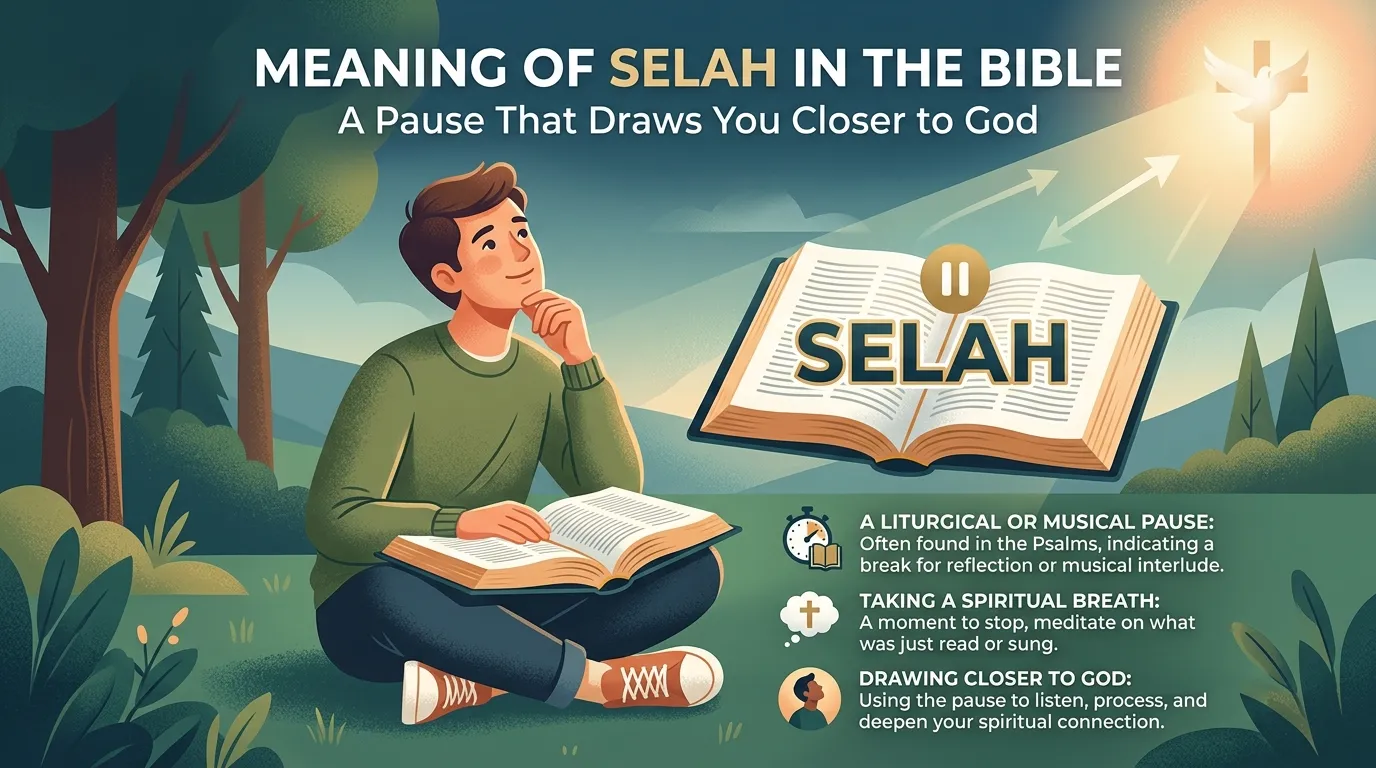
Here is a strange fact about your Bible: it contains a word that no translator has ever dared to translate. It appears seventy-four times in the Old Testament — seventy-one in the Psalms, three in Habakkuk — and in nearly every English version, from the King James to the most modern, it sits there in bare Hebrew: Selah. Translators who confidently render the most obscure Levitical rituals and the most tangled prophetic visions simply transliterate this one little word and move on, as if to say: we do not know, and we refuse to pretend.
That refusal is, in its way, magnificent. The Bible is full of mysteries it does not explain, and Selah may be the most honest of them — a word the church has preserved for three thousand years without fully understanding, like a sealed letter carried carefully from generation to generation. This article is about the mystery itself: what scholars think, why they disagree, and what the untranslated word teaches us about reading Scripture.
Seventy-Four Appearances, Zero Explanations
Begin with the data, because the data is genuinely odd. Selah appears in thirty-nine psalms — more than a quarter of the Psalter — and clusters in particular places: Psalms 3–7, the Korah psalms, the Asaph psalms, and notably at the ends of Books I, II, and III of the Psalms (Psalms 41, 72, 89). It also appears three times in Habakkuk 3, the prophet’s great psalm of trust. It never appears in narrative, law, or prophecy proper. It belongs exclusively to poetry meant to be sung or prayed aloud.
And the Bible never explains it. No psalm pauses to define it. No prophet decodes it. The ancient Targums — Aramaic paraphrases of the Hebrew Scriptures — mostly leave it alone too. This silence is itself evidence: whatever Selah meant, the original audience knew. It needed no explanation in its own time, the way a modern hymnal needs no footnote for “chorus” or “repeat.” The mystery exists only for us, the latecomers — which means the mystery is a window into how much of the Bible’s original lived context we have lost, and how faithfully the text preserves what it no longer explains.
The Scholars’ Best Guesses
For two centuries, biblical scholars have proposed theories, and intellectual honesty requires presenting them as theories — educated, serious, and inconclusive. Here are the leading candidates:
1. A musical direction: “pause” or “interlude.” This is the most popular view. Selah may have instructed the musicians to pause the singing while instruments played, or to lift the volume, or to change the accompaniment. Supporting evidence: the Septuagint (the ancient Greek translation, made when temple worship was still a living memory) renders Selah as diapsalma — “a musical interlude.” The clustering in sung psalms fits. The objection: it is still a guess about what kind of musical direction.
2. From the root “to lift up” (slh). Some scholars connect Selah to a Hebrew root meaning lift or exalt — a signal to lift the voices, lift the instruments, or lift the hands. The congregation, at the Selah, would physically raise something: pitch, volume, hands, hearts. This theory has the advantage of giving Selah active content rather than mere silence.
3. “Forever” or “amen.” A minority tradition, reflected in some ancient versions, treats Selah as an affirmation — the congregation’s “so be it” after a weighty declaration. When the psalmist proclaims “The Lord of hosts is with us; the God of Jacob is our fortress” (Psalm 46:11) and the text adds “Selah,” the people answer: amen. Forever. Yes.
4. A structural marker. A newer literary theory suggests Selah marks paragraph breaks or stanza divisions — the ancient equivalent of a section heading, showing where one movement of the psalm ends and another begins. Its appearance at the ends of Psalter books supports this: Selah as a canonical seam, stitching the collection together.
Notice what all four theories share: none of them can be proven, and all of them might be partly true. Selah may have begun as a musical term, accrued liturgical meaning, and ended as a structural marker — words do that over centuries. The scholarly disagreement is not a failure; it is the responsible result of limited evidence.
Selah as a Canonical Seam
The fourth theory deserves special attention, because it reframes the mystery entirely. Look at where Selah falls: at the end of Psalm 41 (closing Book I of the Psalter), Psalm 72 (closing Book II), and Psalm 89 (closing Book III). These are not random placements. They are the hinges of the collection — the places where an editor, assembling the Psalms into their final five-book form, marked the transitions.
If this is right, then Selah is doing something far more interesting than cueing musicians. It is a fingerprint of the Bible’s editors — evidence that the Psalter was deliberately arranged, not randomly accumulated. The five books of the Psalms mirror the five books of Moses; the Selahs at the seams are like the stitching on a well-made garment, visible only if you look closely. The mystery word becomes a clue to the canon’s architecture.
This also explains why Selah appears in Habakkuk 3: the prophet’s prayer is styled as a psalm — it even includes musical directions (“On my stringed instruments,” Habakkuk 3:19). Habakkuk is deliberately writing in the Psalter’s genre, Selah and all. The word is a genre signal: this is meant to be sung.
What the Translators’ Honesty Teaches Us
Step back from the theories and consider the meta-lesson, because it may be the most valuable thing Selah offers. The translators’ refusal to guess is a model of intellectual integrity. They could have picked the most popular theory and rendered every Selah as “pause” or “interlude.” Readers would never have known. Instead, across four centuries of English Bible translation, they preserved the mystery — transliterating what they could not translate, admitting ignorance in the text itself.
This is how Scripture wants to be handled. Not every question gets an answer; not every word yields its secret. Deuteronomy 29:29 stands over the whole enterprise: “The secret things belong to the Lord our God, but the things revealed belong to us.” Selah is one of the secret things — small, harmless, and instructive. It trains readers in the posture faith requires: confidence in what is clear, humility about what is not.
The opposite posture — the demand that every word be decoded, every mystery solved — is what produces the worst kinds of Bible teaching: the numerology that finds hidden codes in letter counts, the prophecy charts that claim certainty about dates, the preachers who announce “the Hebrew really says” with more confidence than the lexicons support. Selah rebukes all of that with a single untranslated syllable: some things we do not know, and that is fine.
Reading Around the Mystery
Does the uncertainty matter for faith? Remarkably little — and that is the final lesson. Whatever Selah precisely meant, its function is clear enough: it marks moments of weight in the psalms, places where the text itself says stop here, this matters. Whether the original congregation paused, lifted their voices, or turned a page, the effect on the modern reader is the same: Selah interrupts our hurry.
And that may be providential. A fully explained Selah — “musical interlude,” footnoted and filed — would be easy to skip. An unexplained Selah catches the eye, puzzles the reader, and forces the question the psalm wants asked: what was just said that deserves this marker? Look at the verse before any Selah and you will find something weighty: God’s protection (Psalm 46:7), answered prayer (Psalm 3:4), the folly of trusting riches (Psalm 52:7), the universal need for mercy (Habakkuk 3:9). The mystery is a highlighter. It points at the treasure without unwrapping it — and the treasure is always the verse beside it.
So the next time you meet Selah in your reading, do not be frustrated by the unknown. Be grateful for it. You are touching a word that temple choirs sang three thousand years ago, that translators preserved in honesty, that scholars debate in humility, and that still stops hurried readers in their tracks — a small sealed letter, still being carried, still doing its work. Pause at it. Wonder about it. Then read the verse it marks, slowly, as if hearing it for the first time — because in a very real sense, you are joining the congregation that first heard it, across three thousand years. That is what Selah has been asking readers to do all along — and on that, at least, everyone agrees.
For a compact survey of the etymological theories and the history of how different traditions have handled this untranslatable word, the Wikipedia article on Selah gathers the main views in one place for the curious; but the deepest response to the mystery is not research — it is reverence, the willingness to let one small word remain beautifully, instructively unknown.










