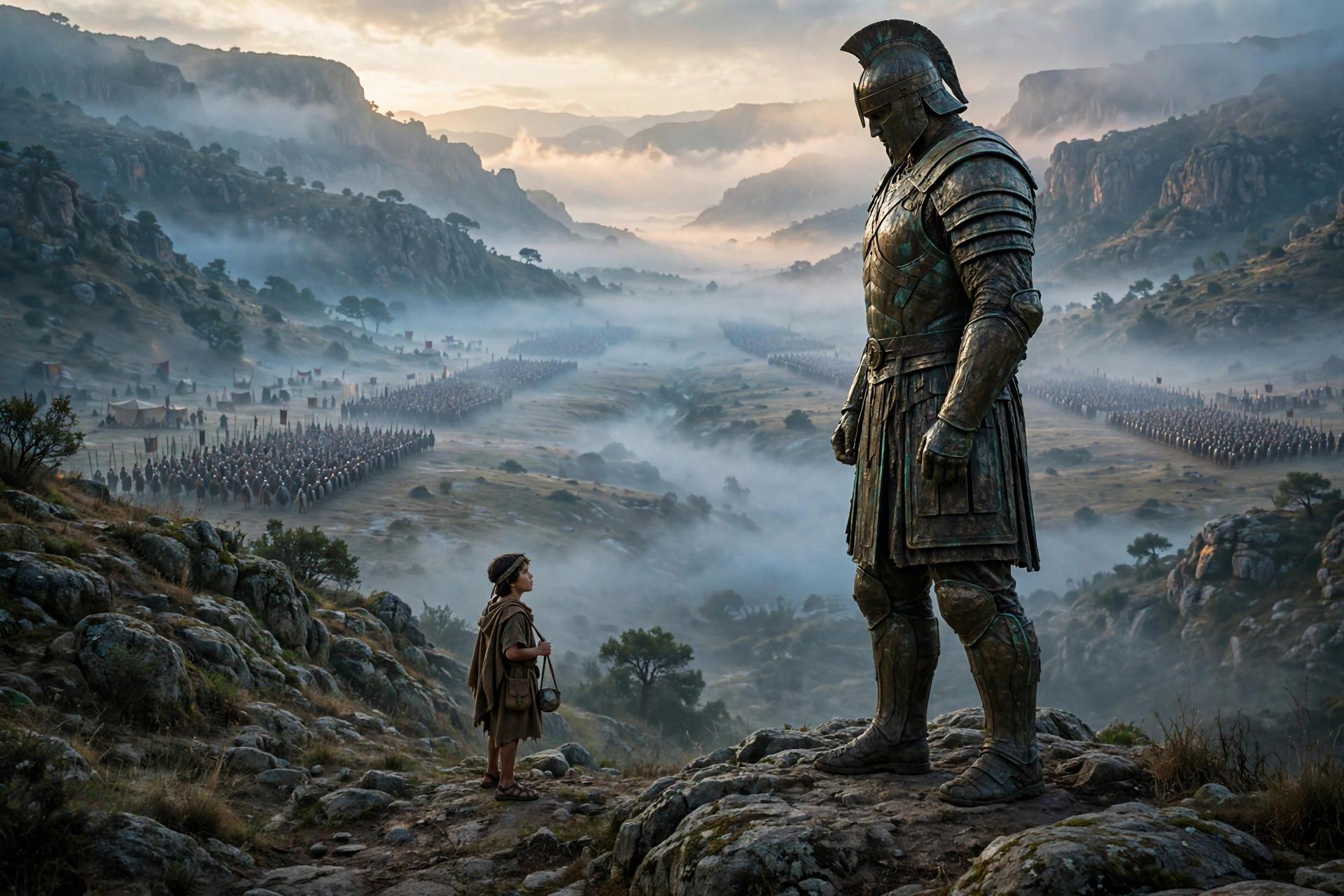
Two armies faced each other across the Valley of Elah, camped on opposite hillsides, and neither would charge. Every morning for forty days, a giant walked down into the gap between them. He stood nine feet tall in bronze armor that weighed more than a grown man, and he shouted the same challenge across the valley: send me a man to fight me, and if he kills me, we will be your servants — but if I kill him, you will be ours. The armies of Israel trembled. The giant’s name was Goliath, and he was a Philistine.
For nearly two centuries, the Philistines were Israel’s nightmare: a technologically advanced, militarily ruthless coastal people who seemed impossible to defeat. They appear in the stories of Samson, Samuel, Saul, and David. They humiliated Israel, captured the ark, and nearly strangled the young nation in its cradle. To understand Israel’s early history, you have to understand the Philistines — and to understand your own spiritual battles, you have to understand what the Philistines represent.
Sea People on Israel’s Doorstep
The Philistines were not native to Canaan. They were part of the mysterious “Sea Peoples” who swept across the eastern Mediterranean around 1200 BC, toppling empires. While Egypt repelled them at its borders, a group settled on the southern coastal plain of Canaan — the land that still carries their name. The Hebrew word for them is Pelishtim, and the word is related to the idea of invaders or migrants — they were, from Israel’s perspective, the newcomers who never left.
They organized themselves into a pentapolis, a league of five great cities: Gaza, Ashkelon, Ashdod, Ekron, and Gath (Joshua 13:3). Each city had its own lord, and the five lords acted together — a federation that made them far harder to defeat than a single kingdom would have been. They worshipped Dagon, a grain god depicted as half-man and half-fish, along with Baal-zebub at Ekron. And they held one advantage that made them nearly unbeatable: iron.
First Samuel 13:19–22 describes the stranglehold. There was no blacksmith in all Israel, because the Philistines had said, “Lest the Hebrews make swords or spears.” Israelites had to go down to Philistine smiths just to sharpen their plowshares and axes — and pay for the privilege. On the day of battle, we are told, “there was neither sword nor spear found in the hand of any of the people who were with Saul and Jonathan” (1 Samuel 13:22). Only the king and his son had weapons. Imagine going to war against an iron-armed professional army with farm tools. That was Israel’s reality for generations. The Philistines were not just enemies; they were a system of domination.
Forty Days of Taunting
The most famous Philistine is the most famous giant in literature. First Samuel 17 introduces Goliath of Gath with the loving detail of a sports commentator: six cubits and a span tall — over nine feet. A bronze helmet. A coat of mail weighing five thousand shekels — about 125 pounds. Bronze greaves on his legs. A spear “like a weaver’s beam,” its iron head weighing six hundred shekels. A shield-bearer walked in front of him. He was not just a warrior; he was a weapons platform.
For forty days he defied “the armies of the living God” (1 Samuel 17:26) — note the phrase, because it is the key to the whole story. Saul’s army saw a giant; they measured the armor and calculated the odds. David, arriving with cheese for his brothers, heard the same taunts and asked a different question: “Who is this uncircumcised Philistine, that he should defy the armies of the living God?” (1 Samuel 17:26). The issue was never the size of the giant. It was the honor of God.
David refused Saul’s armor — he had not tested it — and went down into the valley with a staff, a sling, and five smooth stones. Goliath despised him: “Am I a dog, that you come to me with sticks?” (1 Samuel 17:43). Then David preached the sermon of the battlefield:
“You come to me with a sword, with a spear, and with a javelin. But I come to you in the name of the LORD of hosts, the God of the armies of Israel, whom you have defied… For the battle is the LORD’s, and He will give you into our hands.” (1 Samuel 17:45, 47)
One stone, sunk in the giant’s forehead. David ran, stood on the Philistine, and cut off his head with Goliath’s own sword. The Philistine army fled, and Israel pursued them to the gates of Ekron. The forty days of taunting ended in an afternoon — not because Israel found a bigger warrior, but because a boy believed that the living God was bigger than the giant.
A Blind Prisoner and a Fallen Idol
But Goliath was not the first Philistine story, and the giant was not their only defeat. A generation earlier, God raised up Samson — a strongman with a tragic flaw — who fought the Philistines almost single-handedly. Samson killed a thousand Philistines with the jawbone of a donkey (Judges 15:15). He carried the gates of Gaza up a hill on his shoulders (Judges 16:3). He was a one-man army, and the Philistines could not stop him — until Delilah discovered the secret of his strength, and they shaved his head while he slept.
What followed is one of the darkest scenes in Scripture. The Philistines gouged out Samson’s eyes, bound him in bronze fetters, and made him grind grain in the prison at Gaza — doing the work of a donkey (Judges 16:21). They brought him out to entertain them at a feast for Dagon, their god, celebrating that their god had delivered Samson into their hands. And there, blind and mocked between the pillars of the temple, Samson prayed one last prayer: “O Lord GOD, remember me, I pray! Strengthen me, I pray, just this once” (Judges 16:28). He pushed the pillars apart, and the temple collapsed on three thousand Philistines. “So the dead that he killed at his death were more than he had killed in his life” (Judges 16:30).
The Philistines also learned what happens when you steal God’s glory. After capturing the ark of the covenant at Aphek, they set it in Dagon’s temple at Ashdod — as a trophy. The next morning, Dagon had fallen face-down before the ark. They set him back up. The morning after that, Dagon lay shattered on the threshold, his head and hands broken off (1 Samuel 5:4). Then tumors broke out on the people of Ashdod, then Gath, then Ekron — until the Philistine lords themselves voted to send the ark back to Israel with gold offerings (1 Samuel 6). Their god could not stand up in God’s presence, and their cities could not contain His judgment. The Philistines defeated Israel’s army, but they could not defeat Israel’s God.
The Real Giant
So what are the Philistines for — for us, today? Scripture never treats them as just ancient history. They are the Bible’s picture of entrenched, mocking, seemingly unbeatable opposition to God’s people. Every believer meets Philistines: the addiction that has iron weapons while you have farm tools. The cultural giant that stands in the valley every morning and shouts that your God is small. The compromise that starts as coexistence on the coastal plain and ends as domination.
Notice the pattern in every Philistine story: God’s people win when they stop measuring the giant and start magnifying God. Saul’s army measured armor for forty days and never moved. David measured God and moved in an afternoon. Israel measured Philistine iron and lived in fear; Jonathan — remember him? — climbed a cliff with only his armor-bearer and routed a garrison, saying, “nothing restrains the LORD from saving by many or by few” (1 Samuel 14:6). The math of faith is different from the math of fear.
And notice the warning in Samson. The Philistines did not defeat him in battle; they defeated him in the lap of Delilah, one compromise at a time. Giants are sometimes slain with stones, and sometimes they win by seduction. The Philistines teach us both lessons: face the giant in God’s name, and never make peace with the valley the giant came from.
The Philistines mocked the living God for two hundred years. Their five cities are ruins. Their gods are museum pieces — Dagon with his head broken off, exactly as 1 Samuel 5 left him. And the God they defied is worshipped by billions. That is the final score of every war against heaven.
Two Common Questions
Who were the Philistines, historically?
The Philistines were a Sea Peoples group, likely of Aegean origin, who settled on Canaan’s southern coast around 1200 BC. Archaeology confirms their distinct culture — their pottery, architecture, and diet differed from the Canaanites around them. They organized into five city-states (Gaza, Ashkelon, Ashdod, Ekron, Gath), mastered ironworking before Israel did, and dominated the coastal plain through the era of the judges and early monarchy. The name “Palestine” derives from them, via the Roman renaming of Judea — though the modern region’s people are not their direct descendants.
What happened to the Philistines?
They faded as a distinct people. David broke their military dominance (2 Samuel 5; 8:1), reducing them to vassals. Later, the Assyrian and then Babylonian conquests devastated their cities; Nebuchadnezzar’s campaigns in the early 500s BC effectively ended Philistine independence, and they were absorbed into the surrounding populations. By the Persian period, the Philistines as a distinct ethnic group had disappeared from history — a quiet end for a people who once terrified a nation.
From the Valley of Elah to the temple of Dagon, the Philistines’ story is the story of every power that sets itself against the living God: loud in the morning, silent by evening. They had the iron, the giants, and the gods — and Israel had the LORD of hosts. That was enough then, and it is enough now. For background on who the Philistines were historically, see the Wikipedia article on the Philistines.










