You’re stopped at a red light on the edge of a parking lot. A man holds a cardboard sign: ANYTHING HELPS. GOD BLESS. Your window is up. Your wallet is in your pocket. And in the space of ten seconds, your conscience runs through every argument you’ve ever heard: Give, because Jesus said so. Don’t give, because he’ll spend it wrong. Give to the shelter instead. Don’t give at all — the light is about to change. The light changes. You drive on. And you wonder, all the way home: what does God actually want me to do?
It is one of the most practical questions a Christian can ask, and the Bible answers it at extraordinary length. Helping the poor is not a minor theme in Scripture — it is one of the major ones. If you want to know whether you got the parking-lot question right, you have to hear the whole Bible on the subject first.
More Than Two Thousand Verses
Scholars have counted: the Bible contains well over two thousand verses about the poor, poverty, justice, and generosity. That is not a footnote; that is a drumbeat. And it starts in the Law, where God built care for the poor into the economic system of Israel itself.
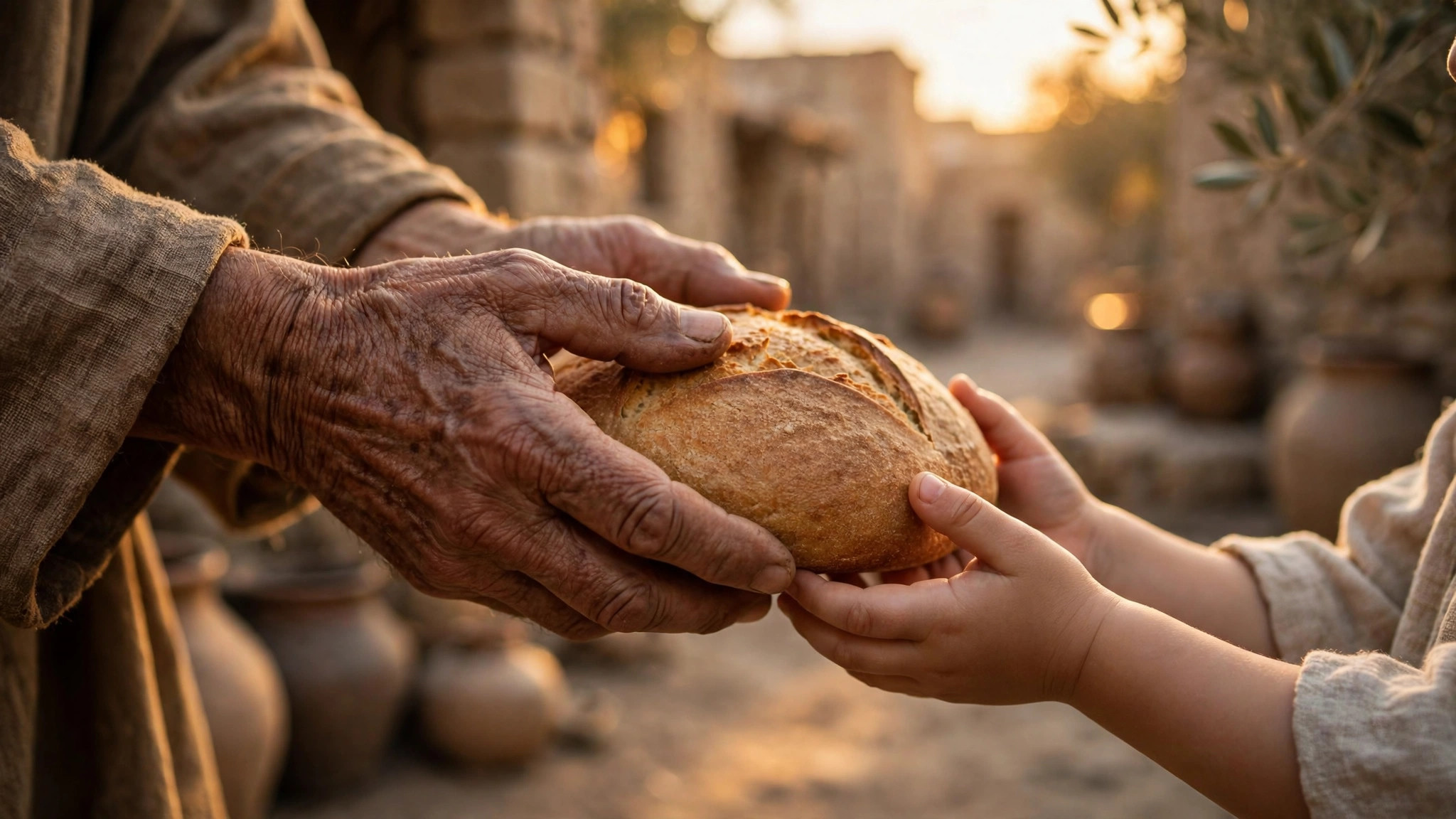
Leviticus 19:9–10 commanded farmers: when you reap your harvest, do not reap to the very edges of your field, and do not gather the fallen grapes of your vineyard. Leave them for the poor and the stranger. This was gleaning — the welfare system of ancient Israel, built on dignity rather than handouts. The poor worked for their food; they gathered what the harvesters deliberately left behind. Boaz obeyed this law extravagantly when he told his men to let handfuls of grain fall on purpose for Ruth (Ruth 2:16) — and that act of obedience wove a Moabite widow into the family line of King David, and of Christ.
Deuteronomy went further. Every seventh year, debts were to be released (Deuteronomy 15:1–2). Every fiftieth year, the Jubilee returned land to its original families so poverty could never become permanent and hereditary (Leviticus 25). And Deuteronomy 15:11 gave the reason the system could never be retired: “For the poor will never cease from the land; therefore I command you, saying, ‘You shall open your hand wide to your brother, to your poor and your needy, in your land.’” God did not promise to eliminate poverty in this age. He promised to hold His people accountable for how they treat the poor within it.
The Law’s message is unmistakable: in God’s economy, generosity is not charity — it is obedience. The edges of the field belonged to the poor by divine right, not by the farmer’s mood.
The Prophets’ Report Card
When Israel grew rich and forgot the edges of the field, God sent the prophets — and their report card was devastating. The prophets measured Israel’s spiritual health by exactly one metric: how the nation treated its poor.
Isaiah opened his book with God’s verdict on empty religion: “Learn to do good; seek justice, rebuke the oppressor; defend the fatherless, plead for the widow” (Isaiah 1:17). Later, when the people complained that their fasting wasn’t working, God told them why: true fasting is “to share your bread with the hungry, and that you bring to your house the poor who are cast out” (Isaiah 58:7). Worship without justice, Isaiah says, is noise.
Amos was blunter. He was a shepherd from Tekoa, no professional prophet, and God sent him north to confront a booming economy built on exploitation: “They sell the righteous for silver, and the poor for a pair of sandals” (Amos 2:6). The wealthy of Samaria lounged on ivory beds while the poor were crushed at the gate — and Amos warned that judgment was coming precisely because of it. His most famous line is a demand, not a suggestion: “Let justice run down like water, and righteousness like a mighty stream” (Amos 5:24).
The prophets’ logic never changes: you cannot claim to love a God you cannot see while despising the poor you can see. How a nation — and a church, and a person — treats its most vulnerable members is the truest measure of its religion.
“You Did It for Me”
Then Jesus came, and He made it personal. In the most sobering passage He ever spoke about judgment — Matthew 25:31–46 — the King separates the nations the way a shepherd separates sheep from goats, and the criterion shocks everyone: what did you do for the hungry, the thirsty, the stranger, the naked, the sick, the prisoner?
“Assuredly, I say to you, inasmuch as you did it to one of the least of these My brethren, you did it to Me.” (Matthew 25:40)
Read that slowly. Jesus identifies Himself with the poor so completely that how we treat them is how we treat Him. The man with the cardboard sign at the red light is not an interruption of your Christian life. According to Matthew 25, he may be the examination.
Jesus lived this, not just preached it. He touched lepers. He ate with tax collectors. He told the parable of the Good Samaritan — in which the hero is the religious outsider who stops, binds wounds, pays the innkeeper, and promises to return — as the direct answer to the question “who is my neighbor?” (Luke 10:29–37). And He warned the rich young ruler that his wealth was the one thing standing between him and the kingdom (Mark 10:21–22). Jesus was not neutral about money. He talked about it constantly, because He knew what it does to the human heart.
The Church That Had No Poor
The first Christians took Jesus at His word — literally. Acts 4 describes a community so generous that Luke can write, without exaggeration for effect: “Nor was there anyone among them who lacked” (Acts 4:34). Those who owned lands or houses sold them and laid the proceeds at the apostles’ feet, and distribution was made “to each as anyone had need” (Acts 4:35). The church’s first internal crisis was about making sure widows were not neglected in the daily distribution (Acts 6:1) — and the apostles treated it as important enough to restructure leadership over.
Paul carried the same charge across the empire. When the Jerusalem leaders gave him the right hand of fellowship, they added one request: “that we should remember the poor” — and Paul adds, “the very thing which I also was eager to do” (Galatians 2:10). His great collection for the saints in Jerusalem (1 Corinthians 16; 2 Corinthians 8–9) was not a side project; it was the proof of the gospel’s power to cross ethnic and economic lines. And his theology of giving is the New Testament’s: “God loves a cheerful giver” (2 Corinthians 9:7) — not a guilty giver, not a coerced giver, a cheerful one.
The early church did not end poverty. But wherever the gospel took root, the poor were noticed, fed, and honored — and the watching world noticed too. The church that had no poor among it became the church the empire could not ignore.
When Generosity Gets Complicated
But honesty requires the other half of the story. The Bible commands generosity and wisdom, and wisdom sometimes says: not this way, not this time. Generosity without discernment can feed the very bondage it wants to break.
Paul wrote to the Thessalonians, where some believers had quit working and were living off others’ charity while waiting for Christ’s return: “If anyone will not work, neither shall he eat” (2 Thessalonians 3:10). That is not cruelty; it is clarity. The Bible distinguishes between those who cannot help themselves — widows, orphans, the disabled, the victims of disaster — and those who will not. True compassion helps the first group freely and challenges the second group toward responsibility. Enabling addiction or idleness is not love; it is laziness dressed as mercy.
And here is the balance the Hebrew Scriptures held for centuries. The Hebrew word tzedakah — usually translated “charity” or “righteousness” — literally means justice. Giving to the poor was not considered generosity in the modern sense; it was considered doing what is right. But the rabbis also taught that the highest form of tzedakah is helping someone become self-sufficient — a job, a loan, a partnership — so they no longer need charity at all. The goal was never dependency. The goal was dignity.
So what about the man at the red light? Scripture gives you principles, not a script: give cheerfully and generously (2 Corinthians 9:7); give wisely, preferring help that restores over help that merely sustains (tzedakah’s highest form); support the poor through your church’s organized mercy (Acts 6); and never let the complexity become an excuse for doing nothing (James 2:15–16 — “Depart in peace, be warmed and filled” without giving what the body needs is dead faith). And remember the widow with her two mites (Mark 12:41–44): Jesus praised her giving precisely because she was poor. Poverty exempts no one from generosity — it just changes the amount.
What People Ask About Helping the Poor
Am I supposed to give to everyone who asks?
Jesus said, “Give to him who asks you” (Matthew 5:42), and that command should weigh heavily on us. But the whole counsel of Scripture adds wisdom to willingness: give generously, but give thoughtfully. You are not obligated to fund someone’s self-destruction, and you are free to give in forms wiser than cash — food, time, a ride, a connection to help. The command is to have an open hand, not an empty head.
Is it better to give cash to homeless people or help another way?
There is no single biblical answer, because the Bible predates the question. What Scripture does teach: direct, personal mercy is precious (the Good Samaritan gave his own time and money, Luke 10:33–35), and organized, accountable mercy is also biblical (the daily distribution to widows, Acts 6:1–3). Many Christians do both — carry gift cards or care kits for the street, and give substantially through their church and trusted ministries for the long work. Either way, the goal of tzedakah is restoration: help that moves a person toward stability, not just survival.
What if I am poor myself?
Then you are in good company — including the widow Jesus praised above all the rich donors in the temple (Mark 12:41–44), and the Macedonian churches, who gave “beyond their ability” out of “deep poverty” (2 Corinthians 8:2–3). God measures giving by sacrifice, not size. And poverty does not disqualify you from the other half of mercy: time, prayer, presence, advocacy, and the dignity of treating poor neighbors as equals rather than projects.
Does helping the poor earn salvation?
No — and this matters enormously. We are saved by grace through faith, not by works (Ephesians 2:8–9). But James insists that faith without works is dead (James 2:17), and Jesus makes care for “the least of these” the evidence examined at judgment (Matthew 25:31–46). Good works do not purchase salvation; they prove it. A heart transformed by grace will have open hands. If the hands stay closed, James says, question the transformation — not the doctrine, the heart.
Back at the red light, the sign still says ANYTHING HELPS. GOD BLESS. The Bible’s answer is not a formula but a formed character: a person whose field has edges left for the poor, whose worship includes justice, who sees Christ in the least of these, whose church has no one lacking, and whose generosity is wise enough to restore rather than merely relieve. Be that person, and the ten seconds at the red light will take care of themselves. For more on how churches have cared for the poor through history, see the Wikipedia article on Christianity and poverty.










