You have seen it on the back of a car: a simple outline of a fish, sometimes with a name inside it. It is one of the oldest Christian symbols in existence — older than the cross as a public emblem, older than church buildings, older than Christian art of any kind. It was drawn in the dust by persecuted believers, carved into the walls of catacombs, and stamped onto seals. But the fish was never about fish. It was a code, a confession, and a summary of the gospel — all in a single Greek word.
A Code in Five Letters
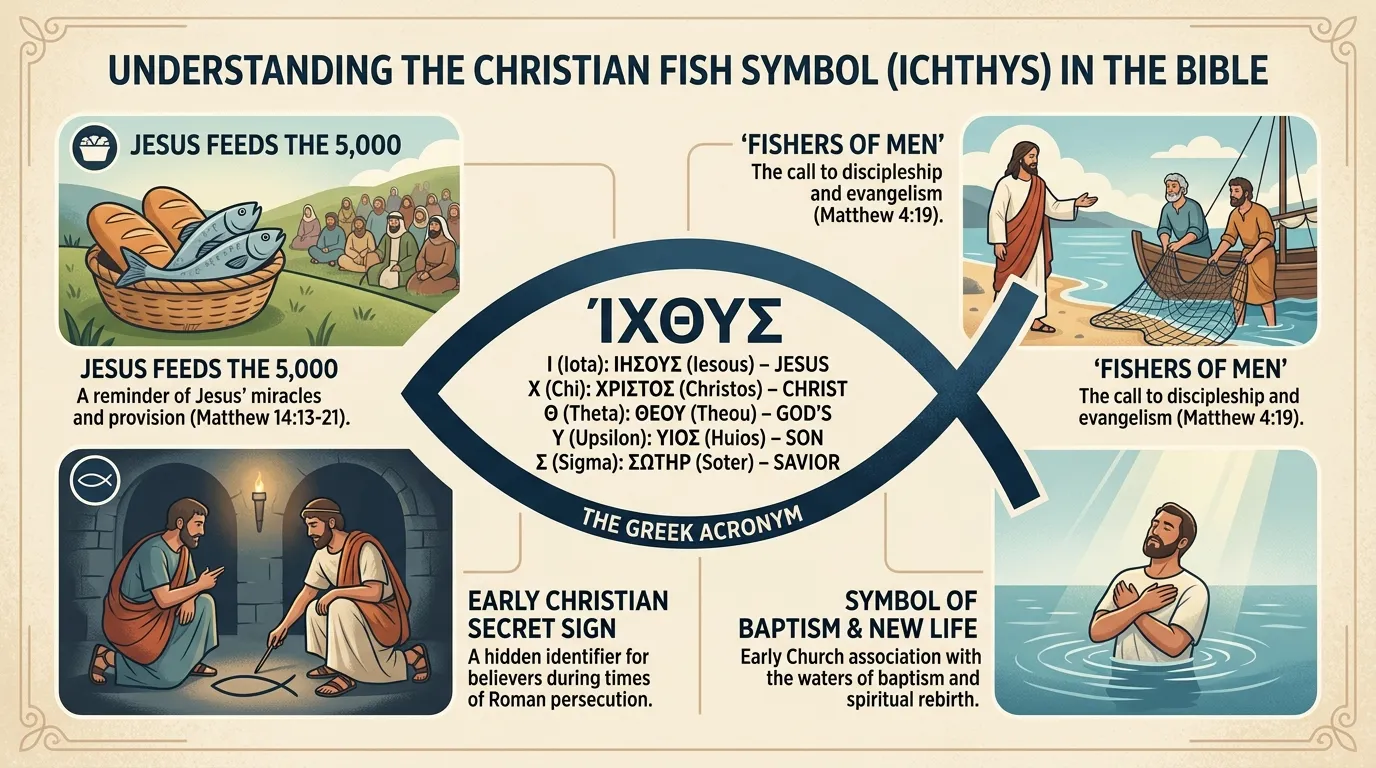
The Greek word for fish is ichthys — ΙΧΘΥΣ. In the early church, each letter of that word became the first letter of a phrase: Iesous Christos Theou Yios Soter — “Jesus Christ, Son of God, Savior.” The fish was an acrostic, a creed you could draw with a single stroke in the sand.
Tradition holds that the symbol served as a secret sign during persecution. One believer would draw an arc in the dust; if the other person completed the fish, they knew they had found a fellow Christian. Whether every detail of that story is historical, the function is clear: in a world where openly declaring “Jesus is Lord” could get you killed, the fish let Christians identify one another without words. It was a whisper of a confession in a hostile empire.
It is important to be precise about what the fish is and is not. The Bible never commands Christians to use a fish symbol. The acrostic does not appear in Scripture. The symbol is a product of the early church’s creativity, not a biblical ordinance. But everything the symbol says is biblical. Jesus Christ, Son of God, Savior — that is the gospel in five words.
Why Fish? Five Stories
The fish was not chosen at random. Fish swim through the story of Jesus’ ministry from beginning to end.
The call. Jesus found Simon Peter and Andrew casting nets into the Sea of Galilee. “Follow me,” He said, “and I will make you fishers of men” (Matthew 4:19). The first disciples were fishermen, and their new trade was catching people — not by force, but by the gospel. The fish became the sign of the mission.
The catch. In Luke 5, Peter fished all night and caught nothing. At Jesus’ word he let down the nets again, and they caught so many fish the nets began to break. Peter’s response was not excitement but conviction of sin: “Depart from me, for I am a sinful man, O Lord” (Luke 5:8). The fish became the sign of what happens when human effort meets divine command — abundance, and a revelation of who Jesus is.
The feeding. With five loaves and two fish, Jesus fed five thousand people (Matthew 14:13–21). The smallest offering in the crowd became, in His hands, more than enough. The fish became the sign of God’s provision — that what we bring to Jesus, however small, is enough when He blesses it.
The coin. When the temple tax collectors asked whether Jesus paid the tax, He sent Peter fishing — and Peter found a coin in the mouth of the first fish he caught, enough to pay for them both (Matthew 17:24–27). The fish became the sign of God’s care for the ordinary obligations of life, and of Jesus’ quiet authority over creation.
The breakfast. After the resurrection, Jesus stood on the shore of Galilee and cooked breakfast for His disciples — fish over a charcoal fire (John 21:9–13). The risen Christ, the Lord of the universe, served grilled fish to tired fishermen. The fish became the sign that the resurrection is not an escape from the physical world but a redemption of it — and that the risen Lord cares about hungry people.
There is one more fish worth mentioning, from the Old Testament: the great fish that swallowed Jonah. Jesus Himself drew the connection: “For just as Jonah was three days and three nights in the belly of the great fish, so will the Son of Man be three days and three nights in the heart of the earth” (Matthew 12:40). The fish became a sign of death and resurrection — of being swallowed by darkness and delivered by God.
What the Fish Meant to the Early Church
The early Christians used the fish in ways that show how central it was. It appears in the catacombs of Rome, carved on tombs. It appears on seals, rings, and lamps. The fish on a tomb was a statement: this person believed in Jesus Christ, Son of God, Savior, and therefore death was not the end.
Water also connected the fish to baptism. Just as fish live in water, Christians are born of water and the Spirit. Tertullian, writing around AD 200, made the connection explicit: “We, little fishes, after the example of our Fish, Jesus Christ, are born in water.” The fish was not merely a logo. It was a theology of belonging: we live in the water of baptism, we follow the Fish who saved us, and we bear His name.
The fish also carried a quiet protest. The Roman world had its own symbols of power — the eagle, the laurel, the emperor’s image. Christians chose a fish: the humblest of creatures, the food of the poor, the trade of Galilean peasants. The empire’s symbol was a bird of prey. The church’s symbol was its prey. The contrast was the point. The gospel does not conquer the way empires conquer.
The Fish Today
The fish endures, on cars and necklaces and church signs, because it still does what it always did: it says, quietly, “I belong to Jesus.” But the same caution that applied to every symbol applies here. The fish has no power. It does not protect the car it is stuck to. It does not make its wearer holier. It is a reminder and a witness — a way of saying to a watching world, “Jesus Christ, Son of God, Savior,” without saying a word. The power is in the Person the fish points to, not in the fish itself.
And the mission the fish stands for has not changed. The first disciples were fishers of men. The symbol on the bumper is a reminder that the calling is still open — to follow the Fish, to be caught by His grace, and to help others be caught too.
The Fish in the Catacombs
The catacombs of Rome — the underground burial tunnels where early Christians laid their dead — are the best evidence for how the fish was used. The walls are covered with Christian art: fish, anchors, doves, loaves and fishes, the Good Shepherd. The fish appears on tombs, on lamps, on seals. One famous epitaph, the inscription of Abercius, a second-century bishop, describes the believer as a fish caught by the great Fish. The imagery was everywhere because the confession was everywhere.
The anchor often appears beside the fish, and the pairing is meaningful. The fish says, “Jesus Christ, Son of God, Savior.” The anchor says, “Hope holds.” Together they declare the gospel and its result: the Savior has come, and the hope He gives is sure. The early Christians, who lived under the threat of persecution and the certainty of death, decorated their tombs with hope. They did not carve skulls or scenes of mourning. They carved fish and anchors — the signs of a Savior and a hope that death could not touch.
The catacomb art also shows what the early church valued. The fish appears far more often than the cross. The cross did not become a common Christian symbol until the fourth century, after Constantine ended the persecution. Before that, the cross was too shameful — too associated with the empire’s most humiliating form of execution — to be displayed openly. The fish was the church’s public symbol precisely because it was discreet. It confessed the gospel without advertising the manner of the death. The cross would later become the church’s central emblem, but the fish was first — the symbol of a church that confessed its Savior in whispers before it could proclaim Him in shouts.
Fishers of Men: The Mission Behind the Symbol
The fish was never only a badge of identity. It was a reminder of a mission. When Jesus called the fishermen, He did not say, “Follow me, and I will make you theologians.” He said, “I will make you fishers of men.” The symbol on the wall was a job description. Every Christian who drew the fish was saying, “I am a fisher of men. I am part of the mission.”
That mission is the reason the fish still matters. The symbol is not a tribal marker — a way for Christians to recognize each other and ignore everyone else. It is a net. It exists to catch people, not to exclude them. The first disciples left their nets to follow Jesus, and then they spent their lives casting a different kind of net — the gospel — into the sea of the world. The fish on the car is a quiet way of saying, “I have been caught, and I am casting the net.” A fish symbol that never leads to a conversation about Jesus has forgotten what it stands for. The symbol’s power is not in the shape. It is in the mission the shape represents — the mission of a Savior who came to seek and save the lost, and who calls His people to do the same.
For the history of the symbol in early Christian art and usage, see the article on Ichthys.