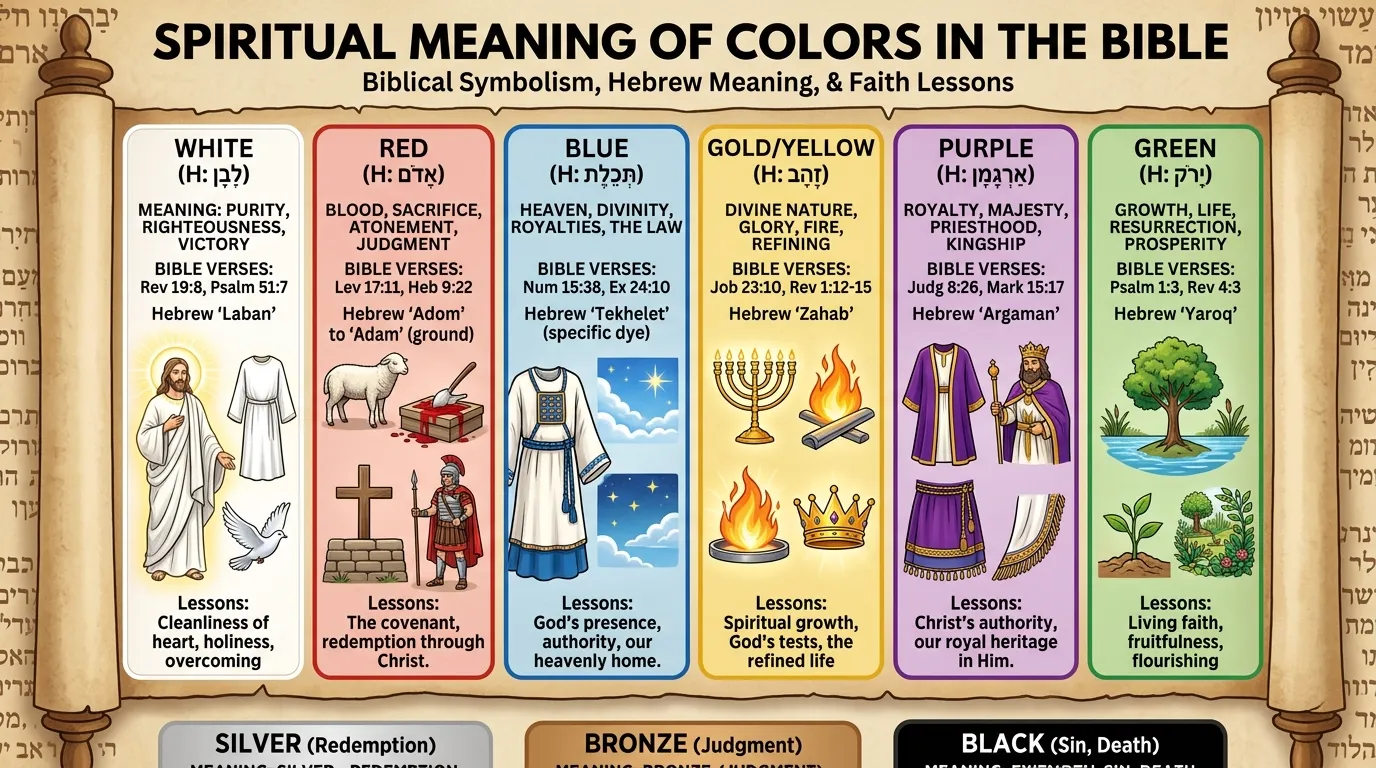
In Exodus 35, Moses issues one of the strangest supply lists in ancient literature. For the tabernacle — God’s portable dwelling — the people are to bring gold and silver, yes, but also “blue, and purple, and scarlet, and fine linen, and goats’ hair” (Exodus 35:6). Dyes. Thread. Color. The God who spoke galaxies into being cares about the color scheme of His tent.
He cares because in Scripture, color is never just decoration. Every hue in the tabernacle, every garment, every vision is dyed with meaning. To read the Bible’s colors is to learn a second language — one God has been speaking since the first rainbow.
Blue: The Color of Heaven
The Hebrew word is tekhelet — a rich blue-purple dye extracted, at enormous cost, from sea snails. It was the color of royalty and of the sky, and God drapes His dwelling in it. The tabernacle’s curtains, the veil, the high priest’s robe — all blue (Exodus 26:1; 28:31).
The most telling use is in Numbers 15:38: every Israelite is commanded to put a cord of blue in the tassels of his garment, “that ye may look upon it, and remember all the commandments of the LORD.” Blue was a wearable reminder — a thread of heaven tied to an earthly robe. Every glance downward was supposed to lift the eyes upward.
In the visions, blue keeps its heavenly association. Ezekiel sees above the cherubim “a sapphire stone” throne (Ezekiel 1:26), and the pavement under God’s feet at Sinai is “as it were a paved work of a sapphire stone” (Exodus 24:10). Blue is the color of the throne room — transcendence you can see.
Purple: The Color of Kingship
Purple dye — from the same costly murex snails — was worth more than gold by weight. It clothed kings and marked authority. The tabernacle curtains include it (Exodus 26:1); the high priest’s ephod is woven with it (Exodus 28:6).
The gospels weaponize the color. When the soldiers mock Jesus, they throw “a purple robe” on Him (Mark 15:17) — a cruel joke, crowning a supposed king with the color of kings. The irony is the sermon: the robe is mockery, but the kingship is real. “Thou sayest that I am a king,” Jesus tells Pilate. “To this end was I born” (John 18:37).
Lydia, the first European convert, is “a seller of purple” from Thyatira (Acts 16:14) — a wealthy businesswoman in the luxury trade, whose open heart and open home become the beachhead of the gospel in Philippi. Purple meets grace, and commerce becomes mission.
Scarlet and Crimson: The Color of Sin — and of Atonement
Here is the Bible’s boldest color paradox. Scarlet is the color of guilt: “though your sins be as scarlet, they shall be as white as snow; though they be red like crimson, they shall be as wool” (Isaiah 1:18). The dye was made from crushed worms — the Hebrew tola’at shani, “worm scarlet” — and it stained permanently. Sin, Isaiah says, dyes you.
Yet the same scarlet runs through the tabernacle curtains and the priestly garments (Exodus 26:1; 28:6). And on the Day of Atonement, a scarlet thread is tied to the scapegoat (tradition; cf. Leviticus 16). How can the color of sin be the color of the sanctuary?
Because scarlet is also the color of blood — and blood is the color of atonement. “Without shedding of blood is no remission” (Hebrews 9:22). The scarlet in the veil whispers what the torn veil would one day shout: sin is scarlet, but the remedy is scarlet too. The dye of guilt becomes, in God’s hands, the dye of grace.
White: The Color of Purity and Victory
White needs no translation. At the Transfiguration, Jesus’ garments become “white as the light” (Matthew 17:2). The risen Christ in Revelation wears hair “white like wool, as white as snow” (Revelation 1:14). The redeemed stand “clothed with white robes” (Revelation 7:9), and the white has a source: they “washed their robes, and made them white in the blood of the Lamb” (Revelation 7:14) — the Bible’s most impossible laundry.
White is also the color of honest counsel: “Buy of me… white raiment, that thou mayest be clothed, and that the shame of thy nakedness do not appear” (Revelation 3:18). And of resurrection hope — the angel at the tomb wears “raiment white as snow” (Matthew 28:3). Wherever God shows His holiness or His victory, white appears.
Red, Green, Black: The Rest of the Palette
Red in its earthy form speaks of humanity and war. Adam’s name connects to adamah (ground) and adom (red) — man is the red earth creature. Esau, “red and hairy,” becomes Edom — “Red” (Genesis 25:25, 30). The red horse of Revelation 6:4 takes peace from the earth. Red is the color of flesh, of blood spilled in violence as opposed to blood shed in atonement.
Green is the color of life and flourishing. The righteous are “like a tree planted by the rivers of water” with leaves that do not wither (Psalm 1:3). Joseph is “a fruitful bough” (Genesis 49:22). When Revelation describes the new creation, the tree of life’s leaves are “for the healing of the nations” (Revelation 22:2) — green as medicine.
Black is famine and mourning: the black horse carries scales of scarcity (Revelation 6:5), and sackcloth — the garment of grief — darkens the sun in Joel’s prophecy (Joel 2:31, cf. Revelation 6:12). Gold, though a material more than a dye, is glory throughout: the mercy seat, the lampstand, the streets of the New Jerusalem “pure gold, as it were transparent glass” (Revelation 21:21).
The Rainbow: God’s First Color Sermon
Before the tabernacle, before the priestly garments, before any dye — there was the rainbow. After the flood, God sets His bow in the cloud: “I do set my bow in the cloud, and it shall be for a token of a covenant between me and the earth” (Genesis 9:13). The first color sermon in Scripture is preached not in thread but in light.
Consider the details. The bow is a war bow — and God hangs it up, pointed away from the earth. The weapon of judgment becomes the emblem of mercy; the instrument of war becomes the sign of peace. Every rainbow since is God saying: I have laid down My arms. “And the bow shall be in the cloud; and I will look upon it, that I may remember the everlasting covenant” (Genesis 9:16) — God binds Himself with color, giving His own memory a visible reminder.
The rainbow reappears at both ends of the biblical story’s visions of God. Ezekiel sees “as the appearance of the bow that is in the cloud in the day of rain, so was the appearance of the brightness round about” the throne (Ezekiel 1:28) — and falls on his face. John sees “a rainbow round about the throne, in sight like unto an emerald” (Revelation 4:3). Judgment remembered, mercy enthroned: the God of the flood is the God of the throne, and His color is covenant faithfulness.
Every color in Scripture, from Eden’s bow to the New Jerusalem’s jeweled foundations (Revelation 21:19-20), speaks this same language: God does not merely use color; He is the author of the spectrum, and He preaches in it.
Wearing the Colors: The High Priest’s Garments
The tabernacle’s colors did not stay on curtains — they were worn. The high priest’s ephod was woven of “gold, and blue, and purple, and scarlet, and fine twined linen” (Exodus 28:6): heaven (blue), kingship (purple), atonement (scarlet), purity (white linen), glory (gold) — the whole gospel, tailored. Over his heart he bore the breastplate with twelve stones, one for each tribe: the people’s names, carried in color and jewel, “upon his heart… continually” (Exodus 28:29).
On his forehead, a gold plate engraved “HOLINESS TO THE LORD” (Exodus 28:36). Color upon color, all of it representative: the priest goes into God’s presence carrying the people and wearing holiness. It is a wearable prophecy of Christ, our great High Priest, who bears our names before the Father (Hebrews 7:25) and clothes us in His own righteousness — “that we might be made the righteousness of God in him” (2 Corinthians 5:21). The colors were never decoration. They were doctrine you could see.
Reading the Palette
Three principles keep this study honest. First, context rules: red can mean atonement (scarlet thread) or violence (red horse) depending on the passage — never flatten a color into a single code. Second, Scripture interprets Scripture: Isaiah tells you what scarlet means; do not import meanings from dream dictionaries. Third, the colors point to Christ: blue heaven come down, purple kingship mocked and vindicated, scarlet sin answered by scarlet blood, white resurrection.
God could have built a gray tabernacle. He chose blue, purple, and scarlet — heaven, kingship, and atonement woven together, the whole gospel in thread. The next time you read of a color in Scripture, stop and ask what the Dyer is saying. He rarely wastes pigment. For the fascinating material history behind the Bible’s most precious dye, the Wikipedia article on tekhelet traces the blue of the tabernacle from sea snail to modern revival — a reminder that every thread in God’s tent was deliberate.










