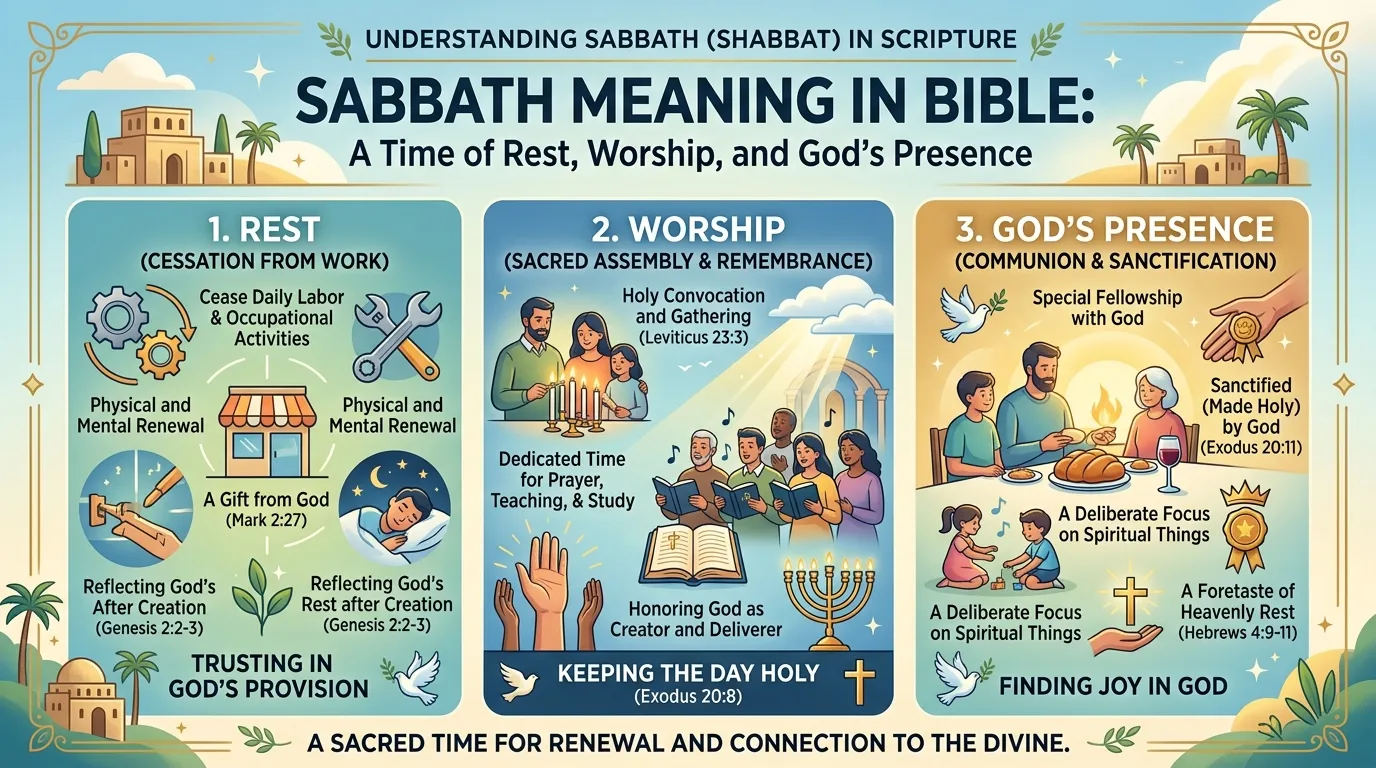
On Friday evening, as the sun drops, something ancient happens in Jewish homes around the world: candles are lit, bread is covered, and a day begins — not with work, but with rest. For three thousand years, the Sabbath has been God’s standing appointment with His people: twenty-four hours in seven that belong to Him, a weekly rehearsal of what it means to stop.
The Hebrew word is shabbat, from the verb shavat — to cease, to stop, to rest. It is not primarily about worship services or rules. It is about stopping. And in a world that monetizes every waking hour, stopping may be the most countercultural thing a believer can do.
It Started Before Sinai
The Sabbath predates the Ten Commandments by centuries. Genesis 2:2-3 records that “on the seventh day God ended his work which he had made; and he rested on the seventh day from all his work… and God blessed the seventh day, and sanctified it.” God was not tired — “the Creator of the ends of the earth fainteth not, neither is weary” (Isaiah 40:28). He rested as a pattern, building rhythm into the fabric of creation itself.
Then, before the law is even given, comes the manna lesson. In Exodus 16, God feeds Israel with daily bread from heaven — but with Sabbath instructions: gather double on the sixth day, gather nothing on the seventh. Some go out anyway on the seventh day and find nothing, and God’s response is instructive: “How long refuse ye to keep my commandments and my laws?” (Exodus 16:28). The Sabbath was already a command before Sinai; Sinai engraved what God had already been teaching.
The lesson of the manna is the lesson of the Sabbath in miniature: you can stop, because God provides. The double portion on Friday was God’s way of saying, “Rest — I’ve got tomorrow covered.” Every Sabbath since has been an acted-out trust fall.
The Commandment and Its Reasons
“Remember the sabbath day, to keep it holy. Six days shalt thou labour, and do all thy work: but the seventh day is the sabbath of the LORD thy God” (Exodus 20:8-10). Of the ten commandments, this is the longest — and the only one framed as remembering something already known.
Scripture gives the commandment two foundations. In Exodus 20:11, the reason is creation: “for in six days the LORD made heaven and earth… and rested the seventh day.” In Deuteronomy 5:15, the reason is redemption: “remember that thou wast a servant in the land of Egypt, and that the LORD thy God brought thee out thence.” The Sabbath looks backward to how the world was made and to how Israel was freed — rest as a memorial of both creation and liberation.
Notice who rests: “thou, nor thy son, nor thy daughter, thy manservant, nor thy maidservant, nor thy cattle, nor thy stranger that is within thy gates” (Exodus 20:10). The Sabbath was ancient labor law — the slave, the foreigner, even the animal gets the day. In a world where rest was a luxury of the powerful, God made it a right of the powerless.
Jesus and the Sabbath Controversies
By Jesus’ day, the Sabbath had been fenced with hundreds of human regulations — how far you could walk, what counted as work, whether you could heal. Jesus does not abolish the Sabbath; He liberates it, repeatedly and deliberately on the Sabbath day itself.
When His disciples pluck grain on the Sabbath, He answers the Pharisees: “The sabbath was made for man, and not man for the sabbath: therefore the Son of man is Lord also of the sabbath” (Mark 2:27-28). That sentence reframes everything. The Sabbath is a gift made for human flourishing, not a burden made for human crushing — and Jesus claims authority to interpret it.
He heals on the Sabbath — the man with the withered hand (Mark 3:1-5), the bent-over woman (Luke 13:10-16), the man at Bethesda (John 5:1-9) — and each healing is a sermon: the Sabbath is for restoration. “Is it lawful to do good on the sabbath days, or to do evil? to save life, or to kill?” (Mark 3:4). To refuse healing on the Sabbath, Jesus argues, is itself Sabbath-breaking.
A Fair Word on Saturday and Sunday
Christians have differed honestly on Sabbath observance, and fairness requires saying so. Seventh-day observers (including Seventh-day Adventists and many Messianic believers) keep Saturday as the biblical Sabbath, noting that the commandment specifies the seventh day and that Jesus kept it. Most other Christians worship on Sunday, the first day — the day of Christ’s resurrection (John 20:1), the day the early church gathered to break bread (Acts 20:7) and collect offerings (1 Corinthians 16:2), called “the Lord’s day” in Revelation 1:10.
What both traditions agree on is larger than what divides them: God commands regular, weekly rest and worship; the day is set apart for Him; and legalism about the day misses the point Paul makes in Romans 14:5-6 — “One man esteemeth one day above another: another esteemeth every day alike. Let every man be fully persuaded in his own mind.” The Sabbath was made for man. Whichever day you keep, keep it for God, not as a weapon against other believers.
The Deeper Rest: Hebrews 4
The book of Hebrews takes the Sabbath somewhere astonishing: it becomes a picture of salvation itself. “There remaineth therefore a rest to the people of God. For he that is entered into his rest, he also hath ceased from his own works, as God did from his” (Hebrews 4:9-10).
The weekly Sabbath, Hebrews argues, was always a shadow. The substance is resting from the work of saving yourself — ceasing from self-justification the way God ceased from creation. Every Sabbath kept in faith is a rehearsal of grace: you stop working because the work is done. “It is finished” (John 19:30) is the ultimate Sabbath word.
This is why the Sabbath still preaches to the exhausted. Burnout is often unbelief wearing work clothes — the functional conviction that everything depends on you. The Sabbath answers: it does not. “Be still, and know that I am God” (Psalm 46:10).
Sabbath Healings: Mercy on God’s Day
The Gospels record seven distinct Sabbath healings, and together they form Jesus’ commentary on what the day is for. The man with the withered hand (Mark 3:1-5): Jesus heals knowing the Pharisees are watching to accuse Him — mercy first, controversy accepted. The bent-over woman, “bowed together” for eighteen years (Luke 13:11-16): He calls her forward, lays hands on her, and she stands straight, glorifying God — while the synagogue ruler objects. Jesus’ reply exposes the critics’ inconsistency: they untie oxen on the Sabbath; shall not “this woman, being a daughter of Abraham,” be loosed (Luke 13:16)?
The man at Bethesda, paralyzed thirty-eight years (John 5:1-9): healed with a word, then told to carry his mat — the carrying itself becomes the controversy. The man born blind (John 9:1-7): mud made on the Sabbath, washing commanded, sight given — and the Pharisees divide over it. Each healing escalates the same argument: is the Sabbath for preserving rules or for restoring people?
Jesus answers with a principle the prophets had taught: “I will have mercy, and not sacrifice” (Matthew 12:7, quoting Hosea 6:6). The Sabbath was never meant to be a day when compassion clocks out. A God who “rested” on the seventh day is still “working” in redemption — “My Father worketh hitherto, and I work” (John 5:17). The Sabbath rest of God is not inactivity; it is the settled, unhurried work of making all things new.
Practicing the Stop
What does a faithful Sabbath look like in practice? The principles, drawn from the whole biblical witness:
- Cease. Actually stop — from labor, from commerce where possible, from the productivity treadmill. The Hebrew means stop, and euphemisms do not satisfy it.
- Worship. The Sabbath is “a holy convocation” (Leviticus 23:3) — a called gathering. Rest without worship is a vacation; worship without rest is a performance. God asks for both.
- Delight. “Call the sabbath a delight, the holy of the LORD, honourable” (Isaiah 58:13). Feast, family, unhurried conversation, joy — the Sabbath is a celebration, not a fast.
- Restore. Follow Jesus’ example: use the day for mercy. Visit, heal, encourage, reconcile. The Sabbath is for making broken things whole.
- Trust. Let the manna preach: the work will wait, the inbox will wait, the world will turn without you. Rest is applied theology — the belief that God runs the universe competently in your absence.
Six days God gives you for your work; one day He asks for Himself — and then gives it back to you as gift. The Sabbath is the only commandment that is pure grace wearing the clothes of law: stop, and let Me carry it. For the long history of how this day has been understood and kept across traditions, the Wikipedia article on the Sabbath offers a thorough survey; the practice itself, though, is learned in one way only — by stopping, weekly, and discovering that God was right.










