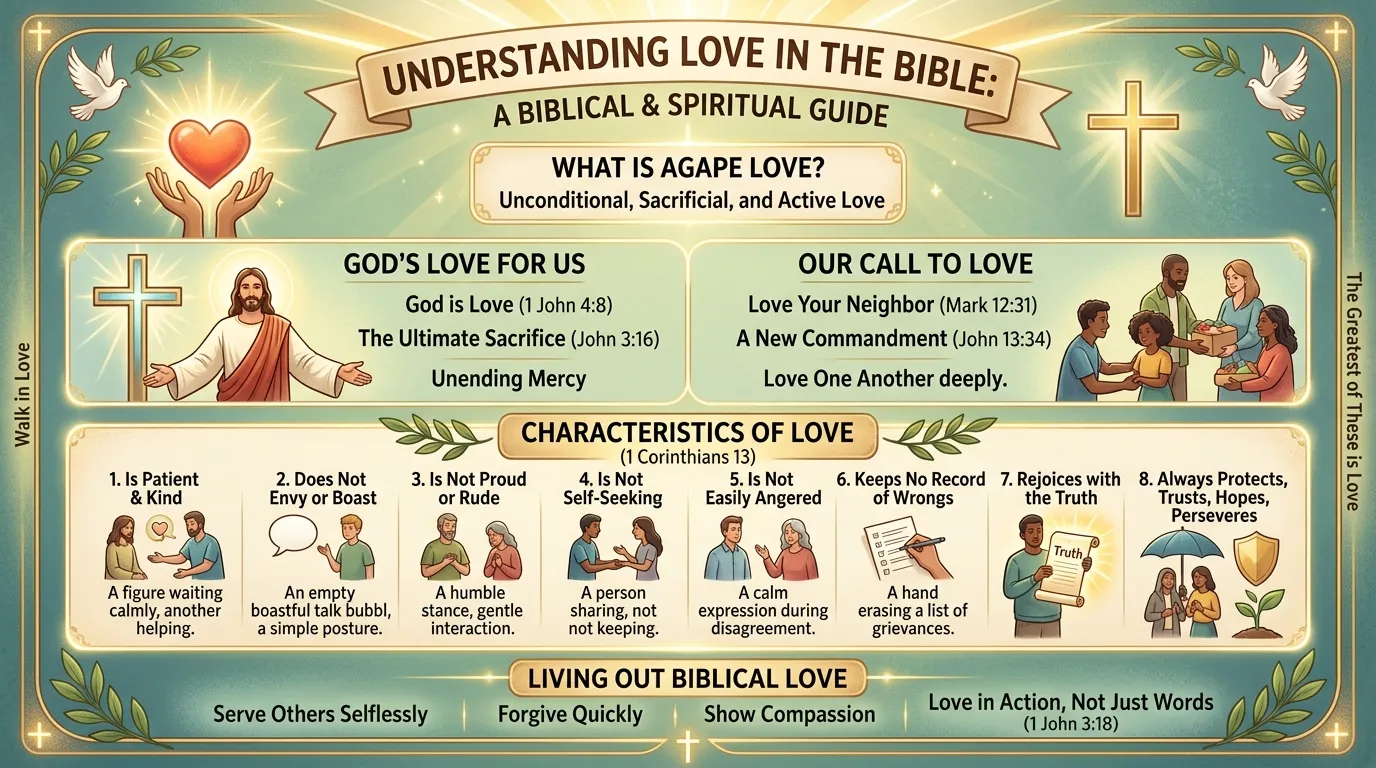
A lawyer once tried to trap Jesus with a question: “Teacher, which is the greatest commandment in the Law?” Jesus did not hesitate. “Love the Lord your God with all your heart and with all your soul and with all your mind. This is the first and greatest commandment. And the second is like it: Love your neighbor as yourself. All the Law and the Prophets hang on these two commandments” (Matthew 22:37–40). The entire Bible — every story, law, prophecy, and letter — hangs on love. But what does the Bible actually mean by that word? It cannot mean what our culture means, because our culture uses “love” for everything from romance to pizza. Scripture means something far weightier, and it repays the effort to learn what.
Love Before It Was Ever Commanded
Long before Jesus named love the greatest commandment, the Old Testament was already showing what it looks like. Moses told Israel that God did not choose them because they were numerous or impressive — “the LORD set his affection on you and chose you” simply because He loved them (Deuteronomy 7:7–8). Divine love, from the beginning, is not a response to our worth. It is the reason we have any.
The prophets carry the theme further, and none more vividly than Hosea. God told the prophet to marry an unfaithful woman and keep loving her — a living parable of God’s love for an unfaithful Israel. Hosea bought his wife back from slavery and brought her home. That is biblical love in one picture: not a feeling that fades when the beloved fails, but a covenant commitment that pursues, pays the price, and restores.
Throughout the Old Testament this love has a name that English struggles to translate: chesed, often rendered “steadfast love” or “lovingkindness.” It appears some 250 times, and it means loyal, covenant love — the kind that keeps its promises when keeping them costs everything. When the psalmist sings “his steadfast love endures forever” (Psalm 136), he is not describing a mood. He is describing God’s character.
The Four Faces of Love
The New Testament was written in Greek, and Greek has several words our English flattens into one — a fact worth knowing, as long as it serves the meaning rather than replacing it. Four of them matter most:
- Agape — self-giving, sacrificial love that seeks the good of the other regardless of feeling or merit. This is the word the New Testament reaches for when it describes God’s love: “God so loved the world that he gave his one and only Son” (John 3:16). Agape gives.
- Phileo — the warm love of friendship and affection. Jesus wept at the tomb of Lazarus, and the onlookers said, “See how he loved him!” (John 11:36) — that is phileo, love with tears in it.
- Storge — natural family affection, the love between parents and children, brothers and sisters. Paul urges believers to “be devoted to one another in love” using a compound of this word (Romans 12:10).
- Eros — romantic, desiring love. The word itself never appears in the New Testament, but the reality is honored in Scripture: the Song of Songs celebrates marital love as God’s good gift, and Hebrews declares “marriage should be honored by all” (Hebrews 13:4).
These are not rival definitions competing for the title of “real” love. They are faces of one reality, and the Bible’s distinctive contribution is agape — the love that acts for another’s good at cost to itself. Every other love can curdle into selfishness; agape is love purified of self-interest. That is why, when the New Testament wants to define love, it points not to a feeling but to a cross: “This is how we know what love is: Jesus Christ laid down his life for us” (1 John 3:16).
Love With a Definition
No passage defines love more carefully than 1 Corinthians 13, and it deserves to be read as Paul intended — not as wedding poetry but as a portrait of Christlike character for a fractured church. “Love is patient, love is kind. It does not envy, it does not boast, it is not proud. It does not dishonor others, it is not self-seeking, it is not easily angered, it keeps no record of wrongs” (1 Corinthians 13:4–5).
Read that list slowly and something unsettling happens: every phrase becomes a mirror. Patience is love refusing to punish someone for being slow. Kindness is love taking initiative for another’s good. Not keeping a record of wrongs is love deleting the ledger most of us maintain so carefully. Paul is not describing romance; he is describing the daily, unglamorous work of treating other people the way God treats us.
And then Paul raises the stakes beyond behavior into eternity: “And now these three remain: faith, hope and love. But the greatest of these is love” (1 Corinthians 13:13). Faith will one day become sight; hope will one day become possession. Love alone continues, because love is not just what God does — it is who God is.
Love With Its Sleeves Rolled Up
Biblical love is never content to stay a sentiment. James’s brother in the faith, John, puts it bluntly: “Dear children, let us not love with words or speech but with actions and in truth” (1 John 3:18). Jesus illustrated it with the Good Samaritan — a man who crossed ethnic hatred, spent his own money, and interrupted his own journey for a stranger left for dead (Luke 10:25–37). Then came the command that still stings: “Go and do likewise.”
This active love has a specific shape in Scripture. It feeds the hungry and clothes the naked — Jesus says that inasmuch as we do it for the least of His brothers and sisters, we do it for Him (Matthew 25:40). It forgives, because the forgiven forgive: “Be kind and compassionate to one another, forgiving each other, just as in Christ God forgave you” (Ephesians 4:32). It even extends to enemies — the most radical sentence Jesus ever spoke: “Love your enemies and pray for those who persecute you” (Matthew 5:44). No other religion had commanded that. None had a God who practiced it first, praying “Father, forgive them” from the cross.
This is the test the apostles keep returning to. “Whoever claims to love God yet hates a brother or sister is a liar,” John writes. “For whoever does not love their brother and sister, whom they have seen, cannot love God, whom they have not seen” (1 John 4:20). Love of God that never reaches a human being is not love. It is theater.
When Love Costs Everything
Scripture is honest that this kind of love is expensive, and it gives us people who paid the price. Ruth, a widowed Moabite with every reason to go home, clung to her mother-in-law Naomi and vowed, “Where you go I will go, and where you stay I will stay” (Ruth 1:16) — love as a decision made in a graveyard of lost husbands, with no benefit in sight. Jonathan, the crown prince, loved David “as he loved himself” and stripped off his own robe and armor to give to his friend (1 Samuel 18:1–4), surrendering his claim to the throne out of loyalty. And on the night before the cross, Jesus rose from supper, wrapped a towel around His waist, and washed His disciples’ feet — including the feet of Judas, who would betray Him within hours (John 13). That is the measure of biblical love: it serves even the one who will sell it out. None of these stories are about feeling affectionate. They are about choosing another’s good when it costs you your comfort, your crown, or your dignity.
The Love That Remains
So what does love mean in the Bible, when all of it is gathered up? It means this: love is God’s nature before it is our duty. “God is love,” John declares — not merely that God loves, but that love is what He is (1 John 4:8). Everything else flows downhill from that summit. He loved us first, while we were still sinners (Romans 5:8). He loved us at the cost of His Son. And He now asks — commands, even — that the love we received become the love we give: to Him with our whole being, to our neighbor as ourselves, to our enemies in defiance of every instinct.
That is why the lawyer’s question received the answer it did. Strip away the ceremonies, the debates, the religious performance, and what remains is love — received from God, returned to God, and extended to everyone He puts in our path. The whole Bible hangs on it. The only question left is whether our lives do.
For readers curious about the history of the word itself, the Wikipedia entry on agape traces how this Greek term came to carry the weight of divine, self-giving love — a helpful companion to reading John’s letters and Paul’s great chapter with fresh understanding.










