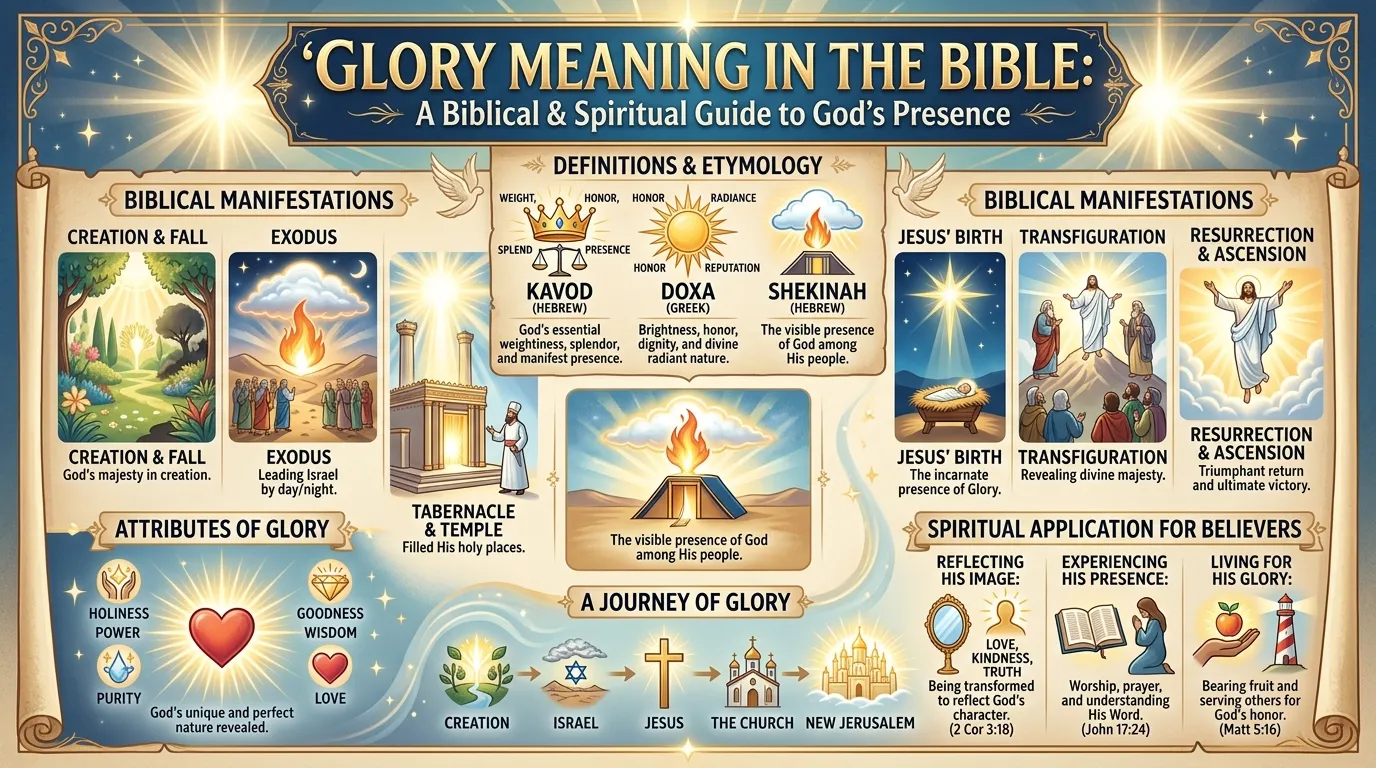
The Hebrew word for glory is kabod, and its root meaning is “weight” or “heaviness.” The Greek equivalent, doxa, originally meant “opinion” or “reputation” — what people think of you — and came to mean radiance, splendor. Between those two roots lies the whole biblical theology of glory: God is weighty, substantial, the heaviest reality in the universe; and that weight, when perceived, shines. Glory is what God weighs, and glory is what God looks like when the weight becomes visible.
This article traces glory through its great manifestations — the moments when the invisible weight became visible. Sinai, the tabernacle, the temple, the Christmas field, the Mount of Transfiguration: at each stop, the Bible shows us something more of what glory is and what it does to the people who encounter it.
Sinai: Glory as Terror and Fire
The first great manifestation comes at Mount Sinai, and it is overwhelming. “The glory of the Lord dwelt on Mount Sinai, and the cloud covered it six days… Now the appearance of the glory of the Lord was like a devouring fire on the top of the mountain in the sight of the people of Israel.” Thunder, lightning, trumpet blasts, smoke, earthquake — the full arsenal of theophany. The people are told not to touch the mountain on pain of death.
This is glory as sheer weight — the kabod in its raw form. It is terrifying because it is real. A weightless god can be approached casually; the God of Sinai cannot. The terror is pedagogical: Israel is learning that the God who redeemed them from Egypt is not a tribal mascot but the holy Creator, and holiness is dangerous to the unholy. The distance is part of the revelation. Glory, at Sinai, says: God is not safe, and that is precisely why He can save.
But even at Sinai there is mercy woven into the terror. God descends in glory not to destroy but to covenant — to give the law, to bind Himself to this people. The fire on the mountain is the same fire that burned in the bush without consuming it. Glory judges, but glory also draws near. The tension between the two will drive the rest of the story.
The Tabernacle: Glory Moves In
After Sinai, something astonishing happens: the glory moves from the mountain into a tent. “Then the cloud covered the tent of meeting, and the glory of the Lord filled the tabernacle. And Moses was not able to enter the tent of meeting because the cloud settled on it, and the glory of the Lord filled the tabernacle.” The unapproachable fire of Sinai takes up residence in the middle of the camp.
The tabernacle is glory domesticated without being diminished. The same kabod that shook the mountain now dwells between the cherubim, above the mercy seat. The mercy seat — the lid of the ark, where blood is sprinkled on the Day of Atonement — is where glory and mercy meet. The architecture preaches: God’s weighty holiness is now accessible, but only through sacrifice, only on God’s terms.
When Solomon’s temple is dedicated, the pattern repeats on a grander scale: “the glory of the Lord filled the house of the Lord,” and the priests cannot stand to minister. Glory disrupts business as usual. It does not enhance the service; it interrupts it. Where God’s weight truly rests, human activity stops — because there is nothing to add to it.
The Departure and the Return
Ezekiel witnesses the most sobering glory-event in Scripture: the glory leaving. In a vision, he watches the kabod rise from the cherubim, move to the threshold of the temple, then to the east gate, then to the Mount of Olives — departing Jerusalem because of the people’s idolatry. The glory that had filled the house now abandons it. The temple stands empty: walls without weight, ritual without reality.
The departure makes the promise of return electric. Haggai, prophesying to the returned exiles rebuilding a modest second temple, declares: “The latter glory of this house shall be greater than the former.” And Malachi promises: “The Lord whom you seek will suddenly come to his temple.” The glory will come back — not as cloud and fire, but as a person.
That is exactly what happens, though not as anyone expected. John’s Gospel opens with the claim: “The Word became flesh and dwelt among us, and we have seen his glory, glory as of the only Son from the Father, full of grace and truth.” The verb “dwelt” is eskēnōsen — He tabernacled among us. Jesus is the glory returned, the kabod in human flesh, the temple rebuilt as a person. The shepherds see it first: “the glory of the Lord shone around them.” The glory that left in Ezekiel’s vision has come back — in a manger.
Transfiguration: Glory Unveiled
On the Mount of Transfiguration, the veil lifts briefly. “His face shone like the sun, and his clothes became white as light.” Moses and Elijah appear, talking with Him. The cloud overshadows them, and the voice speaks: “This is my beloved Son.” Peter, James, and John see what John described: the glory, unveiled, belonging to Jesus by nature.
The Transfiguration is Sinai revisited — the cloud, the voice, the shining face — but with a decisive difference. At Sinai the glory was unapproachable; here the disciples are invited up the mountain. At Sinai Moses’ face reflected the glory; here Jesus’ face generates it. The glory has not changed. The access has. In Christ, the weight of God can be approached, beheld, even touched — because the one who is glorious has become human.
Paul draws the line from Sinai to the Christian’s face: Moses’ reflected glory faded, but ours does not, because it comes from the Spirit within. “We all, with unveiled face, beholding the glory of the Lord, are being transformed into the same image from one degree of glory to another.” Glory is not only something we witness. It is something we become — gradually, as we behold.
The Weight of Glory: What It Does to Us
Encounters with glory in Scripture produce a consistent set of effects, and they are worth cataloging because they describe what the Christian life should feel like. First, awe: Isaiah sees the Lord “high and lifted up” and cries, “Woe is me!” Glory reveals our lightness by revealing God’s weight. Second, worship: the elders in Revelation fall down before the throne, casting their crowns. Third, transformation: from Moses’ shining face to Paul’s “one degree of glory to another,” beholding changes the beholder. Fourth, mission: Isaiah’s “Here am I! Send me” follows the vision. Glory never leaves people where it found them.
C.S. Lewis captured the longing glory creates in his sermon “The Weight of Glory”: we are haunted by a desire for a glory we cannot name, “the scent of a flower we have not found, the echo of a tune we have not heard.” Lewis argues this desire is not vanity but homesickness — we were made for the weight of God’s glory, and nothing lighter will satisfy. The kabod is not an abstract doctrine. It is the thing every human heart is starving for.
Glory Now and Glory Then
The New Testament holds glory in the already-and-not-yet tension that characterizes all of Christian hope. Already: Christ in us, the hope of glory. Already: we behold and are transformed. Already: the Spirit is the down payment, the firstfruits, the guarantee. But not yet: “we suffer with him in order that we may also be glorified with him.” Not yet: the creation groans, waiting for the revealing of the sons of God.
Paul weighs present suffering against future glory and finds no comparison: “this light momentary affliction is preparing for us an eternal weight of glory beyond all comparison.” Note the wordplay — weight of glory. The kabod returns in Greek dress. Our afflictions are light; the glory is heavy. The scales are not close.
And the end of the story is all glory. The New Jerusalem “has no need of sun or moon to shine on it, for the glory of God gives it light, and its lamp is the Lamb.” The glory that dwelt on Sinai, filled the tabernacle, departed in Ezekiel’s vision, returned in Christ, and shone on the mountain of Transfiguration — that glory becomes the permanent lighting of the eternal city. The weight that once terrified will be the air we breathe. “They will see his face.” The heaviest reality in the universe, finally and forever unveiled.
The concept’s full range — from divine radiance to human honor — is surveyed in the article on glory in religion, a helpful complement to Scripture’s own weighty testimony.










