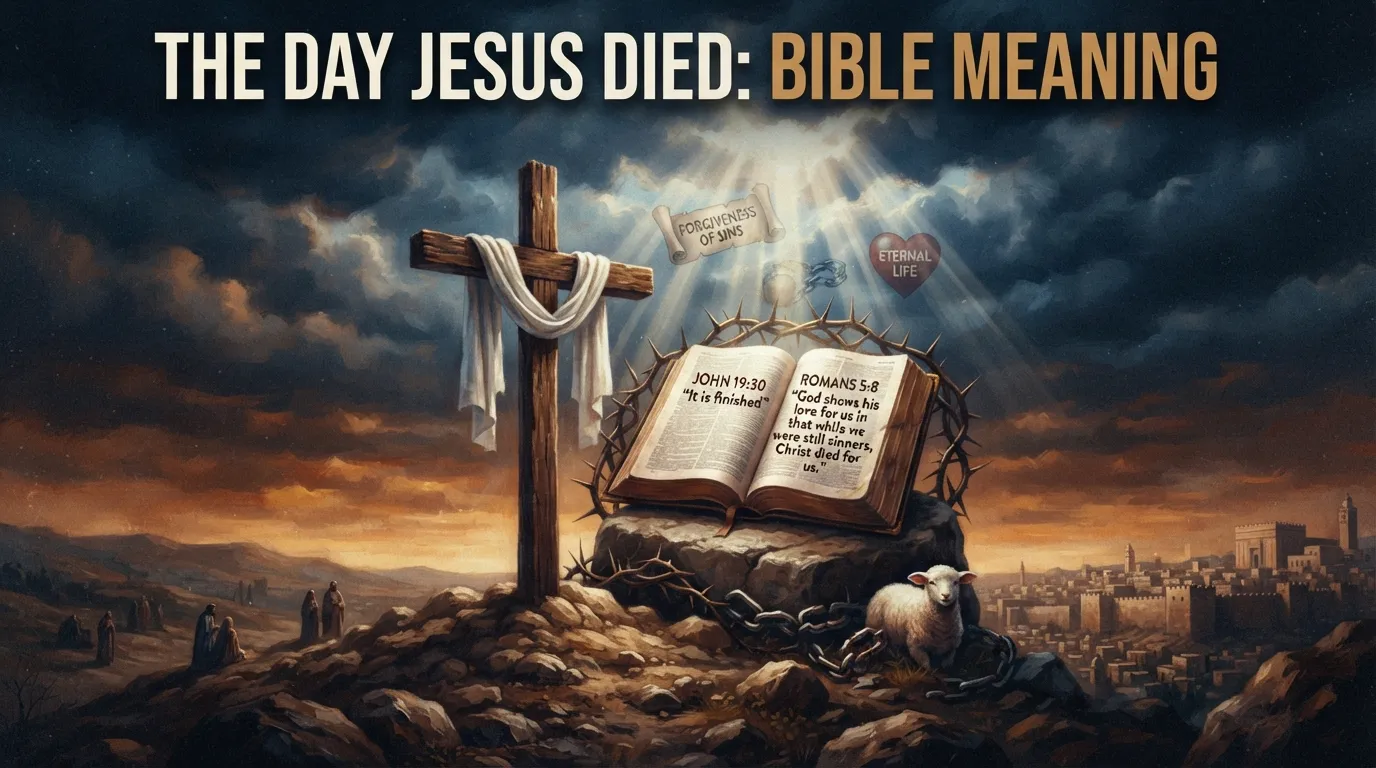
On the morning of the crucifixion, Jerusalem was crowded with pilgrims, loud with Passover preparations, and tense with Roman soldiers on high alert. By nightfall, a man had been executed outside the city wall, the sky had gone dark at midday, the temple veil had torn, and a Roman centurion had declared that the executed man was the Son of God. The day Jesus died is the most consequential day in human history — and the Gospels describe it with a precision that has kept readers, historians, and theologians engaged for two thousand years.
The four Gospels — Matthew 27, Mark 15, Luke 23, and John 19 — all narrate the crucifixion, each with its own emphasis. Together they give us a day-by-day and hour-by-hour account that is both history and theology: what happened, and what it meant.
Which Day Was It? The Friday Question
The traditional Christian understanding is that Jesus died on a Friday — which is why the Friday before Easter is called Good Friday. The Gospels support this in a straightforward way: Jesus was crucified on the “day of Preparation,” the day before the Sabbath, and He was buried hastily before the Sabbath began (Mark 15:42; John 19:31). The Sabbath is Saturday, so the day of Preparation is Friday.
There is one apparent wrinkle. John 19:14 says Jesus’ trial before Pilate took place “about the sixth hour” on “the day of Preparation of the Passover,” which some readers take to mean Jesus died on the day the Passover lambs were slaughtered (Thursday or Friday afternoon, depending on the calendar). The Synoptic Gospels (Matthew, Mark, Luke) describe the Last Supper as a Passover meal, while John seems to place the crucifixion at the very hour the lambs were being killed in the temple. Scholars have proposed several harmonizations: different calendar reckonings between groups in Jerusalem, or John using Roman time versus Jewish time. What all four Gospels agree on is the core sequence: a Passover-season arrest, trial, crucifixion, death in the afternoon, and burial before the Sabbath. The early church, from the very first generation, remembered the day as Friday.
The date is usually placed in either AD 30 or AD 33, during the governorship of Pontius Pilate and the high priesthood of Caiaphas. Passover, which begins on the 15th of Nisan in the Jewish lunar calendar, fell on different weekdays in those years, and the debate between AD 30 and 33 continues. What matters theologically is not the exact year but the event: at Passover, in Jerusalem, the Lamb of God was slain.
The Hours of the Cross
Mark gives the most precise timeline. “And it was the third hour when they crucified him” (Mark 15:25). Jewish time counted from sunrise, so the third hour is roughly 9 a.m. From 9 a.m. to noon, Jesus hung on the cross in the morning light, with the charge against Him nailed above His head: “The King of the Jews.” Two criminals were crucified beside Him. Soldiers gambled for His clothing. Passersby mocked Him. One of the criminals joined in the mocking — then repented, and heard one of the most astonishing promises in Scripture: “Today you will be with me in paradise” (Luke 23:43).
“And when the sixth hour had come, there was darkness over the whole land until the ninth hour” (Mark 15:33). From noon to about 3 p.m., darkness covered the land. This was not an eclipse — a solar eclipse cannot occur during Passover, which falls at a full moon. The Gospels present it as a supernatural sign. In the Old Testament, darkness at midday was a sign of God’s judgment (Amos 8:9: “I will make the sun go down at noon and darken the earth in broad daylight”). The darkness marked the moment when the weight of the world’s sin fell on Christ.
At about the ninth hour — roughly 3 p.m. — Jesus cried out with a loud voice, “Eloi, Eloi, lema sabachthani?” — “My God, my God, why have you forsaken me?” (Mark 15:34). Then, according to John, He said, “It is finished” (John 19:30). Luke records His final words: “Father, into your hands I commit my spirit” (Luke 23:46). “And having said this he breathed his last.”
The Seven Sayings: A Sermon from the Cross
Across the four Gospels, Jesus spoke seven times from the cross. Gathered together, they form a complete picture of His heart in His final hours:
- “Father, forgive them, for they know not what they do” (Luke 23:34) — forgiveness for His executioners, prayed while the nails were still fresh.
- “Today you will be with me in paradise” (Luke 23:43) — salvation for a dying criminal who had nothing to offer but belief.
- “Woman, behold, your son!” (John 19:26) — care for His mother, entrusted to the apostle John even as He died.
- “My God, my God, why have you forsaken me?” (Matthew 27:46) — the cry of abandonment, quoting Psalm 22, the moment He bore the judgment for sin.
- “I thirst” (John 19:28) — His humanity, fulfilling Psalm 69:21, and a reminder that He truly suffered physically.
- “It is finished” (John 19:30) — the declaration of completion. The Greek word is tetelestai, a word stamped on paid debts and completed transactions. The work of redemption was done.
- “Father, into your hands I commit my spirit” (Luke 23:46) — trust to the very end, quoting Psalm 31:5.
These seven sayings show a Savior who was forgiving, saving, caring, suffering, human, victorious, and trusting — all at once, all on the same day.
The Passover Lamb
The timing of Jesus’ death was not coincidence. The Passover commemorated Israel’s deliverance from Egypt, when the blood of a spotless lamb on the doorposts caused the angel of death to pass over (Exodus 12). Every year, lambs were slaughtered in the temple to remember that night.
John the Baptist had pointed at Jesus and said, “Behold, the Lamb of God, who takes away the sin of the world!” (John 1:29). Paul states it directly: “Christ, our Passover lamb, has been sacrificed” (1 Corinthians 5:7). Jesus died at Passover because He was the Passover — the final, sufficient sacrifice to which all the lambs had pointed. His bones were not broken (John 19:33–36), fulfilling both the Passover regulation (Exodus 12:46) and Psalm 34:20.
Isaiah 53 had prophesied this centuries earlier: “He was oppressed, and he was afflicted, yet he opened not his mouth; like a lamb that is led to the slaughter, and like a sheep that before its shearers is silent, so he opened not his mouth” (Isaiah 53:7). The day Jesus died was the day the prophecy walked out of the scroll and onto a cross.
What Happened the Moment He Died
Matthew records three extraordinary events at the moment of Jesus’ death. First, “the curtain of the temple was torn in two, from top to bottom” (Matthew 27:51). The curtain separated the Holy of Holies — God’s dwelling place — from the rest of the temple. Only the high priest could pass through, once a year. That it tore from top to bottom meant God tore it. Access to God was now open through Christ. Hebrews 10:19–20 explains: believers now have “confidence to enter the holy places by the blood of Jesus, by the new and living way that he opened for us through the curtain, that is, through his flesh.”
Second, “the earth shook, and the rocks were split” (Matthew 27:51). Creation itself reacted to the death of its Maker. Third, tombs were opened, and after the resurrection, many saints appeared in Jerusalem (Matthew 27:52–53) — a foretaste of the resurrection power unleashed that day.
Then came the most unexpected confession. The Roman centurion — a professional executioner who had watched countless men die — saw how Jesus died and said, “Truly this man was the Son of God!” (Mark 15:39). The first person to confess Christ after the cross was not a disciple. It was the soldier in charge of killing Him.
Why the Day Is Called Good
“Good Friday” has puzzled many people. What is good about an execution? The answer is that the goodness is not in the suffering but in what the suffering accomplished. On that Friday, the debt was paid. The wrath was satisfied. The curtain was torn. The way to God was opened. The devil’s power was broken (Hebrews 2:14). The day was dark — the darkest day in history — and yet it was good, because it was the day God proved He would go to any length to save His people.
The day Jesus died is also a reminder that God does His greatest work in the worst moments. The disciples saw only defeat that Friday. They could not see that the cross was a victory, or that Sunday was coming. When your own life holds a “Friday” — a diagnosis, a betrayal, a loss that feels final — remember that God’s story did not end on Friday, and neither does yours.
Christians remember this day every year on Good Friday, and every week at the Lord’s Table, and every day in the gospel they proclaim: the Lamb of God died at Passover, once for all, and it is finished. For the historical background on the crucifixion, its dating, and its place in the Passion narrative, see the Wikipedia article on the crucifixion of Jesus.










