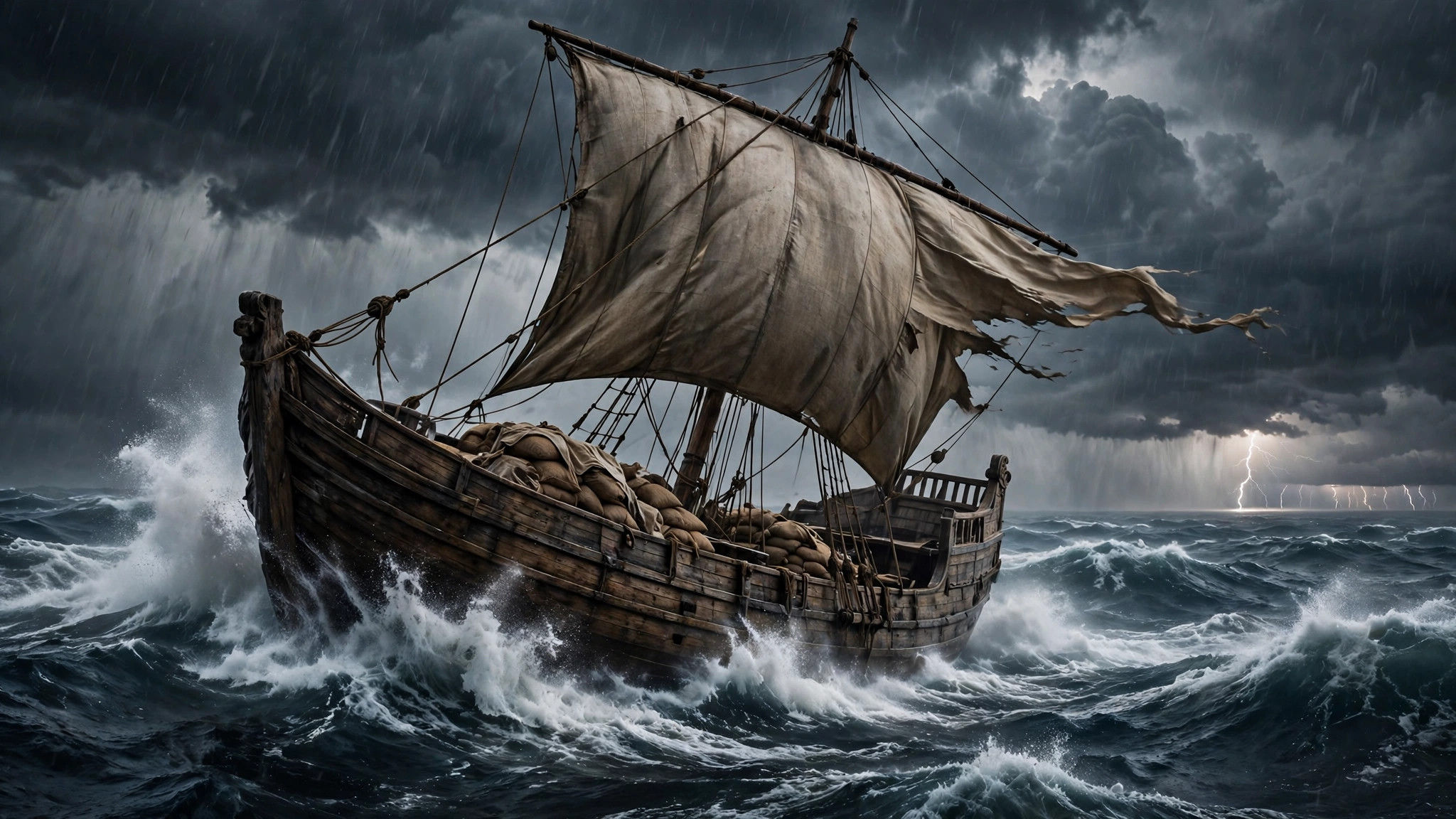
The wind has a name, and the sailors are afraid to speak it. For fourteen nights the grain ship has been driven blind across the Adriatic, the sky iron-gray by day and pitch by night, no sun, no stars, no bearings — only the groan of timbers and the slow certainty that the sea is going to win. Two hundred and seventy-six souls are aboard, and one of them is a prisoner in chains who has been telling them, calmly, that an angel stood by him in the night. This is Acts 27: the most detailed sea voyage in ancient literature, and the strangest missionary journey Paul ever took — because he never chose it at all.
From Caesarea in Chains
The fourth journey begins not with a commissioning service but with an appeal. After two years in Caesarean custody — and a hearing before King Agrippa where Paul's defense nearly converted the king — Paul exercises his right as a Roman citizen and appeals to Caesar (Acts 25:11). Festus agrees: to Rome he will go. Luke's account turns suddenly nautical, naming ships, ports, and winds with a sailor's precision.
They board at Caesarea and coast north along Syria, changing vessels at Myra in Lycia to an Alexandrian grain ship bound for Italy — the ancient world's bulk carrier, slow and heavy. Paul is in the custody of a centurion named Julius, who treats him, Luke notes, with unexpected kindness (Acts 27:3). Already the pattern of this journey emerges: God's man in man's chains, and the chains keep loosening around the wrong wrists. At Sidon, Julius lets Paul visit friends. At every port, the prisoner is quietly becoming the most important person on board.
Then comes the decision that seals the drama. They reach Fair Havens on Crete, late in the sailing season. Paul — an experienced traveler of these waters by now — warns them: I perceive that the voyage will be with injury and much loss (Acts 27:10). The pilot and the ship's owner overrule him. The majority votes to sail. Here is the first lesson of the voyage, delivered before the storm: human expertise, democratically agreed upon, is no substitute for a word from God. They set sail for Phoenix, a better harbor — and sail straight into the tempest.
The Storm That Ate the Map
Luke calls the wind by its local name, and the name is worth knowing: the sailors called it Euroclydon — the word Luke uses means a violent northeaster, a cyclonic gale that barrels down from the mountains of Crete and turns the sea into a washing machine. Modern sailors still dread these autumn storms in the same waters. The ship is caught, unable to face the wind, and the crew simply gives way — the ancient equivalent of surrendering the wheel.
What follows is fourteen days of progressive despair, and Luke narrates it like a man who was there — because he was. They undergird the ship, passing cables around the hull to keep it from breaking apart. They throw the cargo overboard, then the tackle. For days neither sun nor stars appeared, and Luke writes the eulogy of their hope: all hope of our being saved was at last abandoned (Acts 27:20). Read that as a spiritual autobiography of every person who has ever watched the instruments die. This is what a storm does: it eats the map, and then it eats hope.
And it is here, in the dark, that Paul stands up. Not to say "I told you so" — though he gently notes that they should have listened — but to deliver a word from outside the storm: take heart, for there will be no loss of life among you, but only of the ship (Acts 27:22). An angel of the God to whom he belongs stood by him in the night with two promises: Paul must stand before Caesar, and God has granted him the lives of all who sail with him. Notice the scope: the promise given to the prisoner covers the crew. One man's faith becomes 276 people's lifeboat. That is what intercession looks like at sea.
Shipwrecked but Not Lost
On the fourteenth night, the sailors sense land — the sound of surf in the dark. They take soundings: twenty fathoms, then fifteen. Land is close, and land in a storm means rocks. They drop four anchors from the stern and pray for daybreak. Some sailors try to slip away in the lifeboat under pretense of laying anchors; Paul sees through it and warns the centurion that unless these men stay, no one survives. The soldiers cut the lifeboat ropes and let it fall away. In a crisis, Paul — the prisoner — is giving the orders, and the soldiers are obeying. Authority in the kingdom has nothing to do with chains.
As dawn breaks, Paul does something profoundly human and profoundly faithful: he urges everyone to eat. They haven't eaten in two weeks. He takes bread, gives thanks to God in front of them all, breaks it, and eats — a quiet Eucharist on a doomed ship, 276 people watching a chained man thank God for breakfast in a hurricane. They take heart. They eat.
Then the wreck, exactly as foretold. They run the ship aground on a reef; the stern is smashed by the surf. The soldiers plan to kill the prisoners to prevent escape — standard Roman procedure — but Julius, wanting to save Paul, stops them. Everyone makes it to shore, some on planks, some on pieces of the ship. Luke's closing line of the chapter is a quiet triumph: so it was that all were brought safely to land (Acts 27:44). The ship is lost. Not one life is. God keeps His word down to the last soul.
Winter on Malta, Spring in Rome
The island is Malta, and its people show what Luke calls unusual kindness (Acts 28:2) — building a fire for the soaked survivors in the rain. Then the strangest vignette of the voyage: a viper, driven out by the heat, fastens on Paul's hand. The islanders conclude he must be a murderer whom justice has finally caught. Paul shakes the snake into the fire and suffers no harm. The islanders revise their theology on the spot and decide he is a god. Neither conclusion is right, but the incident opens the door: Paul heals the father of Publius, the island's leading man, and then every sick person on Malta comes and is healed. Three months of shipwreck become three months of revival. The gospel, which Paul carried in chains, now walks the island freely.
When sailing season returns, they complete the journey — Syracuse, Rhegium, Puteoli — and Paul finally walks the last miles to Rome on the great Appian Way. Believers come out to meet him as far as the Forum of Appius, and Luke notes simply that when Paul saw them, he thanked God and took courage (Acts 28:15). After two years of custody, storms, shipwreck, and snakebite, the sight of brothers on the road is what steadies him. Never underestimate what your presence on someone's road can do.
Rome receives him under house arrest — his own rented lodging, chained to a guard, yet proclaiming the kingdom of God and teaching about the Lord Jesus Christ with all boldness and without hindrance (Acts 28:31). That is the last line of Acts, and it is deliciously ironic: the prisoner is in chains, and the gospel is "without hindrance." Rome thought it had caged the messenger. It had only given him a rent-free pulpit in the capital of the world, with a rotating audience of imperial guards.
Four Anchors for Your Own Storm
Paul's voyage is more than history; it is a survival manual. When your own Euroclydon hits, drop these four anchors:
- God's presence. The angel's first credential was not a promise but a relationship: the God to whom I belong and whom I worship (Acts 27:23). Before Paul announced what God would do, he remembered whose he was. In the storm, belonging comes before rescue. You are not cargo; you are His.
- God's promise. Paul was told he must stand before Caesar — a divine "must" that no wind could veto. Find the promises God has spoken over your life and hold them like anchors from the stern: they don't stop the storm, but they stop the drift.
- Obedience in the small things. Stay in the ship. Cut away the lifeboat. Eat the bread. The great deliverance of Acts 27 turned on a series of unglamorous obediences. God's rescue plans almost always require our participation in ordinary, unheroic steps.
- Hope that feeds others. Paul's courage became the crew's courage; his thanksgiving became their meal. Your steadiness in the storm is never only for you — God granted Paul the lives of all who sailed with him. Someone's survival may be tied to your faith.
The Harbor
The voyage to Rome teaches one great truth: God's sovereignty does not prevent the storm — it outlasts it. The ship was lost, the cargo was lost, the tackle was lost, and not one promise was lost. Paul arrived in Rome exactly as God said he would, by a route no travel agent would ever book: prison, tempest, reef, snakebite, and finally the capital. If your journey looks nothing like the brochure, take heart — the Author of Acts specializes in arrivals that defy the itinerary. For the historical and geographical background of this famous voyage, see the Wikipedia article on Acts 27.










