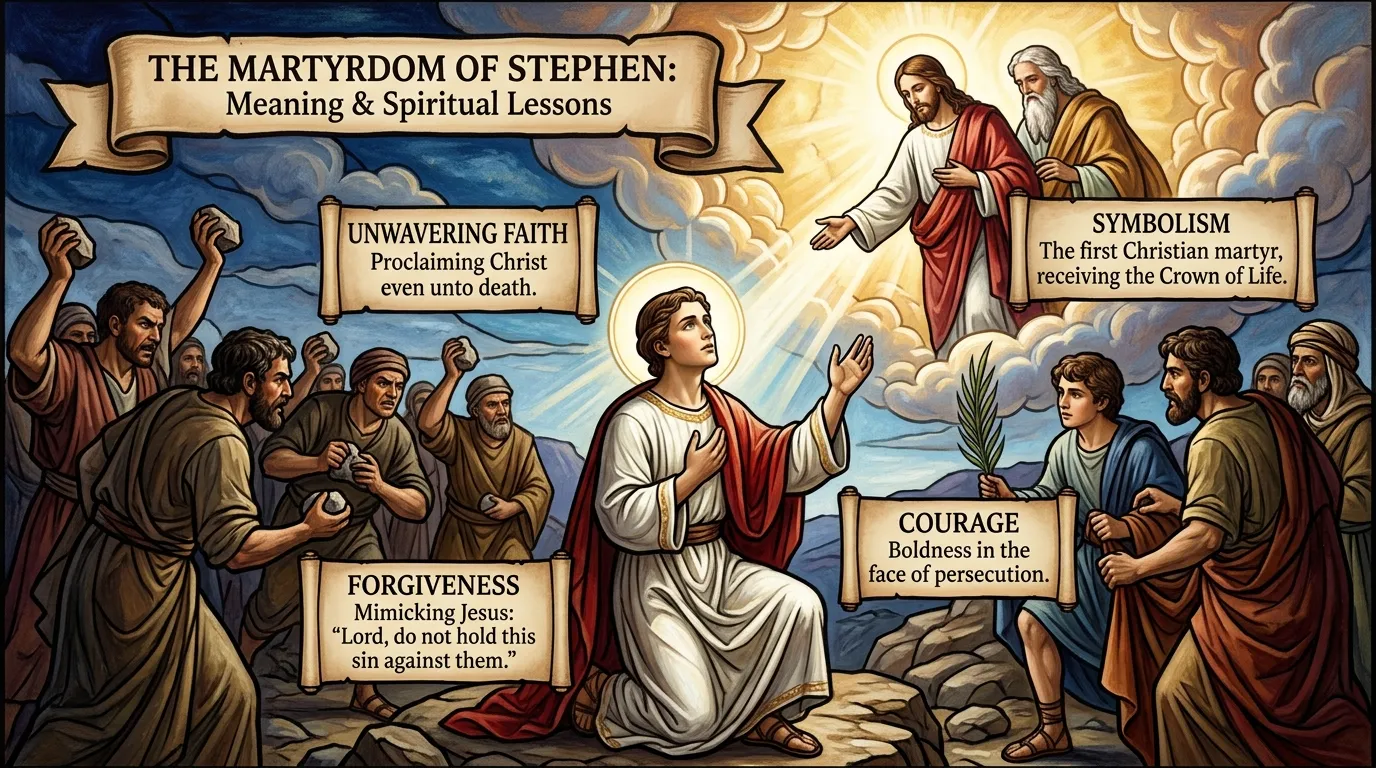
Before he was a martyr, Stephen was a waiter. That sounds like a strange way to begin the story of the first Christian to die for his faith, but it is exactly where Luke begins it — and the beginning explains the end. Stephen was chosen to make sure widows were fed. He did that job so faithfully, so full of the Spirit and wisdom, that he could not stay at the tables for long. His wisdom in debate drew the fury of men who could not answer him, his defense before the council became the longest sermon in the book of Acts, and his death became a mirror of Christ’s own. This is the story of Stephen, and what his death means for every believer who will ever face hostility for the name of Jesus.
The Problem That Made a Deacon
The church in Jerusalem was growing fast, and growth brought friction. The Greek-speaking widows were being overlooked in the daily distribution of food (Acts 6:1). It was an administrative failure with a spiritual edge — the most vulnerable were going hungry — and the apostles treated it with utmost seriousness. They asked the congregation to choose seven men of good reputation, “full of the Spirit and of wisdom,” to take charge of the task (Acts 6:3).
Stephen’s name is listed first. Luke describes him as “a man full of faith and of the Holy Spirit” (Acts 6:5). Notice the qualifications: the church did not assign its food program to whoever was available. Caring for widows was spiritual work, and it required spiritual men. Stephen’s greatness did not begin when he started preaching in the synagogues. It began when he was willing to serve tables. Faithfulness in small, unseen work was the soil in which his courage grew.
There is a quiet rebuke here for every believer who wants a platform before they have a towel. Stephen never campaigned for a wider ministry. He served, and God widened his ministry Himself. “Full of grace and power, he was doing great wonders and signs among the people” (Acts 6:8) — the deacon became a wonder-worker, not by self-promotion but by the Spirit’s overflow.
The Debate He Could Not Lose
Stephen’s ministry of wonders drew opposition. Men from the Synagogue of the Freedmen rose up to dispute with him, “but they could not withstand the wisdom and the Spirit with which he was speaking” (Acts 6:10). That sentence is worth sitting with. It was not Stephen’s cleverness that silenced them — it was wisdom joined to the Spirit. Arguments can be dodged; the Spirit’s conviction cannot.
Unable to win the debate, his opponents changed tactics. They secretly instigated men to accuse him of blasphemy against Moses and God, stirred up the people and the elders and the scribes, and dragged him before the council (Acts 6:11–12). False witnesses were produced. The charges were religious and inflammatory: that he spoke against the temple and the law.
And here Luke gives us one of the most luminous details in all of Scripture. As the council stared at Stephen, “they saw that his face was like the face of an angel” (Acts 6:15). In the moment of greatest danger, heaven was visible on his face. It is the same glory that shone on Moses when he came down from the mountain (Exodus 34:29) — the mark of a man who had been with God. His accusers saw it. It did not soften them. Grace rejected hardens; light refused becomes darkness.
The Sermon That Indicted His Judges
Given the chance to defend himself, Stephen did something extraordinary: he preached the history of Israel. Acts 7 contains the longest sermon in the book, and it is a masterclass in biblical theology. Stephen walks his judges through Abraham, Joseph, Moses, the tabernacle, the temple — showing at every turn the same pattern: God sends deliverers, and God’s people reject them.
The structure of the sermon is the structure of Israel’s story:
- Abraham obeyed God before he had land, law, or temple — proving that God’s presence is not confined to holy places.
- Joseph was rejected by his brothers and later became their savior — the first portrait of the rejected deliverer.
- Moses was rejected by his own people at first (“Who made you a ruler and a judge over us?”), then returned by God as their deliverer — the pattern repeating.
- The wilderness generation turned to idols while Moses was on the mountain, resisting the Holy Spirit as their fathers had always done.
- The temple, Stephen argued, was never meant to contain God: “the Most High does not dwell in houses made by hands” (Acts 7:48).
Then came the turn — the moment the defense became a prosecution. “You stiff-necked people, uncircumcised in heart and ears, you always resist the Holy Spirit. As your fathers did, so do you” (Acts 7:51). Stephen was not merely defending himself against the charge of speaking against Moses and the temple. He was showing that his accusers stood in the long line of those who kill the prophets — and that they had now done it to the Righteous One Himself. The sermon that began as history ended as a mirror, and the council could not bear what it saw.
The Vision: Jesus Standing
As rage boiled over in the council chamber, Stephen was given a sight no one else could see. “Behold, I see the heavens opened, and the Son of Man standing at the right hand of God” (Acts 7:56). Every other New Testament picture of the exalted Christ shows Him seated at God’s right hand — the posture of a king whose work is finished. Here, and only here, He is standing.
Why standing? Scripture does not say outright, and reverent readers have pondered it for centuries. Many have seen in it the posture of a witness rising in a courtroom — Christ standing to testify for His servant. Others see a king rising to receive and honor a faithful soldier. Still others see the advocate standing to welcome home the first martyr. Whichever shade of meaning we emphasize, the picture is unmistakable: heaven was not passive while Stephen suffered. The Lord of glory was on His feet.
That vision changed everything about how Stephen faced what came next. A man who has seen the heavens opened does not fear the stones. The vision did not remove the suffering, but it reframed it: he was not being abandoned to his enemies; he was being received by his King. Faith does not always spare us the fire. Sometimes it lets us see who stands with us in it.
A Death That Echoes His Lord
They dragged Stephen out of the city and stoned him. Luke’s account is restrained — non-graphic, focused not on the violence but on the victim’s spirit. And what it shows is a man dying the way his Master died. The parallels are deliberate and unmistakable:
- He prayed for his killers. As the stones fell, Stephen cried out, “Lord, do not hold this sin against them” (Acts 7:60) — the unmistakable echo of Jesus’s “Father, forgive them, for they know not what they do” (Luke 23:34). Forgiveness under fire is the family resemblance of Christ’s followers.
- He committed his spirit to Jesus. “Lord Jesus, receive my spirit” (Acts 7:59) mirrors “Father, into your hands I commit my spirit” (Luke 23:46). Note the stunning detail: Stephen prays to Jesus. The first martyr’s dying breath is worship of Christ as Lord — one of the earliest and clearest testimonies to His deity.
- He “fell asleep.” Luke’s gentle word for his death (Acts 7:60) frames martyrdom not as annihilation but as rest. The body sleeps; the soul wakes with Christ.
And there, holding the coats of the killers, stood a young man named Saul (Acts 7:58). He approved of the execution. He would go on to ravage the church. And then, on a road to Damascus, the risen Christ would confront him — perhaps, some have wondered, in answer to Stephen’s dying prayer. We cannot know for certain that Stephen prayed for Saul by name. But we know this: the church’s greatest persecutor became its greatest apostle, and the first martyr’s forgiveness rained down on the very ground where Saul stood.
What Stephen’s Death Means for Us
Stephen’s story is not preserved as a museum piece. It is a pattern, and Scripture holds it up for at least four lessons.
Faithfulness in obscurity prepares us for faithfulness in crisis. Stephen could face the council because he had been faithful at the tables. Courage is rarely created in the moment of testing; it is revealed there, having been built in a thousand small obediences beforehand.
Truth spoken in love will still provoke. Stephen’s sermon was biblical, reasonable, and — by the end — unsparing. He did not soften the indictment to save his life. Some hearers will be cut to the heart and repent (as at Pentecost). Others will be cut to the heart and rage (as here). The speaker’s duty is faithfulness; the response belongs to God.
Suffering for Christ is fellowship with Christ. Paul would later call it “the fellowship of his sufferings” (Philippians 3:10). Stephen’s death looked like defeat and was in fact coronation. The church has always understood this: the blood of the martyrs is seed. Persecution scattered the Jerusalem church, “and those who were scattered went about preaching the word” (Acts 8:4). The stones meant to silence the gospel broadcast it.
Forgiveness is the martyr’s final sermon. Stephen’s longest sermon was Acts 7. His shortest — “Lord, do not hold this sin against them” — may have preached longer. Saul never forgot that day. Neither should we: the supreme evidence of the Spirit’s fullness is love for enemies at the very moment they are killing you.
The church has remembered Stephen ever since — his name means “crown,” and he received one that day. Readers who want to explore how Christians through the centuries have honored the first martyr can begin with the historical survey of Saint Stephen in Christian tradition, which traces his commemoration from the early church to the present day.










