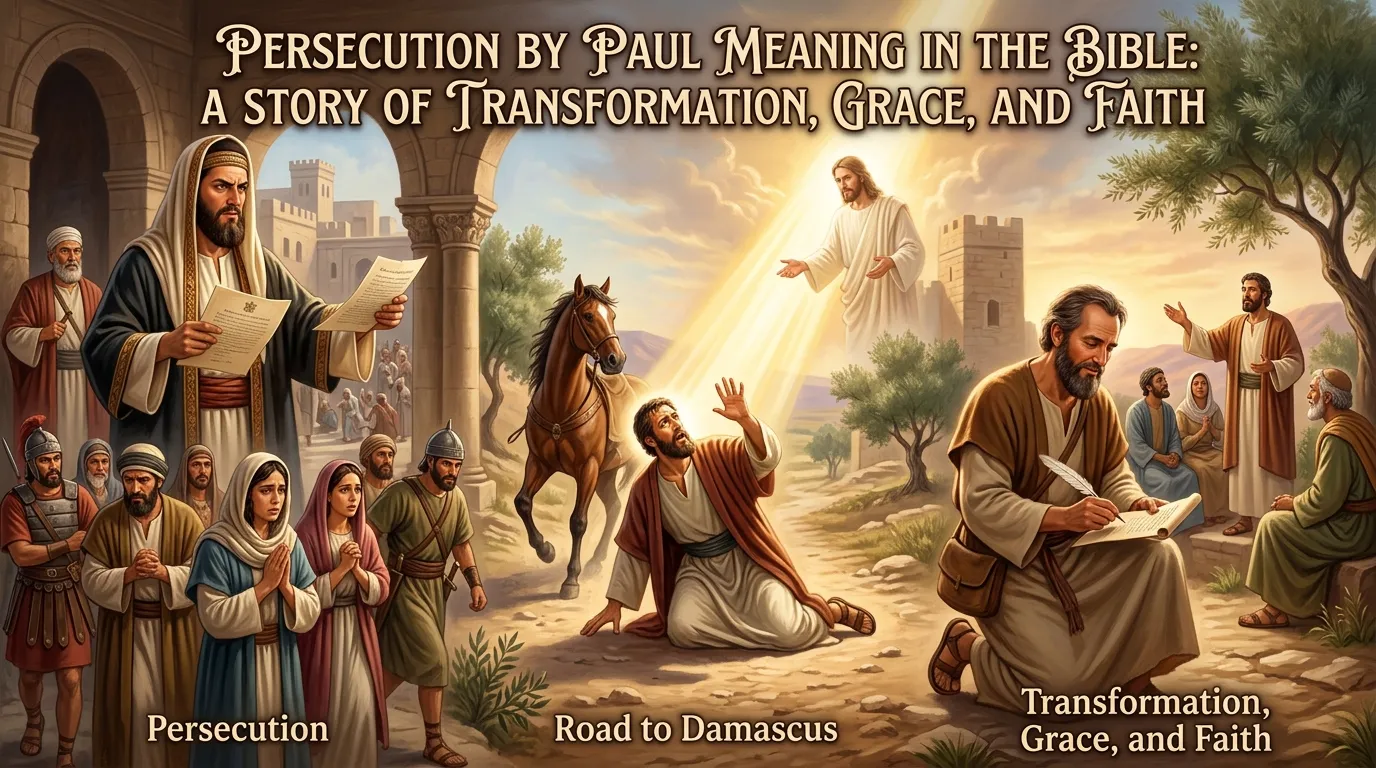
The witnesses laid their coats at the feet of a young man named Saul. That is how he first appears in Scripture — not preaching, not praying, but holding the garments of murderers while they stoned Stephen to death (Acts 7:58). Luke adds one chilling detail: “And Saul approved of their killing him.” Before the apostle Paul wrote a single letter, before he planted a single church, before the name Paul was ever spoken of him, Saul of Tarsus was the most dangerous enemy the young church had. This is the story of that chapter — the persecutor years — and of the noonday confrontation that ended them. It matters because it is the Bible’s proof that no past is too dark for grace to rewrite.
The Coat-Holder at the Stoning
Stephen was the church’s first martyr, a deacon “full of faith and of the Holy Spirit” whose wisdom his opponents could not refute, so they manufactured charges against him instead. Dragged before the Sanhedrin, Stephen preached a sweeping sermon through Israel’s history, ending with an accusation his hearers could not bear: “You stiff-necked people… you always resist the Holy Spirit!” They covered their ears, rushed him, dragged him out of the city, and stoned him. As the rocks fell, Stephen prayed two prayers that echo Christ’s own: “Lord Jesus, receive my spirit,” and “Lord, do not hold this sin against them.”
And Saul stood there, guarding the coats, approving. He did not throw a stone — the text is careful — but his presence was his participation. In the ancient world, holding the executioners’ garments was the role of a trusted associate, someone aligned with the act. Saul’s conscience was not troubled. In his own later telling, he believed he was serving God. Zeal without truth is one of the most destructive forces on earth, and Saul was its perfect vessel: brilliant, devout, disciplined — and aimed at the wrong target.
What makes the scene unbearably poignant is the contrast. Stephen died forgiving his killers. Saul watched, unmoved. One man left the world that day radiating Christ; the other walked away confirmed in his mission to destroy Christ’s followers. Neither knew that heaven had already scheduled their second meeting — and that the forgiven prayer of the dying man would be answered in the conversion of the watching one.
The Ravager of the Church
Stephen’s death lit a fuse. “On that day a great persecution broke out against the church in Jerusalem,” Luke writes, “and all except the apostles were scattered” (Acts 8:1). And Saul became the persecution’s engine: “Saul began to destroy the church. Going from house to house, he dragged off both men and women and put them in prison” (Acts 8:3). Picture it — doors broken open, families torn apart, believers dragged through streets. This was not debate. It was terror, and Saul was its face.
His own later testimony fills in the horror. Before King Agrippa he confessed: “I put many of the Lord’s people in prison, and when they were put to death, I cast my vote against them. Many a time I went from one synagogue to another to have them punished, and I tried to force them to blaspheme. I was so obsessed with persecuting them that I even hunted them down in foreign cities” (Acts 26:10–11). He voted for executions. He tried to force believers to curse Christ. He chased them across borders. In his first letter to Timothy he summarized himself in three words: “a blasphemer and a persecutor and a violent man” (1 Timothy 1:13).
It is worth pausing here, because we rush too quickly to the conversion. The Bible does not rush. It lets the record stand in all its ugliness, unsoftened and unexplained away. Saul was not a seeker with questions. He was not a skeptic open to evidence. He was a man “breathing out murderous threats against the Lord’s disciples” (Acts 9:1) — the Greek suggests murder was the very air he breathed. If grace could reach him, the category of “too far gone” is empty.
Confronted at Noon
Saul was on the road to Damascus with arrest warrants when heaven interrupted. “As he neared Damascus on his journey, suddenly a light from heaven flashed around him. He fell to the ground and heard a voice say to him, ‘Saul, Saul, why do you persecute me?'” (Acts 9:3–4). The question is everything. Saul thought he was persecuting a sect; Jesus revealed he was persecuting a Person. “Who are you, Lord?” — “I am Jesus, whom you are persecuting.” To strike the church is to strike Christ. The Head feels what the body suffers.
Blinded by glory, Saul was led by the hand into Damascus, where he sat in darkness for three days — neither eating nor drinking. The great persecutor, helpless as a child. Then God sent him the last man he would have chosen: Ananias, a disciple in Damascus who knew exactly who Saul was and said so to God. But Ananias went. He laid hands on the man who had come to arrest men like him, called him “Brother Saul,” and Saul’s sight returned. He was baptized, ate, regained his strength — and “at once he began to preach in the synagogues that Jesus is the Son of God” (Acts 9:20). The turnaround was total and immediate. The church’s worst enemy became, within days, its boldest witness. Luke notes the reaction of those who heard him: they were astonished. Astonishment is the only sane response to grace like that.
What a Changed Persecutor Means for the Guilty
Paul never got over what he had been, and he never let his readers forget it either. He returned to his past again and again — not wallowing, but wielding it as evidence. “Even though I was once a blasphemer and a persecutor and a violent man, I was shown mercy,” he wrote to Timothy, and then he gave the reason: “so that in me, the worst of sinners, Christ Jesus might display his immense patience as an example for those who would believe in him” (1 Timothy 1:13, 16). Read that carefully. Paul understood his own story as a display case — God saved the worst specimen precisely so no one else could claim to be beyond saving.
That is the meaning of persecution by Paul for anyone carrying a dark past. Three truths stand out. First, guilt is real, and grace does not pretend otherwise. Paul never minimized what he did; he named it — blasphemer, persecutor, violent man. Forgiveness is not amnesia. It is a debt acknowledged and then canceled at the cross. Second, the past becomes a platform, not a prison. The very zeal that made Saul dangerous made Paul unstoppable; God did not discard his personality, He redirected it. Your history, surrendered to Christ, becomes your testimony. Third, mercy has a mission. Paul was saved as an example — his conversion was never only about him. Every forgiven persecutor becomes living proof to the next guilty soul that the door is open.
There is a final irony worth savoring. The man who once dragged Christians to prison spent his final years writing letters from prison. The man who voted for executions was executed for the faith he tried to kill. The hunter became the hunted, the persecutor became the persecuted — and he counted it all joy. “I consider my life worth nothing to me,” he said, “if only I may finish the race and complete the task the Lord Jesus has given me” (Acts 20:24). The coat-holder at the stoning became the bondservant in chains, and both roles tell the same story: grace finds us where we are, and it never leaves us there.
No One Is Beyond the Noonday Light
The persecution by Paul is not a footnote in church history. It is the church’s founding parable of grace — proof written in real blood and real chains that the gospel is for the worst, not just the respectable. If you are haunted by what you have done, hear the testimony of the coat-holder: the same Jesus who confronted him at noon confronts you now, not with condemnation but with a question — “Why?” — and an invitation. Saul the persecutor became Paul the apostle. Your past is not your verdict. Grace gets the last word.
The church has never stopped marveling at that reversal — the Wikipedia article on the conversion of Paul the Apostle gathers how history, art, and tradition have remembered the noonday encounter on the Damascus road, a fitting companion to Luke’s own account in Acts 9.