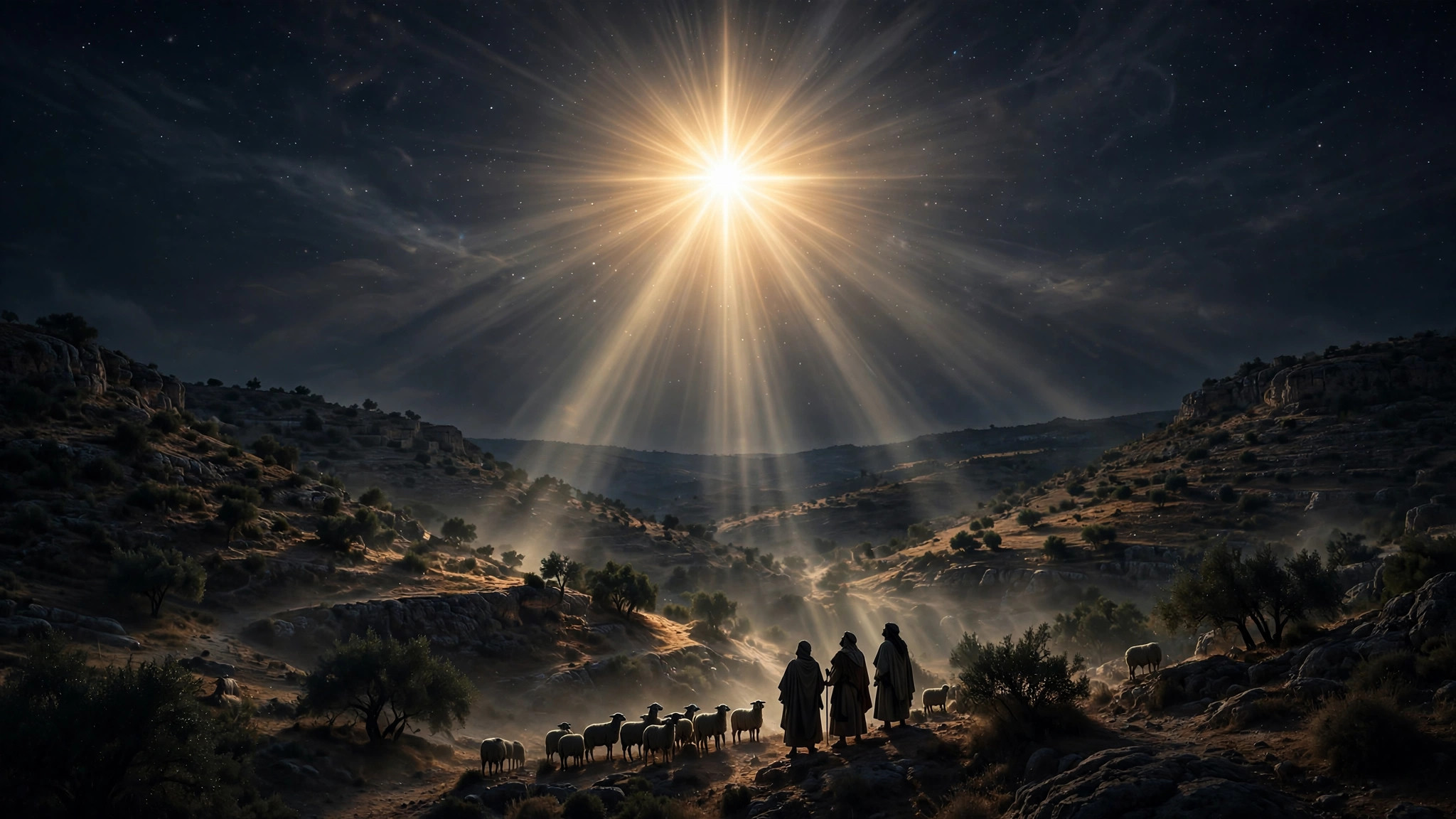
Heaven threw the first Christmas celebration — and no one on earth was invited. Long before there were trees, carols, or gift exchanges, on a hillside outside Bethlehem, the sky tore open with light and an army of angels filled the night with praise. The Bible's account of Christ's birth is not a quiet nativity scene under glass. It is a worship service that heaven could not contain, spilling over into the fields where shepherds trembled. If you have ever wondered whether God Himself celebrates Christmas, the answer is written across Luke chapter 2 in letters of angelic fire: He started it.
The Night Heaven Couldn't Stay Quiet
Picture the scene as Luke paints it. It is night. Shepherds — rough men, working the unglamorous shift — are keeping watch over their flocks. These are not priests or kings; they are the overlooked laborers of Judea. Then glory erupts. An angel of the Lord stands before them, the radiance of God's presence floods the field, and the shepherds are terrified. The angel's first word is the gospel's first word: do not be afraid.
What follows is the announcement that split history in two: unto you is born this day in the city of David a Savior, who is Christ the Lord (Luke 2:11). A Savior. Not a teacher, not a reformer — a Rescuer. And then heaven does something it rarely does: it shows up in force. Suddenly there is with the angel a multitude of the heavenly host praising God (Luke 2:13). The word Luke uses for “host” is a military term — this is an army, but an army that sings instead of marches. Their anthem is the first Christmas carol ever sung: Glory to God in the highest, and on earth peace among those with whom he is pleased (Luke 2:14).
And consider who heaven chose as the audience. Not the priests in the temple, not Herod in his palace, not the scholars who could parse Micah in their sleep — shepherds, men whose testimony wasn't even admissible in court. God has a pattern of bypassing the important to reach the available, and it is no accident that the first evangelists of Christmas were field workers who simply went and told everyone what they had seen (Luke 2:17). Heaven's celebration has always been an open invitation disguised as an announcement: the good news is for all the people, and the first to hear it are often the last the world would choose.
Read that slowly. The angels are not delivering a message anymore; the message has been delivered. They are celebrating it. Heaven looks down at a feeding trough in Bethlehem, sees the eternal Son wrapped in cloth, and cannot stay quiet. Praise detonates across the night sky. If celebration means joy so full it must be expressed, then the angels' song is the purest Christmas celebration in Scripture — thrown by heaven, for the glory of God, witnessed by shepherds who ran to see.
What “Celebrate” Meant That Night
Our word “celebrate” has been thinned by tinsel. For heaven, celebration had two ingredients, and both are in the angels' song.
First, glory upward: glory to God in the highest. Heaven's celebration was worship before it was anything else. The angels did not decorate the sky; they directed every eye in it toward God. Their joy had an object, and the object was the Father's faithfulness in sending the Son. True Christmas celebration, on heaven's terms, is doxology — praise that says, “Look what God has done.”
Second, peace outward: on earth peace among those with whom he is pleased. Heaven celebrated because the birth meant reconciliation — the long war between holy God and rebellious humanity had a peace treaty, and its name was Jesus. The angels rejoiced not over a cute baby but over what the baby's arrival accomplished: God and sinners, brought near.
Notice what is missing: no feast is described, no gifts exchanged, no date on a calendar. Heaven's celebration was worship and wonder, not festivity as we plan it. That doesn't condemn our traditions — the shepherds themselves spread the word with joy — but it recalibrates them. If our Christmas has noise without glory and giving without peace, we have kept the wrapping and lost heaven's gift.
The Old Testament Was Already Counting Down
The angels' song did not come from nowhere. For centuries, the prophets had been marking the days, and their promises are the reason heaven's joy that night was so explosive — the wait was over.
Isaiah, seven hundred years earlier, had seen the child and named His titles: Wonderful Counselor, Mighty God, Everlasting Father, Prince of Peace (Isaiah 9:6). Micah had pinpointed the village — Bethlehem, small among the clans of Judah, yet the birthplace of the coming ruler (Micah 5:2). The prophets spoke of a virgin bearing a son called Immanuel, God with us (Isaiah 7:14). Generation after generation of Israelites lit no candles for this, sang no carols — they simply waited, some faithfully, some forgetting. When the angel finally said “this day,” every unfulfilled promise in Israel's Scriptures exhaled at once. Heaven's celebration was the joy of a kept promise — the older the promise, the sweeter the keeping.
This is why Christmas belongs to the whole Bible, not just two chapters of Luke. The Old Testament is Advent: a long, aching countdown. The Gospels are the arrival. And the church's yearly celebration is simply joining a joy that heaven started and the prophets previewed.
Does God Celebrate It Now?
Does heaven still celebrate Christ's birth, or was that a one-night event? Scripture suggests the joy never stopped — it only changed key.
The book of Revelation pulls back the curtain on heaven's ongoing worship, and what do the elders and angels sing? Worthy is the Lamb who was slain (Revelation 5:12). The birth is never separated from the mission: heaven celebrates the incarnation because the incarnation led to the cross and the empty tomb. The angels over Bethlehem sang of the Savior's arrival; the saints around the throne sing of the Savior's victory. It is one continuous song with two verses.
And there is a tender detail worth noticing: Jesus told His disciples that there is joy in heaven over one sinner who repents (Luke 15:7). If heaven throws joy over a single returning prodigal, how much joy stands behind the night the Prodigal's Rescuer was born? God does not need December 25th on a calendar to celebrate — His celebration is the eternal, unflagging delight in the Son He sent. When we celebrate Christmas rightly, we are not inventing a party; we are echoing one that never ended.
That means our own celebrating is not imitation but participation. When a family sings carols with genuine awe, when a church gathers to proclaim the incarnation, when a believer quietly marvels at the manger on a December morning — heaven does not watch from a distance. The same joy that filled the Bethlehem sky fills the throne room still, and our worship joins a chorus that never stopped singing. We keep Christmas best not by manufacturing festivity but by tuning our hearts to a celebration already in progress, one that began with angels and will end with every tribe and tongue around the throne.
Three Questions Worth Asking
Is Christmas actually in the Bible?
The word “Christmas” never appears in Scripture, and the Bible gives no date for Jesus' birth — December 25th is a church tradition, not a biblical claim. But the event Christmas celebrates, the incarnation of Christ, is the hinge of the entire Bible, announced by angels and prophesied for centuries.
Did the early church celebrate Christ's birth?
The earliest Christians focused their calendar on Easter, Christ's resurrection. The formal celebration of His birth developed over the first few centuries. What Scripture models is not a date but a response: the worship, wonder, and witness of that first night.
How should Christians celebrate Christmas today?
Take heaven's pattern: glory upward and peace outward. Worship Christ deliberately — in song, in Scripture, in awe — and let the peace He brought spill into reconciled relationships and generosity. Tinsel is optional; doxology is not.
Final Word
So does God celebrate Christmas? He did first, He did best, and in a sense He never stopped — the angels' song over Bethlehem simply moved indoors, into the throne room, where it still rings. Our December traditions are at their truest when they are echoes of that first, heaven-thrown celebration: glory to God, peace to men, and a Savior in a manger at the center of it all. For the wider history of how this celebration developed, see the Wikipedia article on the Nativity of Jesus.










