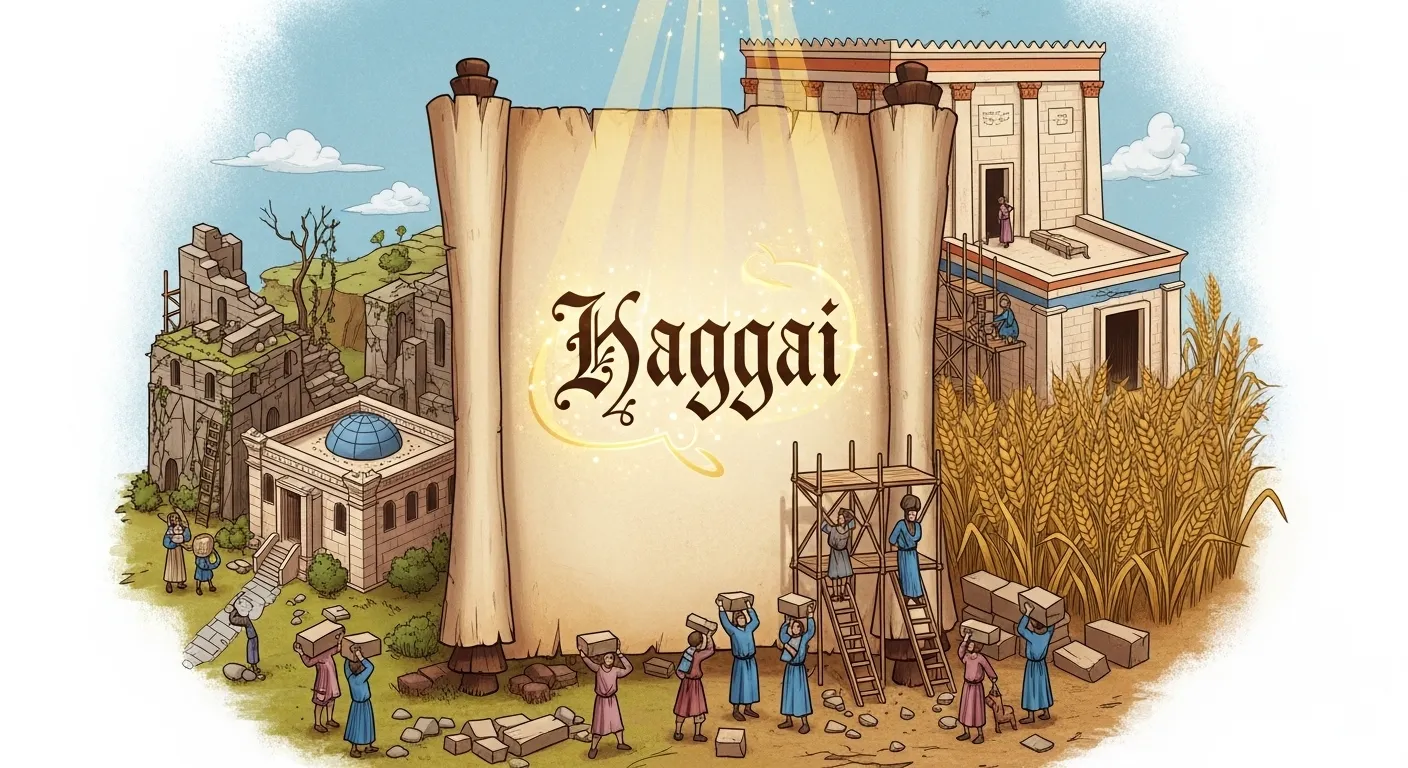
The Jews had come home — and home was a disappointment. After decades in Babylonian exile, a remnant returned to Jerusalem around 538 BC full of hope: the temple would rise again, the nation would be restored, God would surely bless the work. Instead they found rubble, hostile neighbors, crop failures, and an economy in ruins. So they did what discouraged people always do: they scaled back their ambitions. They built their own houses — paneled, comfortable houses — and left God’s house in ruins. Sixteen years passed. Then, in 520 BC, a prophet named Haggai — his name carrying the flavor of festival, of sacred celebration — stood up with a message so direct it still stings: you have the order backwards, and your empty lives are telling on you. The book of Haggai is only two chapters long, but it contains one of Scripture’s most searching diagnoses of misplaced priorities — and one of its most glorious promises.
The Diagnosis: “Give Careful Thought to Your Ways”
Haggai’s opening sermon is a masterpiece of loving confrontation. “Is it time for you yourselves to dwell in your paneled houses, and this temple to lie in ruins?” (Haggai 1:4). The question answers itself. Then comes the phrase that tolls like a bell through the whole book: “Now therefore, thus says the Lord of hosts: ‘Consider your ways!'” — literally, set your heart on your ways, take a long, honest look at the road you are walking.
What follows is a description of life under God’s quiet discipline, and every frustrated reader will recognize it: “You have sown much, and bring in little; you eat, but do not have enough; you drink, but you are not filled with drink; you clothe yourselves, but no one is warm; and he who earns wages, earns wages to put into a bag with holes” (Haggai 1:6). Sowing much, harvesting little. Eating without satisfaction. Money leaking through invisible holes. This is the universal experience of a life with its priorities inverted — maximum effort, minimum return, a gnawing sense that something is off. Haggai names the cause without flinching: “Because of My house that is in ruins, while every one of you runs to his own house” (Haggai 1:9). It was not bad luck. It was not the economy. It was the order of their loves.
The diagnosis lands because it is so transferable. Substitute “career,” “comfort,” “reputation,” or “busyness” for “paneled houses,” and Haggai is preaching to the modern reader. The bag with holes is still with us — the paycheck that never stretches, the schedule that never satisfies, the achievements that never quite fill the emptiness. Haggai’s claim is that these are not random frustrations. They are messages — God’s loving drought, designed to make a distracted people look up and ask why the blessing dried up. “I called for a drought on the land” (Haggai 1:11), God says, openly. He would rather His people be uncomfortable and honest than comfortable and lost.
The Prescription: “Go Up… and Build”
Diagnosis without prescription would be cruelty, so Haggai gives the remedy in one verse: “Go up to the mountains and bring wood and build the temple, that I may take pleasure in it and be glorified” (Haggai 1:8). Three verbs, each worth meditating on. Go up — obedience requires movement, effort, leaving the comfortable plain for the hard mountain. Bring wood — God asks for real materials, real labor, real cost; the offering that costs nothing is worth nothing. Build — stop planning, stop discussing, stop waiting for better conditions; build.
And notice the motive God gives: “that I may take pleasure in it and be glorified.” Not “so you will prosper” — though blessing follows — but so that God is pleased and glorified. This is the great reordering Haggai demands: stop building your life around what pleases you, and start building it around what pleases Him. The promise is that when the order is right, the blessing flows. And remarkably, the people listened. “Then Zerubbabel… and Joshua… with all the remnant of the people, obeyed the voice of the Lord their God” (Haggai 1:12). Twenty-three days after the first sermon, work on the temple resumed. The book of Haggai may be the most immediately obeyed prophetic book in the Bible — proof that plain, direct preaching still works when hearts are ready.
Then comes one of the tenderest sentences in the prophets. As the people pick up their tools, God sends Haggai with a five-word message: “I am with you, says the Lord” (Haggai 1:13). Not “I will bless your project” or “I approve your plans” — I am with you. Presence before prosperity. The workers needed to know, before the first timber was cut, that the God whose house they were building was standing beside them in the rubble. Every act of reordered obedience since — every person who has put God first at real cost — has received the same message in the same moment: I am with you.
The Discouragement: “Who Is Left… Who Saw This Temple in Its Former Glory?”
Two months into the work, discouragement arrived — as it always does. The older men who remembered Solomon’s temple looked at the modest new foundations and wept. It was smaller, poorer, unimpressive. “Who is left among you who saw this temple in its former glory? And how do you see it now? In comparison with it, is this not in your eyes as nothing?” (Haggai 2:3). Every rebuilding project faces this moment: the glorious past mocking the humble present. Every person starting over — after failure, after loss, after exile — hears the same whisper: this will never be what it was.
God’s answer is one of the great promises of Scripture, and it deserves to be memorized: “The glory of this latter temple shall be greater than the former… And in this place I will give peace” (Haggai 2:9). God does not deny that the present looks smaller. He declares that the future will be greater — not by human measurement, but by His. And history vindicated the promise beyond imagining: into this second temple, centuries later, walked Jesus Christ Himself. The glory of the latter house was not in its stones but in its Visitor. The lesson for every discouraged rebuilder: God is not finished with your second act. What you are building in weakness, He intends to fill with glory — and His idea of glory is bigger than your memory of the past.
With the promise comes the command that frames it: “Yet now be strong, Zerubbabel… be strong, Joshua… be strong, all you people of the land… and work; for I am with you” (Haggai 2:4). Three times be strong — to the governor, the priest, and the people; to leadership and laity alike. Strength here is not a feeling but a decision: work. Keep building when the foundations look small. Keep obeying when the past looks better than the present. The strength is supplied — “for I am with you” — but the working is required. God’s presence does not replace human effort; it empowers it.
The Final Word: The Signet Ring
Haggai’s last message, delivered on the same day as the promise of glory, is personal — addressed to Zerubbabel, the governor, a descendant of David living under Persian rule with no throne in sight: “I will take you, Zerubbabel… and will make you like a signet ring; for I have chosen you” (Haggai 2:23). A signet ring was the king’s seal of authority — the most personal, most treasured object a ruler owned, pressed into wax to authenticate decrees. To be God’s signet ring is to be His chosen instrument, His mark of authenticity on history.
The prophecy reaches beyond Zerubbabel himself: he appears in the genealogies of Jesus (Matthew 1:12-13), the Davidic line preserved through exile and return. God’s promise to the obscure governor was a down payment on the Messiah. And the principle extends to every believer: the God who called a displaced governor His signet ring calls ordinary, rebuilding people His chosen instruments today. Your work may look small. Your temple may look modest next to the former glory. But if God has set His seal on you, the work is royal — and the latter glory will be greater than the former.
Rebuild With God at the Center
Haggai’s two chapters form a complete spiritual cycle: consider your ways, build what matters, be strong when it looks small, and trust the promised glory. The book’s question still stands over every life with holes in its bags and emptiness in its achievements: what are you building first — your paneled house, or His? The answer determines everything downstream. Put God first, and the blessing that eluded you while you chased it begins to follow you while you work. “I am with you” — that is the whole gospel of Haggai in five words, and it is enough to build on. For the historical setting of this pivotal moment — the return from exile, the Persian period, and the temple’s reconstruction — the article on the Book of Haggai offers a concise and reliable background.










