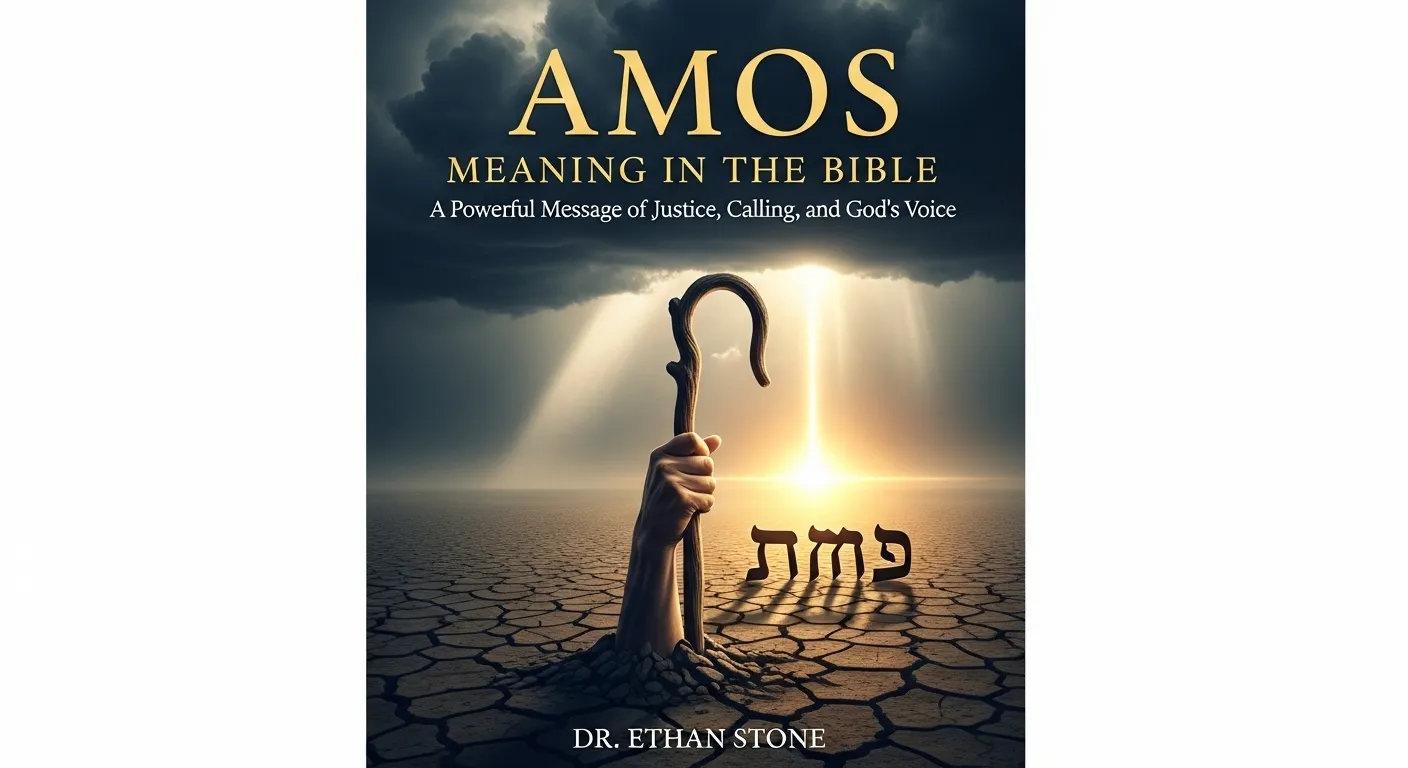
He introduced himself with a disclaimer: “I was neither a prophet nor the son of a prophet, but I was a shepherd, and I also took care of sycamore-fig trees” (Amos 7:14). Amos of Tekoa — a herdsman and orchard-keeper from the Judean hill country — was the most unlikely man to indict a nation. He had no seminary, no pedigree, no prophetic guild card. He had sheep, fig trees, and a message that would shake the kingdom of Israel to its foundations. When the professional priest Amaziah told him to go home and prophesy for pay in Judah, Amos answered with the quiet authority of a man who knows exactly who sent him: “The LORD took me from tending the flock and said to me, ‘Go, prophesy to my people Israel'” (Amos 7:15). God still drafts His messengers from pastures, not just pulpits.
The Indictment of the Nations
Amos begins like a war correspondent, delivering God’s verdicts on the nations surrounding Israel — Damascus, Gaza, Tyre, Edom, Ammon, Moab. Each oracle follows the same drumbeat: “For three sins of Damascus, even for four, I will not relent” (Amos 1:3). The formula is a Hebrew way of saying the cup is full — sin upon sin until judgment is unavoidable. The charges are specific and brutal: threshing Gilead with iron sledges, slave-trading whole communities, ripping open pregnant women in wartime expansion.
Israel’s audience would have loved this part. Yes — judge them, Lord! Every oracle against a foreign enemy was applause material in Bethel. Amos was building a rhetorical trap, and his listeners walked into it cheering. Six oracles against the nations, then one against Judah — still comfortable, still “them.” And then the seventh oracle turned, and the trap snapped shut: “For three sins of Israel, even for four, I will not relent” (Amos 2:6). The prophet his audience had been applauding was prosecuting them. The God who judges Damascus judges Israel by the same standard — a higher one, in fact, because Israel knew better.
The Indictment Comes Home
What had Israel done? Not the spectacular atrocities of the pagan nations — something more respectable and more damning. “They sell the righteous for silver, and the needy for a pair of sandals. They trample on the heads of the poor” (Amos 2:6–7). In an age of prosperity — Jeroboam II’s reign was Israel’s golden age economically — the wealthy were monetizing injustice: courts rigged against the poor, debt slavery for the price of shoes, luxury built on exploitation. Amos reserves his most withering scorn for the comfortable women of Samaria: “Hear this word, you cows of Bashan on Mount Samaria, you women who oppress the poor and crush the needy” (Amos 4:1). It is deliberately offensive language, meant to offend — pampered, well-fed, oblivious.
And the religion? Flourishing. “I hate, I despise your religious festivals,” God says through Amos; “your assemblies are a stench to me” (Amos 5:21). Israel was doing everything right liturgically — feasts, offerings, music — while doing everything wrong ethically. This is Amos’s central charge, and it echoes through every age of the church: worship without justice is noise to God. The Bethel sanctuary had become a place where people felt religious while practicing cruelty, and God would rather have silence than songs from such lips. Then the verse that became the prophet’s epitaph: “Let justice roll on like a river, righteousness like a never-failing stream!” (Amos 5:24). Not a trickle of charity when convenient — a river. Not occasional righteousness — a never-failing stream. God’s people are meant to be the geography through which justice flows.
The Plumb Line and the Summer Fruit
God showed Amos five visions, and two of them became symbols for the ages. The plumb line (Amos 7:7–9): the Lord standing beside a wall, holding the mason’s tool that tests whether a wall is true. “I am setting a plumb line among my people Israel; I will spare them no longer.” No more excuses, no more approximations — the wall would be measured against the straight standard, and it was crooked. The basket of summer fruit (Amos 8:1–2): in Hebrew, qayits (summer fruit) sounds like qets (the end). Ripe fruit means harvest — and harvest, for a nation under judgment, means the end. The wordplay is untranslatable and unforgettable: the time is ripe, and ripeness means reckoning.
It was after the plumb-line vision that Amaziah, priest of Bethel, sent word to King Jeroboam: “Amos is raising a conspiracy against you” (Amos 7:10) — and told Amos to go back to Judah and earn his bread there. Amos’s reply is the charter of every true prophet: he was not for hire, had never been for hire, and was not leaving. Then he delivered Amaziah’s personal verdict with devastating specificity (Amos 7:16–17). The professional clergy wanted a manageable religion; the shepherd brought an unmanageable God.
The Day of the LORD: Darkness, Not Light
Amos also corrects one of the most popular religious fantasies of his day — and ours. The people of Israel were looking forward to “the day of the LORD,” imagining it as the day God would finally crush their enemies and vindicate them. Amos turned the expectation inside out: “Woe to you who long for the day of the LORD! Why do you long for the day of the LORD? That day will be darkness, not light” (Amos 5:18). Then the chilling illustration: “It will be as though a man fled from a lion only to meet a bear, as though he entered his house and rested his hand on the wall only to have a snake bite him” (Amos 5:19). The day of the LORD would be judgment beginning with God’s own people — “Will not the day of the LORD be darkness, not light — pitch-dark, without a ray of brightness?” (Amos 5:20).
The correction lands in every generation that assumes God’s judgment is reserved for them — the other party, the other nation, the other religion. Amos insists that judgment begins at the house of God (a principle Peter would later state explicitly: 1 Peter 4:17). The people most confident of their standing were the ones with the most to fear, because they had the most light and the least obedience. Religious privilege is not a shield against judgment; it is an amplifier of accountability. “You only have I chosen of all the families of the earth; therefore I will punish you for all your sins” (Amos 3:2) — therefore. Election intensifies responsibility; it never excuses it.
For modern believers, Amos 5:18–20 is a standing warning against every version of “God is on our side” triumphalism — political, cultural, or ecclesiastical. The question is never whether God will judge evil; it is whether we have examined ourselves first. “Let us examine our ways and test them, and let us return to the LORD” (Lamentations 3:40). The day of the LORD is good news only for those who have already faced the plumb line and repented. For everyone else — including the religious — it is darkness. Amos loved his people enough to tell them so.
The Last Word Is Restoration
And yet — Amos does not end with the basket of summer fruit. After nine chapters of judgment comes one of the most surprising reversals in the prophets: “In that day I will restore David’s fallen shelter — I will repair its broken walls… The days are coming when the reaper will be overtaken by the plowman… I will plant Israel in their own land, never again to be uprooted” (Amos 9:11–15). Judgment is real, but it is not final. Beyond the exile lies restoration; beyond the plumb line lies a rebuilt house.
The New Testament heard this promise and recognized its fulfillment. At the Jerusalem Council, when the apostles debated whether Gentiles must become Jews to follow Christ, James stood and quoted Amos 9:11–12: “‘After this I will return and rebuild David’s fallen tent… so that the rest of mankind may seek the Lord'” (Acts 15:16–17). The shepherd’s vision of restoration became the charter for the Gentile mission — the proof that God’s rebuilt house would have room for the nations. Amos, the herdsman from Tekoa, ended up authorizing the worldwide church.
Amos’s meaning in the Bible is the meaning of his name’s burden: God sees, God measures, and God cares how His people treat the vulnerable. He is the prophet for every age of prosperity-with-injustice — which is to say, for every age. His questions still stand: Does your worship flow into justice, or substitute for it? Are you measuring your life by the plumb line, or by the applause of the sanctuary? And when God drafts an unlikely messenger — a shepherd, a fig-tender, an ordinary believer — will you listen, or will you, like Amaziah, try to send him home? For the historical background of the prophet and his times, see the Wikipedia article on Amos; for the message that still rolls like a river, open the book that bears his name — all nine chapters — and let the shepherd preach.










