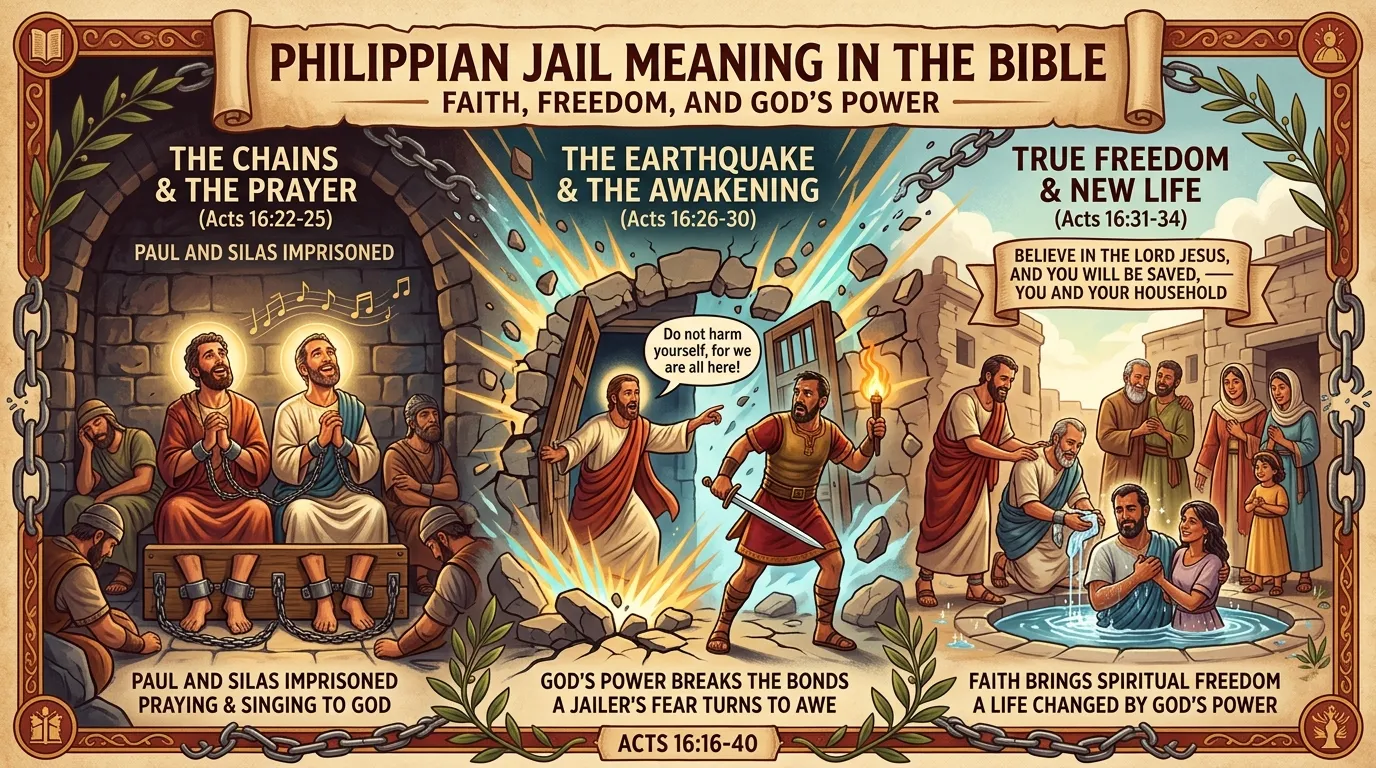
At midnight, in the inner cell of a Philippian prison, two beaten men began to sing. Their backs were raw from rods. Their feet were fastened in stocks. The jailer had been ordered to guard them carefully. And yet, Luke says, “about midnight Paul and Silas were praying and singing hymns to God, and the prisoners were listening to them” (Acts 16:25). What happened next, an earthquake, open doors, loosened chains, and a jailer’s conversion, has made the Philippian jail one of the most beloved scenes in the New Testament. Its meaning is not about prisons in general. It is about what worship, witness, and grace look like in the darkest place.
How Paul and Silas Got There
The road to the Philippian jail began with an act of mercy. Paul and Silas were in Philippi, a Roman colony in Macedonia, when they encountered an enslaved girl with a spirit of divination who earned money for her owners by fortune-telling. She followed them for days, shouting that they were servants of the Most High God. Paul, troubled, commanded the spirit to leave her in the name of Jesus Christ, and it did (Acts 16:16-18).
The girl’s freedom destroyed her owners’ income, and they dragged Paul and Silas before the magistrates. The charge was framed as a threat to Roman order: these men were Jews disturbing the city and advocating unlawful customs. The magistrates ordered them beaten with rods and thrown into prison without a trial, a serious violation of their rights as Roman citizens that Paul would later expose. The jailer received his orders: guard them carefully. He put them in the inner cell and fastened their feet in the stocks.
Notice the injustice. Paul and Silas were not criminals. They had freed a girl from exploitation. Their reward was a beating and a cell. The Philippian jail is therefore not a picture of punishment deserved. It is a picture of suffering endured for doing good, and of God’s presence in the middle of it.
Singing at Midnight
The most striking detail in the story is not the earthquake. It is the singing. Paul and Silas did not wait for deliverance before worshiping. They worshiped while they were still in stocks. Their prayers and hymns were not a performance for the other prisoners, though Luke notes that the prisoners were listening. They were the natural overflow of men who believed that God was present even in a prison cell.
There is a long tradition of midnight songs in Scripture. Israel sang after crossing the Red Sea. David wrote psalms in the night watches. The church at Philippi, which would grow out of this prison, would later receive Paul’s letter commanding joy in all circumstances. The Philippian jail is where that theology was first lived, not just taught. The singing did not deny the pain. It declared that pain was not the whole story.
The Earthquake and the Open Doors
Suddenly, Luke says, there was a great earthquake, so that the foundations of the prison were shaken. The doors were opened, and everyone’s chains were unfastened (Acts 16:26). The earthquake was a work of God, and it was a complete deliverance. Paul and Silas could have walked out. Every prisoner could have walked out.
But the story’s greatest moment is not the earthquake. It is what Paul did next. The jailer, waking to find the doors open, assumed the prisoners had escaped and drew his sword to kill himself, because under Roman law a jailer who lost his prisoners faced their punishment. Paul shouted, “Do not harm yourself, for we are all here” (Acts 16:28). The men who had been beaten and jailed chose to stay, and by staying they saved the life of the man who had locked them up.
This is the moral center of the passage. The miracle was not the escape. The miracle was the refusal to escape. Paul and Silas understood that their freedom was not worth a man’s life. The gospel they preached was a gospel of self-giving love, and in the prison they practiced it.
“What Must I Do to Be Saved?”
The jailer, trembling, fell down before Paul and Silas and asked the question that has echoed through two thousand years: “Sirs, what must I do to be saved?” (Acts 16:30). The answer was the gospel in its simplest form: “Believe in the Lord Jesus, and you will be saved, you and your household” (Acts 16:31). Paul and Silas spoke the word of the Lord to him and to all in his house. That same night, the jailer washed their wounds, was baptized with his whole household, and set food before them. Luke says he “rejoiced along with his entire household that he had believed in God” (Acts 16:34).
The scene is full of reversals. The jailer who had fastened their feet in stocks now washed their wounds. The prisoners who had been beaten now sat at a table in the jailer’s house. The man who had been ready to kill himself now rejoiced. The prison had become a church, and the jailer had become a brother.
The Jail as a Picture of Salvation
The Philippian jail has become a picture of what salvation means. Humanity, in the Bible’s telling, is imprisoned by sin, unable to free itself. God breaks the chains, not because we have earned it but because He is merciful. And the evidence of that freedom is not merely that the doors open but that the freed begin to love the people who locked them up. Paul and Silas stayed for the jailer. The jailer washed their wounds. Salvation in this story is not a private escape. It is a reconciliation.
The passage also shows that God works through suffering rather than merely around it. Paul and Silas did not preach to the jailer in a synagogue or a marketplace. They preached to him in a prison, at midnight, after a beating. The jailer’s conversion was not a detour from the mission. It was the mission. The gospel had come to Philippi, and its first fruit included a jailer who had been its enforcer.
What the Jail Teaches Today
For Christians facing their own dark places, the Philippian jail offers several truths. First, worship is possible in the worst circumstances, and it is often the most powerful witness. The other prisoners were listening. The jailer was listening. The singing did what an argument could not have done. Second, deliverance is not always escape. Sometimes God’s purpose in opening the doors is to give you the chance to stay and save someone else. Third, no one is beyond the reach of the gospel, not even the person holding the keys.
The Morning After: Justice and Apology
The Philippian jail story does not end with the jailer’s conversion. The next morning, the magistrates sent word to release Paul and Silas quietly. Paul refused to slip away. He pointed out that they had been beaten publicly, without trial, though they were Roman citizens, and he demanded that the magistrates come themselves to escort them out (Acts 16:37). The magistrates, alarmed, came and apologized in person, and asked them to leave the city.
Paul’s insistence was not pride. It was protection for the young church. If the apostles slunk out of town like criminals, the new believers in Philippi would carry the stigma. By forcing a public apology, Paul established that the Christians in Philippi were not lawbreakers. The jailer’s household, Lydia’s household, and the rest of the young congregation could hold their heads up. The jail that had been a place of suffering became, in the morning, a place where justice was publicly acknowledged.
Why the Jail Still Echoes
The Philippian jail has echoed through Christian history in hymns, prayers, and prison ministries. Believers who have been imprisoned for their faith, from the early martyrs to modern prisoners of conscience, have found in this story a pattern for their own suffering: worship in the cell, witness to the jailer, and the conviction that God is present in the darkest place. The story has also shaped the church’s understanding of its mission to prisoners. The jailer was not a footnote. He was the mission. The church that grew out of the Philippian jail has always remembered that the people on the other side of the bars matter to God.
The jail is also a reminder that God’s deliverance does not always look like escape. Paul and Silas were delivered from their chains, but they were not delivered from suffering. They would be beaten again, imprisoned again, and Paul would eventually die in Rome. The deliverance in Philippi was not a promise that Christians will always escape. It was a sign that God is present in the prison, that worship is possible at midnight, and that the chains that matter most have already been broken.
The Philippian jail is not a promise that every prison will shake or every suffering will end in an earthquake. Paul himself would spend years in prison and, by tradition, die in Rome. The promise is deeper: God is present in the cell, the singing is heard, and the chains that matter most, the chains of sin and death, have already been broken by Christ. For the broader history of the church in Philippi and the setting of this story, see the Wikipedia article on the Acts of the Apostles.