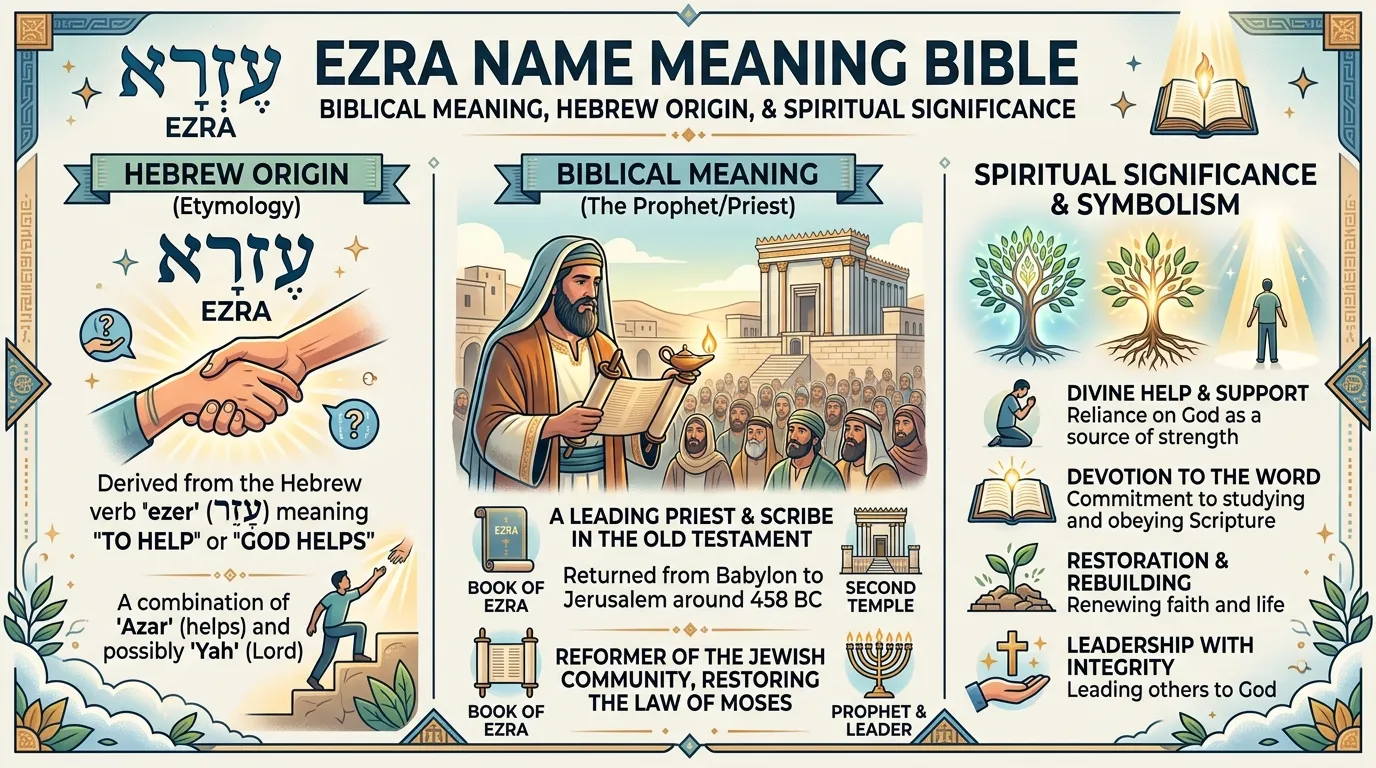
Of all the biblical names parents choose for their children, Ezra is one of the few where the man and the meaning illuminate each other. The name comes from the Hebrew ezrā, built on the root azar, “to help.” Ezra means “help” or “helper” — some render it “God is my help,” catching the theology the name implies. And the Ezra of Scripture is exactly that: a helper of God’s people, a priest and scribe who devoted his life to bringing a nation back to its God.
To understand the name, you have to understand the man. Ezra does not appear in the triumphant chapters of Israel’s story. He appears in the rubble. Jerusalem has been destroyed, the temple burned, the people carried to Babylon. A remnant has returned and rebuilt the temple, but the nation is spiritually hollow — intermarrying with surrounding peoples, ignorant of the law, drifting. Into this discouraging scene walks a scholar from Babylon with a scroll, a commission from a pagan king, and a heart set on God. That is the story the name carries.
The Scribe from Babylon
Ezra’s genealogy is given with unusual care: he is traced back through the high priestly line to Aaron himself. He is a priest by birth, but his defining title is different — “a scribe skilled in the Law of Moses.” In the ancient world, a scribe was more than a copyist. Ezra is a scholar, a teacher, and an interpreter of Scripture, the kind of man who has spent his life mastering the text so thoroughly that a king’s court recognizes his expertise.
That expertise opens a remarkable door. Artaxerxes, the Persian king, issues Ezra a decree granting him authority to travel to Jerusalem with silver and gold for the temple, to appoint judges, and to teach the law. Read the decree in Ezra 7 and you will find a pagan emperor speaking about “the God of heaven” and “the wisdom of your God” with surprising reverence. God can use the machinery of empire to serve His purposes — a truth Ezra’s life demonstrates before he ever reaches Jerusalem.
The journey itself is an act of faith. Ezra refuses a military escort from the king, telling Artaxerxes that God’s hand protects those who seek Him. Then he realizes what he has said, and he is ashamed to ask for soldiers after such a testimony — so he proclaims a fast and prays instead. The caravan sets out unguarded through bandit country, carrying a fortune in temple treasure. They arrive safely. Ezra’s commentary is simple: “The hand of our God was on us, and he delivered us.” Faith, for Ezra, is not a feeling. It is a travel plan.
The Verse That Defines Him
If Ezra’s whole life had to be compressed into one sentence, Scripture has already done it: “For Ezra had set his heart to study the Law of the Lord, and to do it and to teach his statutes and rules in Israel.” Three verbs, in a deliberate order: study, do, teach. This is Ezra’s method, and it is worth lingering over, because the order matters.
Study comes first. Ezra does not teach from impressions or enthusiasm. He studies — the Hebrew suggests a fixed, settled determination, a heart “set” like a foundation stone. In an age when the law was neglected and barely known, Ezra did the slow work of mastery. There is no shortcut here. Anyone who wants to teach Scripture must first submit to it as a student, and submission takes years.
Doing comes second, before teaching. Ezra practiced what he studied. This is the quiet rebuke to every form of religious professionalism that knows the text but ignores it. Ezra’s authority as a teacher flowed from his obedience as a disciple. He did not merely handle the word; he was handled by it.
Teaching comes last, as the overflow of the first two. Because Ezra had studied and obeyed, his teaching carried weight. When he later stands on a wooden platform and reads the law to the assembled people, they listen for hours, weeping. The tears are not a response to performance. They are a response to a man whose life matches his message.
The Crisis and the Confession
Ezra’s hardest moment comes soon after his arrival. The leaders report that the people — including priests and Levites — have intermarried with the surrounding nations, the very compromise that the prophets said caused the exile. Ezra’s reaction is physical: he tears his clothes, pulls hair from his head and beard, and sits appalled until the evening sacrifice. This is not administrative disappointment. It is grief.
Then he prays one of the great confessional prayers of the Bible. Notice the pronouns: “O my God, I am ashamed and blush to lift my face to you, my God, for our iniquities have risen higher than our heads.” Ezra had not personally committed the sin he is confessing. But he identifies with his people so completely that their guilt becomes his prayer. This is intercession in its purest form — standing in the gap, refusing the comfort of personal innocence while the community is in ruins.
The prayer works. The people gather, weeping, and a plan is made to put away the foreign marriages. The episode is painful and, to modern readers, troubling in its severity. But its principle endures: spiritual renewal begins when someone is willing to be broken over sin instead of merely annoyed by it. Ezra’s tears did what no decree could do. They made the nation feel the weight of what it had done.
The Reader on the Platform
The book of Nehemiah gives us Ezra’s finest hour. The wall is rebuilt, the people gather in the square, and they ask Ezra to bring the Book of the Law. He stands on a high wooden platform, opens the scroll, and reads from morning until midday. The Levites circulate, explaining the meaning so the people understand. The response is overwhelming: the people lift their hands, cry “Amen, Amen,” bow their faces to the ground — and weep.
But the leaders tell them not to weep: “This day is holy to the Lord your God; do not mourn or weep.” The reading of the law has exposed their failure, but the point of the exposure is not despair. It is joy. “The joy of the Lord is your strength.” Ezra’s ministry culminates not in condemnation but in a feast — the people go away to eat, drink, and share with those who have nothing, “because they had understood the words that were declared to them.” Understanding Scripture, in Ezra’s world, ends in celebration. That is still the goal of all biblical teaching.
The Legacy Beyond the Book
Jewish tradition credits Ezra with more than the events his book records. He is remembered as the leader of the Great Assembly, the body that preserved and ordered the Scriptures after the exile, and as the scribe whose work helped fix the text of the Hebrew Bible for the generations that followed. Whether every detail of the tradition is historically precise, the instinct behind it is sound: someone had to do the patient, unglamorous work of preserving God’s word when the nation was rebuilding, and Ezra is the natural candidate.
That is why the name still resonates. Every generation needs people willing to do Ezra’s work — not the spectacular work of the platform only, but the quiet work of the study desk: preserving, explaining, handing on. Movements are built by Nehemiahs with their walls and trumpets. They are sustained by Ezras with their scrolls.
What “Help” Looks Like in a Life
Return to the name. Ezra means help, and his life shows what divine help looks like when it wears human skin. Help studies before it speaks. Help fasts and prays before it travels. Help weeps over sin instead of excusing it. Help reads the Scripture publicly and explains it patiently. Help ends in joy.
For parents considering the name, the man behind it offers a prayer to pray over a child: that he would set his heart to study God’s word, do what it says, and teach it to others — in that order. For anyone carrying the name, Ezra is a standing invitation to the same three verbs. The world does not need more experts who do not obey, or more activists who have not studied. It needs Ezras: people whose help is deep because their roots are deep.
The name is a small word for a large calling. God is the ultimate helper — the Psalms call Him “my help and my deliverer” — and those who bear a name meaning help are reminded, every time they hear it, of whose strength they are meant to channel. Ezra knew the secret: the hand of God was on him because his heart was set on God. The order has never changed.
Those who want the fuller historical picture can consult the account of Ezra the scribe, which places his mission in the context of the Persian period and the return from exile.










