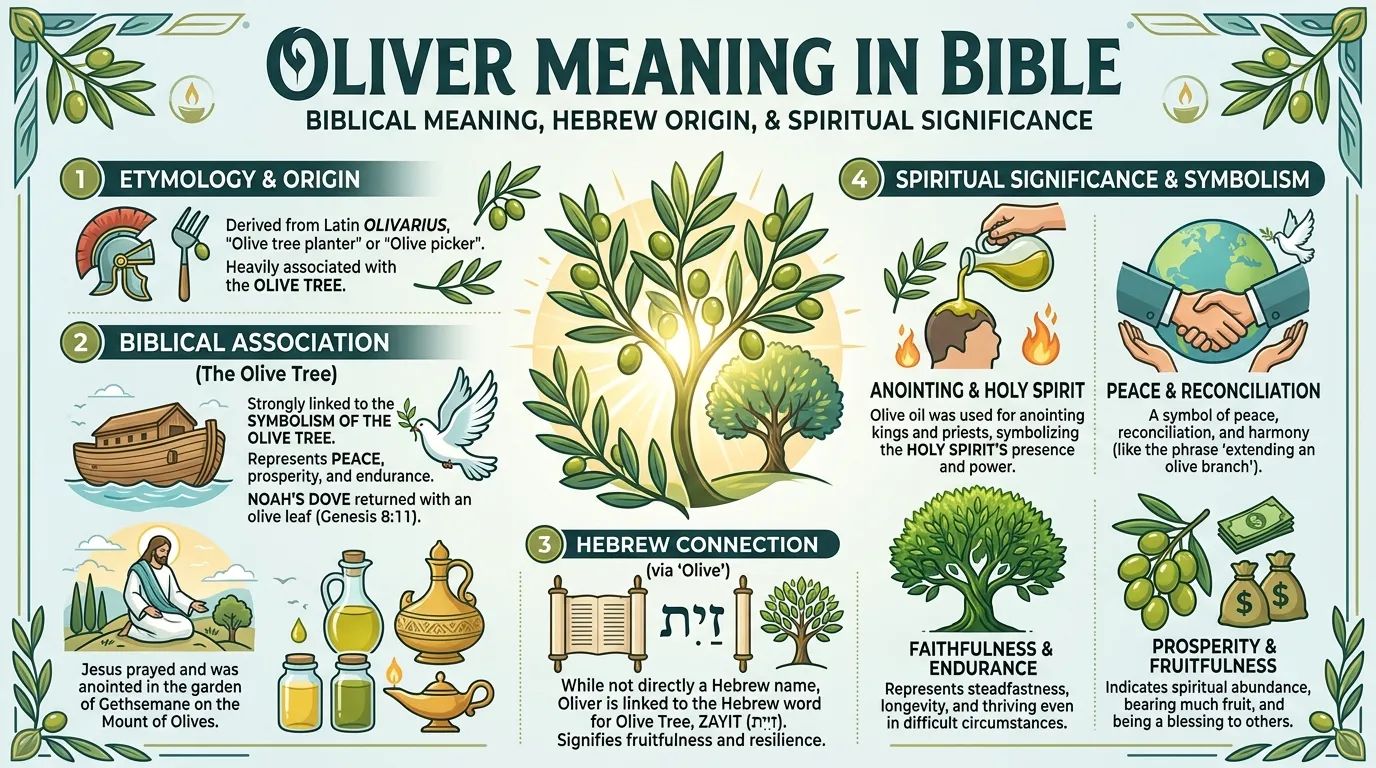
Oliver is not a biblical name. No Oliver walks the pages of Scripture, and no Hebrew or Greek root lies behind it. It is a Germanic name, from the old words for “elf army” or, in its more popular folk etymology, from the Latin oliva, the olive. That second association is the one that matters for Christians, because while the name Oliver never appears in the Bible, the olive tree appears everywhere in it — and everything the olive tree symbolizes can be prayerfully connected to the name.
This is an important distinction to keep straight. There is a difference between a name that comes from the Bible and a name that can remind us of biblical truth. Oliver belongs to the second category. What follows is not an attempt to manufacture a biblical origin that does not exist. It is a walk through the Bible’s own olive grove, to see what grows there and what it might mean for someone who carries this name.
The Tree That Survived the Flood
The olive tree enters the biblical story at one of its darkest moments. After the flood, Noah sends out a dove, and it returns with “a freshly plucked olive leaf” in its beak. In a world that has just been unmade by water, a single green leaf is the first evidence that life persists. The olive tree survived the judgment. It became, in that moment, the Bible’s first symbol of hope after catastrophe — and the dove carrying the olive branch became the enduring emblem of peace.
That image has never left the Christian imagination. When we speak of extending an olive branch, we are quoting Genesis 8 without knowing it. The olive leaf says: the waters are receding, the judgment is passing, God has remembered. For a name associated with the olive, that is a fine first lesson — that after every flood, God sends a sign that life will go on.
Oil for Anointing, Light, and Healing
The olive’s fruit — pressed into oil — may be even more significant than the tree. Olive oil in Scripture is the substance of consecration. When God instructs Moses to make the holy anointing oil, olive oil is its base. Priests are anointed with it. Kings are anointed with it. The tabernacle’s furnishings are anointed with it. To be anointed with oil is to be set apart for God’s purposes, and the word for “anointed one” — Messiah in Hebrew, Christ in Greek — is soaked in olive oil.
Olive oil also fuels the lamps. The golden lampstand in the tabernacle burns pure beaten olive oil, giving light in the holy place continually. The wise virgins in Jesus’ parable carry oil for their lamps while the foolish do not. Oil becomes an image of the Holy Spirit’s presence, of readiness, of the inner life that keeps burning when the night is long. And oil heals: the Good Samaritan pours oil and wine into the wounded traveler’s injuries, and James instructs the elders to anoint the sick with oil in the name of the Lord.
Anointing, light, healing — these are the olive’s three gifts in Scripture, and they read like a job description for a Christian life. To be “set apart” for God, to “give light” in darkness, to “bring healing” to the wounded: if a name can carry an aspiration, these are worthy ones.
The Cultivated Tree and the Wild Branches
Paul gives the olive tree its most theologically loaded role in Romans 11. He pictures Israel as a cultivated olive tree, and Gentile believers as wild olive shoots grafted in among the natural branches. The image is agricultural and precise: grafting was a known practice, and Paul uses it to explain the mystery of how the nations have been brought into God’s covenant people.
But Paul adds a warning that turns the image into a moral lesson. The grafted branches must not boast over the natural ones: “It is not you who support the root, but the root that supports you.” The olive tree becomes a picture of grace — unnatural, undeserved inclusion — and of humility. Every Gentile Christian is a wild shoot living off a root they did not plant. The olive tree thus teaches the two things Christians most need to remember: you were grafted in by mercy, and you stay by faith, not by pride.
Gethsemane: The Olive Press
The name of the garden where Jesus prayed before His arrest is Gethsemane, which means “oil press” — the place where olives are crushed to release their oil. The symbolism is almost too pointed to be accidental. On the night before the cross, Jesus is pressed in the olive press, and what comes out of the pressing is surrender: “Not my will, but yours be done.”
Olive oil only flows under pressure. That is true agriculturally, and the Bible treats it as true spiritually. The crushing in Gethsemane produced the obedience that led to the cross, and the cross produced the salvation of the world. Anyone reflecting on the olive’s meaning has to reckon with this: the oil of gladness, the oil of anointing, the oil of healing — all of it comes through pressing. God’s finest products are not manufactured in comfort.
The Two Olive Trees of Zechariah and Revelation
The olive appears in one of the Bible’s strangest and most encouraging visions. Zechariah sees a golden lampstand fed by two olive trees standing beside it, dripping oil directly into the lamps. When he asks what they are, the angel answers: “These are the two anointed ones who stand by the Lord of the whole earth.” The vision’s message is given in words as famous as any in the prophets: “Not by might, nor by power, but by my Spirit, says the Lord of hosts.”
The two olive trees are the source of the oil; the oil is the Spirit; the light is God’s work in the world. Human might and power are bypassed entirely. The fuel for everything God does comes from His own supply, flowing like oil from the trees. Centuries later, Revelation picks up the image: the two witnesses who prophesy in the last days “are the two olive trees and the two lampstands that stand before the Lord of the earth.” The olive tree thus becomes an end-times symbol of faithful witness — God’s anointed ones, sustained by His Spirit, shining in the darkest days.
For the name Oliver, this adds a final layer: witness. The olive does not only signify peace, anointing, and healing. In the Bible’s most symbolic visions, it signifies the people of God themselves — rooted, supplied, and shining by the Spirit rather than by their own strength.
The Mount of Olives
No tour of the Bible’s olive imagery is complete without the mountain named for the tree. The Mount of Olives stands east of Jerusalem, and it is woven through the story of redemption. David climbs it weeping as he flees Absalom. Ezekiel sees the glory of God depart the temple and pause over the mountain. Jesus teaches on it — the Olivet Discourse, with its prophecies of the end times, is delivered there. He prays at its foot in Gethsemane. And Luke records that He ascended to heaven from its slopes, with angels promising He will return “in the same way.”
Zechariah prophesies that on the day of the Lord, His feet will stand on the Mount of Olives. Whether one reads that literally or symbolically, the mountain of olives has become geography charged with eschatological hope: the place of weeping, of teaching, of prayer, of ascension — and of promised return. The olive, once again, stands at the intersection of sorrow and hope.
What the Olive Teaches the Name
So what can be said, honestly and helpfully, about the name Oliver? That it is not biblical in origin, but that its association with the olive opens a treasury. The olive survives judgment and signals peace. Its oil anoints kings, lights the sanctuary, and heals wounds. Its tree pictures the grafting of the nations into God’s people. Its press is where Jesus surrendered.
Those are not small things to be connected with. A child named Oliver can be prayed for with all of them: that he would be a peacemaker after floods, set apart for God’s purposes, a light in dark places, a healer of the wounded, humble about grace, and willing to be pressed when obedience requires it. None of that is superstition. It is simply taking the Bible’s own imagery and letting it shape how we think and pray.
The olive tree is also, finally, a picture of endurance. Psalm 52 describes the righteous person as “a green olive tree in the house of God,” trusting in God’s steadfast love forever. Olive trees live for centuries; some in the Garden of Gethsemane today are said to be two thousand years old. They survive drought, poor soil, and neglect, and they keep bearing fruit. That is the quiet promise tucked inside this name: not flash, but faithfulness; not speed, but staying power.
Readers who want to know more about the tree behind the symbolism can explore the botanical and cultural history of the olive, whose cultivation in the ancient Near East shaped the very images Scripture uses.










