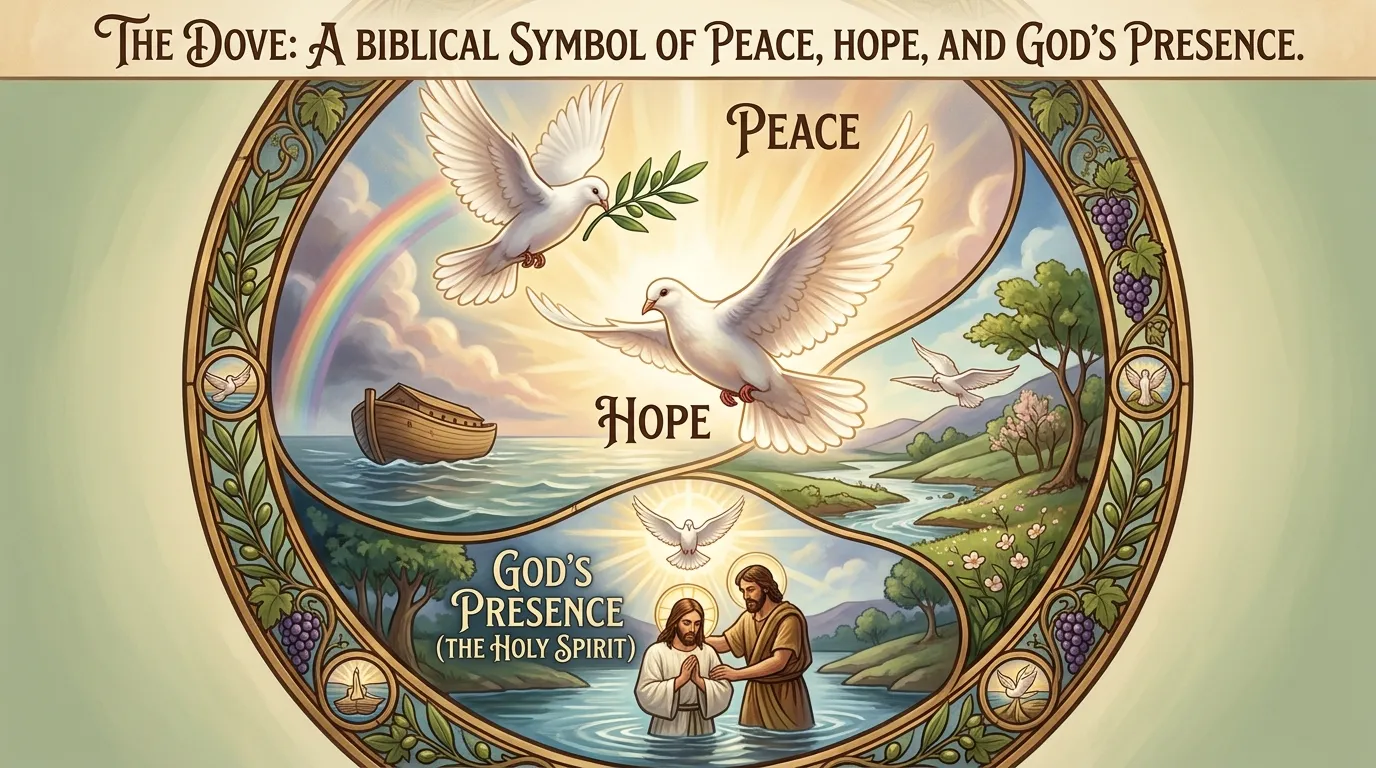
Noah opens the window of the ark and releases a dove. It flies out over a drowned world, finds nowhere to rest, and comes back. Seven days later he sends it again; this time it returns at evening with an olive leaf in its beak — the first green thing in a destroyed world, and Noah knows the waters are receding. A week later the dove leaves a third time, and does not return at all (Genesis 8:8-12).
Three flights, and the whole gospel is in them: sent out, returning with hope, finally free. The dove — Hebrew yonah, the same word as the prophet Jonah’s name — becomes one of Scripture’s most tender symbols. Follow it through the Bible and it preaches peace, sacrifice, love, and the Holy Spirit Himself.
The First Flight: Finding No Rest
The dove’s first flight fails. “The dove found no rest for the sole of her foot, and she returned unto him into the ark, for the waters were on the face of the whole earth” (Genesis 8:9). Noah puts forth his hand, takes her, pulls her back inside.
There is a quiet parable here about the human heart after judgment. Sent out into a world still under water — still under wrath — there is no rest to be found. Augustine would later write that our hearts are restless until they rest in God; the dove’s first flight is that restlessness with wings. It returns, and the hand reaches out to receive it. Every sinner who has tried to find peace in a flooded world and come back empty knows this flight.
The Second Flight: The Olive Leaf
The second flight succeeds, and its evidence is small: “lo, in her mouth was an olive leaf pluckt off” (Genesis 8:11). Not a branch. A leaf. The smallest possible sign that life has survived judgment, that the waters are going down, that God has remembered.
That is how hope usually arrives — not as a resolution but as a leaf. A verse that steadies you. A friend’s text at the right hour. A morning when the grief is slightly lighter. Noah “knew that the waters were abated from off the earth” from a single leaf, and faith still reads providence in small evidences. Do not despise the leaf because it is not the dry land. The leaf means the dry land is coming.
It is no accident that the dove with the olive branch became humanity’s universal emblem of peace. The image was minted here, in Genesis 8, and it has never been spent.
The Third Flight: Freedom
“And he sent forth the dove; which returned not again unto him any more” (Genesis 8:12). The third flight does not come back — because it does not need to. The world is habitable. Judgment is over. The dove is free.
Read the three flights together and you have the arc of redemption: the soul finding no rest under wrath, the soul receiving the first green evidence of grace, the soul finally free — “if the Son therefore shall make you free, ye shall be free indeed” (John 8:36). Noah’s dove, without knowing it, acted out the gospel in three short trips.
The Dove of Sacrifice: Worship for the Poor
The dove appears next in the law — and its role there is deeply compassionate. When an Israelite could not afford a lamb for the sin offering, God permitted “two turtledoves, or two young pigeons” (Leviticus 5:7). The poor man’s sacrifice. The same provision covers the burnt offering (Leviticus 1:14) and the purification after childbirth (Leviticus 12:8).
Mary and Joseph bring this offering. When they present the infant Jesus at the temple, they offer “a pair of turtledoves, or two young pigeons” (Luke 2:24) — Luke’s quiet signal that the Savior was born into poverty. The King of kings enters the temple under the provision made for the poor. The dove, the sacrifice of those who have nothing, becomes the first sacrifice offered for the One who would become the final sacrifice for all.
The Dove of Love: Eyes Like Doves
In the Song of Songs, the lover says to his beloved, “thou hast doves’ eyes” (Song of Songs 1:15) — and she returns the compliment (5:12). In ancient poetry, the dove’s eye suggested gentleness, loyalty (doves mate for life), and a soft, undivided gaze.
The church has long read this as Christ’s description of His people — and the application is searching: does the Bride of Christ have dove’s eyes? A single, gentle, loyal focus on her Beloved, undistracted by rival lovers? “Thou shalt have no other gods before me” (Exodus 20:3) is, in the Song’s imagery, a call to dove-eyed devotion.
The Dove of the Spirit: Descending at the Jordan
Then comes the dove’s greatest moment. At Jesus’ baptism, “he saw the Spirit of God descending like a dove, and lighting upon him” (Matthew 3:16). All four Gospels record it (Mark 1:10; Luke 3:22; John 1:32). Heaven opens, the Father speaks, the Son stands in the water, and the Spirit descends — like a dove.
Why a dove? The symbol gathers every earlier thread: the dove of Noah’s new beginning now marks the new beginning of the new creation; the dove of sacrifice now rests on the final Sacrifice; the dove of gentleness now anoints the one who is “meek and lowly in heart” (Matthew 11:29). And there is a further echo — Genesis 1:2, where the Spirit “moved” (literally hovered, like a bird) over the waters. At the Jordan, the hovering Spirit of creation descends on the one who will make all things new.
Jesus then gives the dove as a discipleship standard: “be ye therefore wise as serpents, and harmless as doves” (Matthew 10:16). Dove-harmlessness — the Greek is akeraios, unmixed, pure — is not naivety. It is serpent-wise and dove-pure: shrewdness without venom, discernment without malice. The Christian in a hostile world is to be the creature that cannot poison anyone.
The Dove in the Prophets: Silliness and Return
The prophets use the dove in two striking passages that deepen the symbol. Hosea, confronting Israel’s spiritual adultery, calls Ephraim “like a silly dove without heart” (Hosea 7:11) — fluttering to Egypt, then to Assyria, seeking help everywhere but from God. The dove’s gentleness has a shadow side: naivety. The harmless can become the heedless, drifting to every power but the true one. Jesus’ “wise as serpents” (Matthew 10:16) is the antidote — dove-gentleness must be paired with serpent-discernment, or silliness results.
But Hosea also gives the dove its homecoming: “they shall tremble as a bird out of Egypt, and as a dove out of the land of Assyria: and I will place them in their houses, saith the LORD” (Hosea 11:11). The silly dove, scattered among the nations, flies home — trembling, but returning. The same bird that pictures foolish wandering pictures final restoration. God’s people may flutter far, but grace has a homing instinct: “I will place them in their houses.”
David, too, reaches for the dove in despair: “Oh that I had wings like a dove! for then would I fly away, and be at rest” (Psalm 55:6). Betrayed by a friend, David envies the dove’s escape. It is the most human dove-moment in Scripture — not theology but longing: if I could just fly away from this. The psalm’s answer is not wings but trust: “Cast thy burden upon the LORD, and he shall sustain thee” (Psalm 55:22). The dove’s flight is beautiful; the believer’s rest is better — not escape from trouble but sustainment in it.
One more flight deserves mention: the dove of your story. Every believer lives the three flights — the restless searching before grace, the first green evidence of God’s work, and the final freedom that is coming. You may be on flight one, circling a flooded world; watch for the hand reaching out. You may be on flight two, holding a single leaf of hope; trust that dry land is near. Or you may be tasting flight three already — the liberty of the children of God, beginning now and completed at His return.
The Dove’s Sermon
Put the threads together and the dove preaches a complete message. To the restless, it says: there is an ark, and a hand reaching out (Genesis 8:9). To the waiting, it says: watch for the leaf; hope comes small before it comes complete (Genesis 8:11). To the poor, it says: God accepts the smallest offering (Leviticus 5:7). To the beloved, it says: keep your eyes single and soft (Song of Songs 1:15). To the baptized, it says: the Spirit descends gently and remains (Matthew 3:16). To the sent, it says: go wisely, harm no one (Matthew 10:16).
A small gray bird, and it carries all that. The next time you see a dove — on a wire, in a park, on a peace poster — remember Noah’s window. The symbol is older than the ark’s landing, and its meaning has never changed: judgment ends, peace comes, and the Spirit descends like a dove. The Wikipedia article on doves as symbols traces how this Genesis image traveled through art, religion, and politics across the centuries; the Bible itself gives the image its first and deepest meaning.










