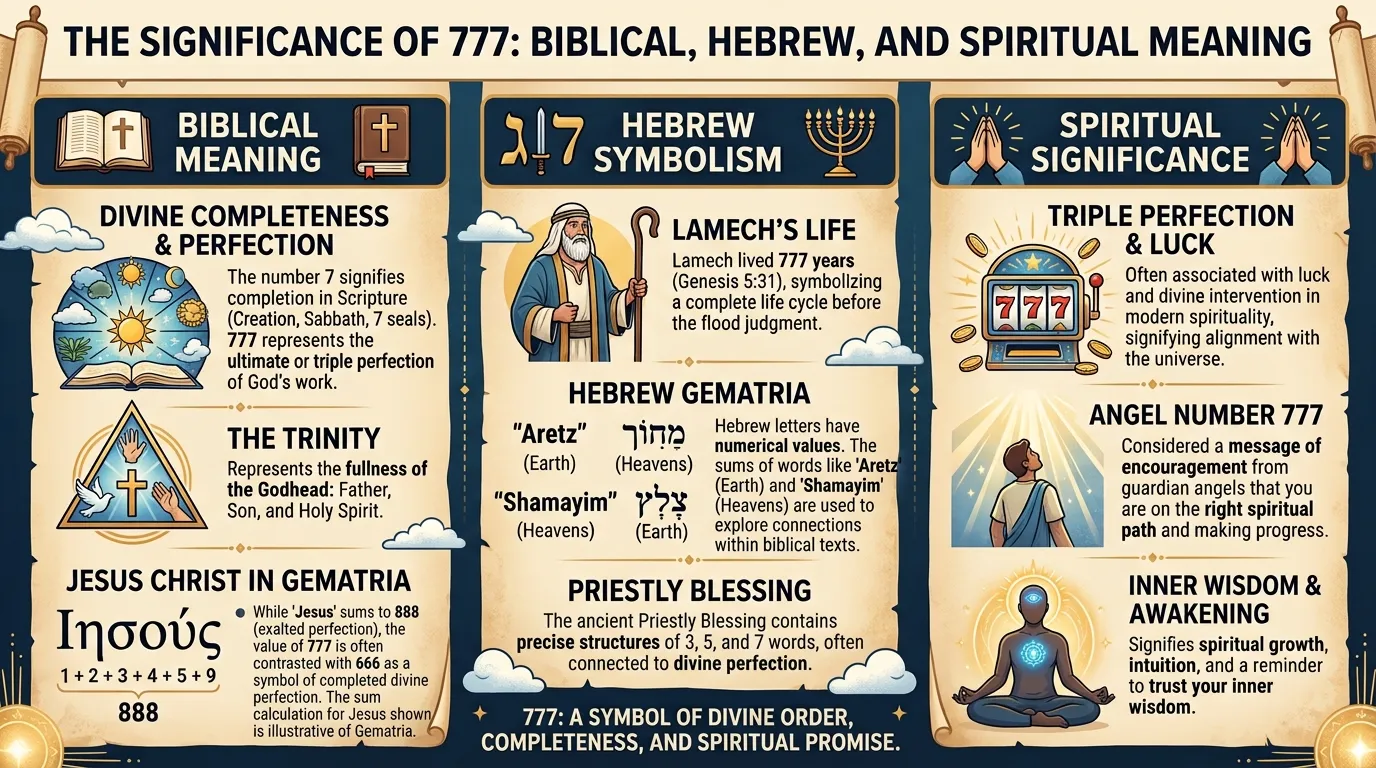
Here is a fact that surprises almost everyone who searches for this topic: the number 777 never appears in the Bible. Not once. Not as a triple, not as a sequence, not in any verse, in any translation. The Bible mentions seven constantly — but it never writes “seven-seven-seven.”
That does not make the question uninteresting. It makes it honest. Because the fascination with 777 is real, and it deserves a better answer than either “it’s a magic angel number” or “stop asking questions.” The truth is richer than both: Scripture gives us everything we need to understand why seven matters, why triplets matter, and why 777 captures the imagination — without ever turning it into a code God never published.
Why Seven Matters: The Bible’s Number of Completeness
Seven is everywhere in Scripture, and its symbolism is not speculative — it is structural. God creates in six days and rests on the seventh (Genesis 2:2-3), stamping completeness into the week itself. The pattern echoes relentlessly:
- Seven seals, seven trumpets, seven bowls in Revelation — God’s judgments complete and total.
- Seven churches addressed in Revelation 2-3 — the whole church, in all places and ages.
- Seven “I AM” statements in John — the complete revelation of Christ.
- Seventy (seven times ten) elders, seventy disciples sent out — completeness multiplied.
- “Seventy times seven” forgiveness (Matthew 18:22) — completeness as a command: forgive completely.
The Hebrew word for seven, sheva, shares its root with the verb “to swear” — oaths were “sevened,” made complete and binding. Seven is the number of a finished thing: creation finished, judgment finished, revelation finished. When the Bible wants to say complete, it often just says seven.
Why Triplets Matter: The Bible’s Way of Saying “Ultimate”
Now add the second ingredient. Scripture intensifies by repetition in threes — and this, unlike 777 itself, is genuinely biblical:
The seraphim cry, “Holy, holy, holy, is the LORD of hosts” (Isaiah 6:3) — not once, not twice, but three times. Triple holiness: holiness to the ultimate degree. Jesus introduces His most solemn sayings with a doubled “Amen” — “Verily, verily, I say unto thee” (John 3:5) — and the Old Testament’s “holy of holies” is literally the “holy holy” place, the most holy place by grammatical intensification.
“A threefold cord is not quickly broken” (Ecclesiastes 4:12). Peter denies three times and is restored three times (John 18; 21). Paul pleads three times for the thorn’s removal (2 Corinthians 12:8). The threefold pattern runs through Scripture as the signature of emphasis, completeness, and divine fullness — the Trinity being the ultimate three.
So when people sense that 777 feels significant, they are responding to two real biblical instincts at once: seven means complete, and triple repetition means ultimate. 777 is the folk-theology shorthand for “completeness to the ultimate degree.” The instinct is sound; the number itself is just not in the text.
Seven in the Life of Jesus
If seven is the Bible’s number of completeness, watch how it gathers around Christ. Seven demons cast out of Mary Magdalene (Luke 8:2) — complete deliverance. Seven baskets of leftovers after the feeding of the four thousand (Matthew 15:37) — complete provision. Seven brothers in the Sadducees’ riddle (Matthew 22:25) — complete absurdity, answered by complete wisdom.
Seven parables of the kingdom in Matthew 13 — the complete picture of how the kingdom grows. Seven “I AM” sayings in John — the complete self-revelation: bread, light, door, shepherd, resurrection, way, vine. Seven words from the cross — the complete atonement, spoken to the end: forgiveness, paradise, provision, forsakenness, thirst, finished, committed.
And sevenfold praise in Revelation 5:12 — “Worthy is the Lamb that was slain to receive power, and riches, and wisdom, and strength, and honour, and glory, and blessing” — count them: seven ascriptions, the complete worship of the complete Christ. The sevens of Scripture converge on Him the way rivers converge on the sea. If you want a biblical “777,” this is it: not a code to crack but a chorus to join — completeness, completeness, completeness, all of it Christ.
777 and 666: The Contrast That Isn’t Quite There
Much of 777’s reputation comes from its mirror image: 666, “the number of the beast” (Revelation 13:18). The reasoning goes: if 666 is ultimate evil (six = falling short of seven, tripled), then 777 must be ultimate good. It is elegant. It is also, strictly speaking, unbiblical — the Bible never makes this pairing.
What Revelation actually does with six is subtler. Six is the number of man — created on the sixth day (Genesis 1:26-31) — and 666 is humanity’s number tripled: man magnified, man deified, man without God, falling short of seven (divine completeness) at every digit. The contrast Revelation draws is not between 666 and 777 but between the beast’s number and the Lamb’s name — between self-exaltation and the one “worthy… to receive power, and riches, and wisdom, and strength, and honour, and glory, and blessing” (Revelation 5:12), praised in a sevenfold doxology.
Sevenfold praise — there is your biblical “777,” if you need one: not a number to decode but worship to join.
The Honest Limits
This is where integrity requires plain speech. The popular “angel number” teaching — that seeing 777 means angels are confirming your path, or that it unlocks prosperity — has no biblical foundation. It borrows the Bible’s vocabulary (angels, numbers, blessing) and attaches it to a system the Bible never teaches. God does not outsource His guidance to digit patterns.
That does not mean God cannot use a coincidence to prompt you. If seeing 777 reminds you of His completeness, drives you to Scripture, or prompts prayer — receive the prompting with thanks. But build nothing on it. “Thy word is a lamp unto my feet” (Psalm 119:105): guidance comes through the revealed Word, confirmed by the Spirit, tested by the church — not through repeated digits on a receipt.
And beware the prosperity trap. Some teachers link 777 to guaranteed blessing and breakthrough. But the Bible’s sevens include seven seals of judgment, seven years of famine (Genesis 41:27), and seven churches — two of which receive no commendation at all. Seven means complete, not comfortable. God’s completeness includes His holiness, His discipline, and His “it is finished” (John 19:30) — which was spoken from a cross.
There is one more right use of the number: as a call to finish well. Seven is completion; the Christian life is a race to be completed, not merely started — “I have finished my course” (2 Timothy 4:7). Let every 777 you notice ask the question: am I finishing?
What 777 Can Rightly Remind You Of
Strip away the speculation, and the number — as a human meditation prompt, not a divine code — can point to solid truths:
- God finishes. Seven is completion; your salvation is not a draft. “He which hath begun a good work in you will perform it until the day of Jesus Christ” (Philippians 1:6).
- God is thrice holy. The seraphim’s triple cry is the Bible’s real “triple seven” — ultimate holiness, worthy of ultimate reverence.
- Rest is complete. The seventh day hallows the week; the finished work of Christ hallows the soul. Completeness, in Scripture, usually looks like rest, not achievement.
- Worship is sevenfold. Join Revelation 5:12’s sevenfold ascription — the closest thing Scripture gives to a “777,” and it is sung, not decoded.
Questions About 777
Is 777 God’s number?
The Bible never calls it that. Seven is richly symbolic in Scripture; the triple form 777 is a human extrapolation. God has not given Himself a lucky number, and treating one as such edges toward superstition.
What does it mean when I keep seeing 777?
Most likely: your brain’s pattern-recognition system (which is excellent at noticing repeats) plus a meaningful association you have already formed. Let it prompt prayer and Scripture, not decisions. If it draws you to God’s completeness, that is a good fruit from a neutral trigger.
Is 777 the opposite of 666?
Not biblically. The contrast is appealing but invented; Revelation never pairs them. The true opposite of the beast’s number is not another number but a Person — the Lamb who was slain.
Does the Bible use triple numbers anywhere?
Only once, and it is not 777: the “holy, holy, holy” of Isaiah 6:3 and Revelation 4:8 — a triple word, not a triple number. Scripture intensifies by repeating words (verily verily, holy holy holy), never by stacking digits. That is a telling difference: God’s emphasis comes through proclamation, not numerology.
The fascination with 777 testifies to something true: the human heart senses that seven means finished, whole, complete — and longs for a completeness only God can give. Scripture satisfies that longing not with a code but with a cross and an empty tomb. For the number’s mathematical properties and cultural appearances, the Wikipedia article on 777 is a fine reference; for its meaning, the Bible’s own sevens — creation, rest, and the finished work of Christ — say everything worth saying.










