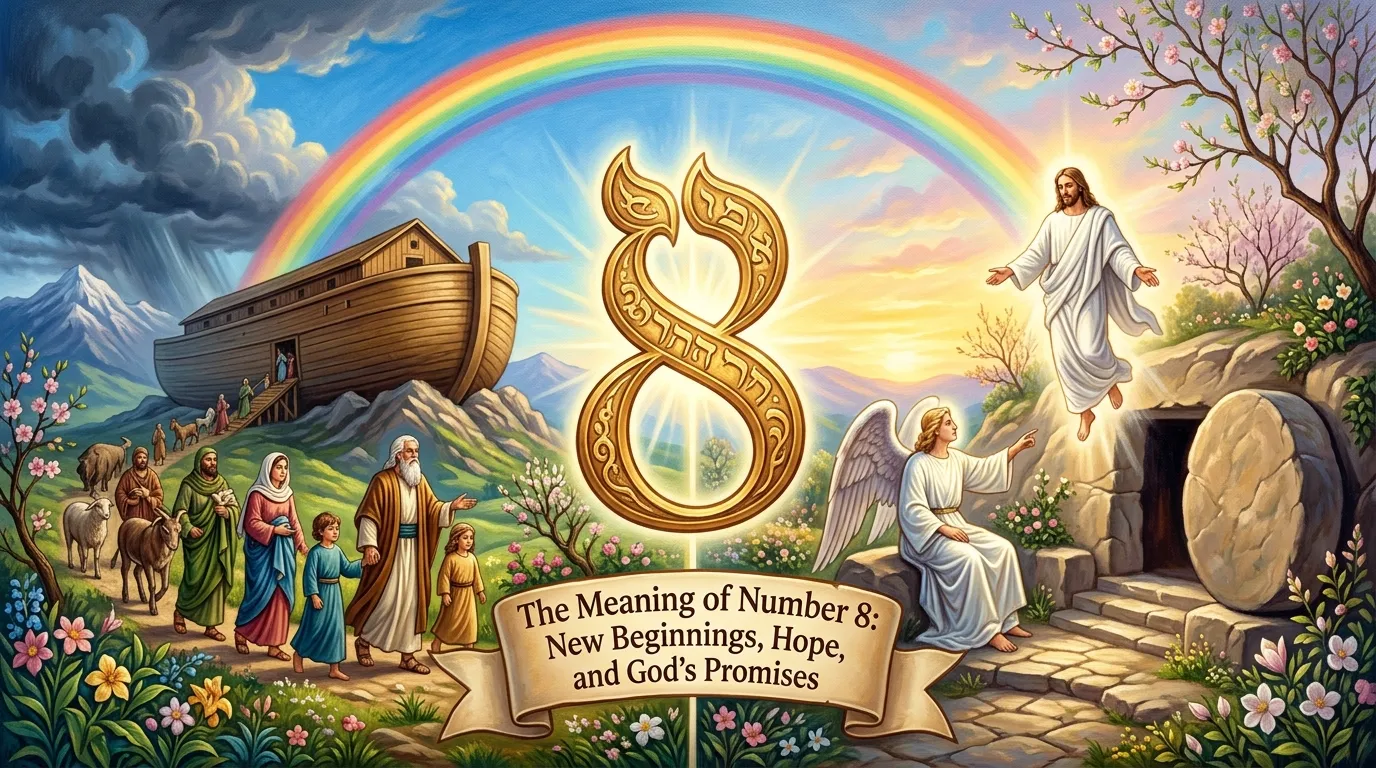
On the eighth day, everything changed. A Hebrew boy was circumcised on the eighth day (Genesis 17:12) — marked as belonging to God’s covenant people. The Feast of Tabernacles ran seven days and then added an eighth, “a solemn assembly” (Leviticus 23:36), as if the week of celebration overflowed its boundaries. And the women came to the tomb “on the first day of the week” — which is also, by ancient reckoning, the eighth day: the day after the Sabbath, the first day of a new creation. Across Scripture, the number eight keeps showing up at the same address: new beginnings.
But before we build a system on that observation, honesty requires a caution — one this article will keep. The Bible never assigns eight an official meaning the way a dictionary assigns definitions. It never says “eight means new beginnings” in so many words. What it does is use eight repeatedly at moments of fresh starts, and wise readers notice patterns without turning them into promises. There is a world of difference between “Scripture often associates eight with new beginnings” (true and edifying) and “God will give you a new beginning because you saw the number 8” (unbiblical and misleading). This article aims for the first.
Where Eight Actually Appears
The pattern is worth tracing, because it is genuinely there:
- Circumcision on the eighth day (Genesis 17:12; Leviticus 12:3). The covenant sign is given not on day one or day seven but day eight — the child’s first day of the new week, entering covenant life. Paul later calls the resurrection-era equivalent “a circumcision made without hands” (Colossians 2:11).
- The eighth day of the feasts. Both the Feast of Tabernacles (Leviticus 23:36) and the dedication of the temple (2 Chronicles 7:9) add an eighth day beyond the complete seven — as if God’s celebrations refuse to fit inside completeness and spill into something new.
- Eight souls in the ark (1 Peter 3:20). Noah, his wife, his three sons and their wives — eight people carried through judgment into a washed world. Peter explicitly connects the ark to baptism: the eight who passed through water prefigure those who pass through baptismal water into new life.
- The eighth day resurrection. Jesus rises “on the first day of the week” (John 20:1) — the day after the seventh-day Sabbath, the eighth day by inclusive counting. The early church instinctively grasped this: they moved their primary worship to Sunday, the eighth day, the day of new creation (Acts 20:7; Revelation 1:10).
- David, the eighth son (1 Samuel 16:10–11). Seven sons pass before Samuel; the eighth, the overlooked shepherd boy, is God’s choice for king. The pattern holds: after human completeness (seven), God’s new thing (eight).
Seven, Then Eight: Why the Pattern Works
Seven in Scripture is the number of completeness: seven days of creation, sevenfold forgiveness, seven churches, seven seals. The Sabbath — the seventh day — is the crown of the created order. Eight, then, is what comes after completeness: not a better seven but a new one. The eighth day does not improve the old week; it starts a new week.
Theologically, this maps beautifully onto the gospel. The old creation, complete in seven days, fell. The new creation, launched on the eighth day at the empty tomb, will not fall. “If anyone is in Christ, he is a new creation. The old has passed away; behold, the new has come” (2 Corinthians 5:17). Every Sunday gathering is, whether we realize it or not, an eighth-day celebration — the church meeting on resurrection ground, rehearsing new creation weekly.
The Early Church Kept Counting to Eight
The apostles’ successors did not miss the pattern. The Epistle of Barnabas (circa AD 100) explicitly calls Sunday “the eighth day… the beginning of another world” — the day Jesus rose, the day the new creation dawned. Justin Martyr, writing around AD 150, explains to a pagan emperor that Christians gather on Sunday “because it is the first day on which God… made the world; and Jesus Christ our Savior on the same day rose from the dead.” The eighth-day theology was not a medieval invention; it was the first generations’ instinctive reading of the resurrection.
This is why baptismal fonts in the ancient church were so often octagonal — eight-sided. The catechumen descended into an eight-walled pool and rose into eighth-day life: buried with Christ, raised to newness. Architecture preached the sermon every Sunday. The number never became magic; it became memory — a shape that reminded every believer what day it was in redemptive history.
Even the structure of Matthew’s Beatitudes nods toward eight: eight blessings (Matthew 5:3–10), with the eighth — “Blessed are those who are persecuted for righteousness’ sake” — carrying the promise of the kingdom, just as the first did. The list completes its circle and begins again: persecution for Christ’s sake is, paradoxically, the doorway to the kingdom’s new beginning. The persecuted are not the finished; they are the freshly started.
An Honest Word About Number Symbolism
This is where care matters. The Bible uses numbers meaningfully, but it never teaches numerology as a system. Nowhere does Scripture instruct believers to decode their lives through number sightings, assign spiritual meanings to addresses or dates, or expect events because a number appeared. That practice comes from pagan and occult traditions, not from the Bible — and it can quietly shift trust from God’s revealed word to private patterns.
The safe rule: let Scripture’s patterns illustrate Scripture’s promises, never replace them. Eight beautifully illustrates new beginnings — but the promise of new beginnings rests on the resurrection, not on arithmetic. If the number eight encourages you to remember that God specializes in fresh starts, it has served you well. If it becomes a good-luck token, it has become an idol. “We walk by faith, not by sight” (2 Corinthians 5:7) — and certainly not by digit-counting.
Living in the Eighth Day
Taken rightly, the eights of Scripture preach a sermon of hope:
- God is not finished with your story. The eighth day follows the seventh — after the week is complete, after the situation looks settled, God starts something new. The tomb was sealed; then came Sunday.
- New beginnings require passing through. The eight in the ark passed through water; Israel’s boys entered covenant on day eight through a small pain; Jesus reached the eighth day through death. Resurrection mornings follow crucifixion Fridays. Do not despise the passage.
- The overlooked are God’s specialty. David the eighth son, the disciples’ fishing boats on resurrection morning (John 21) — God keeps choosing the afterthought and making it the centerpiece.
- Worship weekly on resurrection ground. Every Lord’s Day is an eighth day. Gather with the church not from habit but from theology: this is the day death lost.
“Behold, I am making all things new” (Revelation 21:5) — that is the eighth-day promise in one sentence, spoken by the one who walked out of the tomb on the eighth day to prove it. Whatever week you are living in — however complete your failures feel, however sealed your tomb looks — the God of the eighth day specializes in mornings after.
Keeping the Eighth Day: Sunday as New-Creation Rehearsal
The early church’s instinct — treating Sunday as the eighth day — is worth recovering practically. If every Lord’s Day is resurrection ground, then Sunday is not merely a day off; it is a weekly rehearsal of new creation. A few ways to keep it as the eighth day:
- Begin with resurrection, not routine. Before the week’s anxieties load, anchor Sunday morning in the empty tomb: “This is the day that the LORD has made; let us rejoice and be glad in it” (Psalm 118:24) — a resurrection psalm quoted at the triumphal entry (Matthew 21:9) and applied to Christ the cornerstone (Acts 4:11).
- Practice eighth-day forgiveness. The risen Jesus’ first gift to his disciples was peace and the commission to forgive (John 20:21–23). Make Sunday the day grudges get buried — new beginnings for relationships, weekly.
- Give the firstfruits. “On the first day of every week, each of you is to put something aside” (1 Corinthians 16:2) — the church’s oldest giving rhythm, tied to resurrection day. Eighth-day generosity declares that the new creation has a new economy.
- Rest as a statement. Ceasing work one day in seven proclaims that the world does not depend on your striving — “it is in vain that you rise up early… for he gives to his beloved sleep” (Psalm 127:2). Sabbath rest is eighth-day theology with your calendar.
None of this earns the new beginning; all of it remembers it. The eighth day happened once, at the tomb, and happens again at the renewal of all things. Sundays are the bridge between — weekly reminders that we live after the resurrection and before the restoration, in the already-but-not-yet of God’s new week.
The human fascination with number meanings is ancient and widespread — far beyond the Bible — and the encyclopedia’s article on numerology surveys how cultures have read significance into digits. Scripture’s own use is narrower and richer: not a code to crack, but a pattern to notice — seven for completeness, eight for the new beginning that follows.