He was the kind of young man any parent would be proud of. Morally upright since his youth, successful enough to be called rich, and — most remarkably — spiritually hungry enough to run up to a traveling rabbi and ask, in front of everyone, what he still lacked. Matthew tells us this encounter in Matthew 19:16–22, and it ends not with celebration but with sorrow. Jesus looked at everything the young man had achieved, named the one thing he could not release, and said, “Go, sell your possessions and give to the poor, and you will have treasure in heaven. Then come, follow me.” The young man went away grieving, “because he had great wealth.”
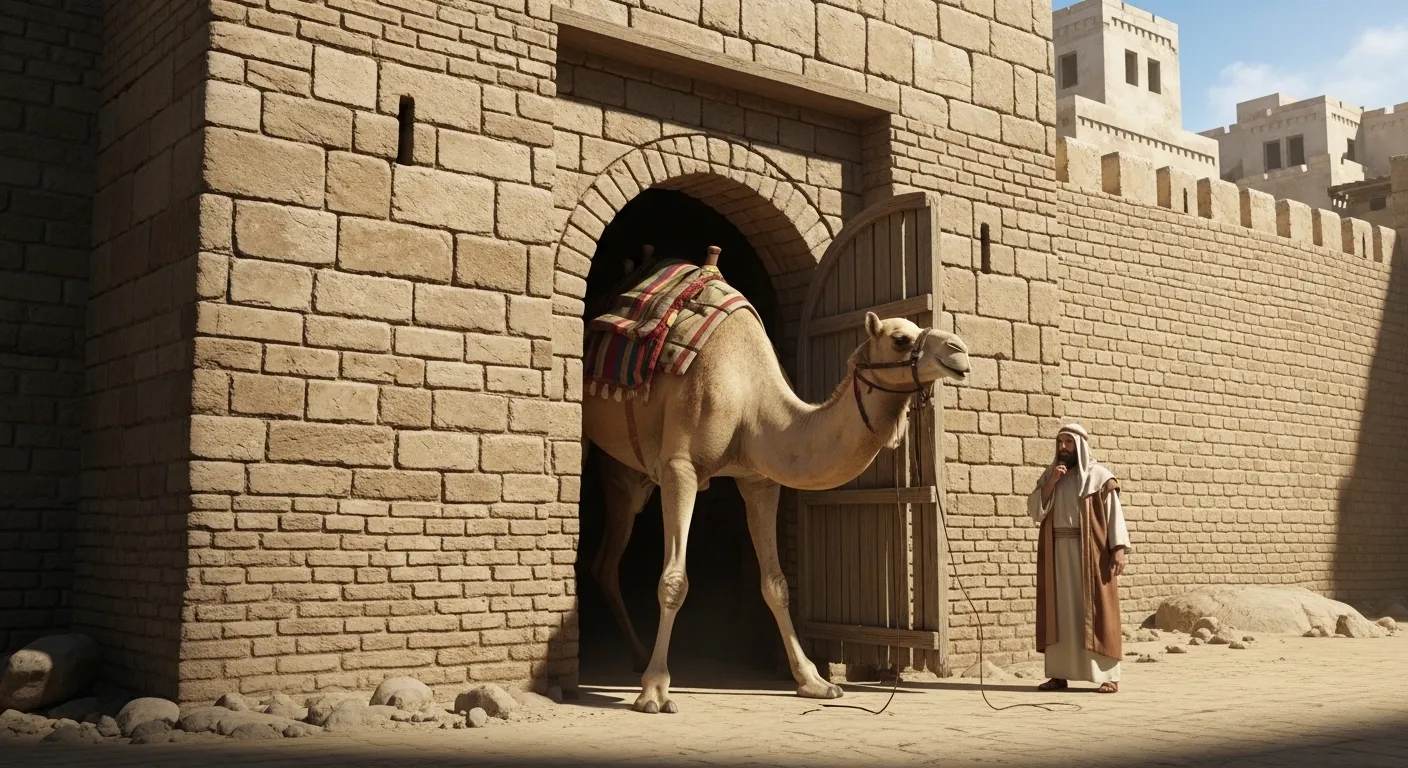
It was to the disciples’ stunned faces, watching that well-dressed back disappear down the road, that Jesus spoke one of the most startling sentences ever uttered: “It is easier for a camel to go through the eye of a needle than for someone who is rich to enter the kingdom of God” (Matthew 19:24). Mark and Luke both preserve the saying too (Mark 10:25; Luke 18:25), which tells us the early church considered it essential, not incidental. A camel — the largest animal a first-century Jew would see on an ordinary day, a beast of burden standing seven feet at the hump — threading the eye of a sewing needle. The image is deliberately absurd. That is the point.
The Young Man Who Had Everything
To feel the force of the saying, linger on the man who prompted it. He is not a villain. He keeps the commandments. He kneels before Jesus with a genuine question. When Jesus lists the commandments, the man can honestly answer, “All these I have kept since I was a boy.” There is no hypocrisy here — only a man who has done everything right and discovered, to his quiet terror, that it is not enough.
Jesus loved him, Mark adds (Mark 10:21). That detail matters. What follows is not punishment but diagnosis, the way a good physician presses exactly the spot that hurts. “You still lack one thing.” For this man, the one thing was his wealth — not because money is the universal disease of every soul, but because for him it was the rival throne. The man’s sorrow as he walks away is the saddest proof of the diagnosis: he cannot imagine life without his possessions, and so he walks away from Life itself.
Notice what Jesus does not do. He does not say the same thing to Zacchaeus, who was also rich, and who joyfully gave away half his goods (Luke 19:8). He does not demand poverty from Joseph of Arimathea, a rich man who used his wealth to bury Jesus honorably (Matthew 27:57–60). The demand was surgical, fitted to one man’s heart. But the principle behind it reaches everyone: anything we cannot surrender has become our master.
A Camel, a Needle, and Deliberate Impossibility
Jesus spoke in the exaggerated pictures of a Middle Eastern storyteller. Elsewhere he talks about straining out a gnat while swallowing a camel (Matthew 23:24) and about the plank in your own eye (Matthew 7:3–5). The camel-through-the-needle belongs to that family of holy hyperbole — an image meant to make the listener laugh in shock and then go quiet.
The Greek word for the needle’s “eye” is the ordinary word for a sewing needle’s eye. Some later copyists, uncomfortable with the absurdity, tried to soften the text: a few manuscripts read “rope” (kamilos) instead of “camel” (kamelos) — a rope through a needle’s eye is still impossible, but at least it is the same category of thing. The best and earliest manuscripts keep “camel,” and the harder reading is almost certainly what Jesus said. The impossibility is the sermon.
Why does wealth make the kingdom so hard to enter? Not because God dislikes rich people, but because wealth does something specific to the human heart: it manufactures the illusion of self-sufficiency. The poor man knows he needs help; the rich man can afford to forget. Money answers so many of life’s questions — food, shelter, medicine, status — that it quietly starts answering the one question it cannot answer: who will save me? Jesus names the rival directly elsewhere: “You cannot serve both God and money” (Matthew 6:24).
The “Needle Gate” — A Beautiful Legend, Honestly Told
You may have heard a preacher explain that the “eye of the needle” was actually a small gate in Jerusalem’s wall, so low that a camel could only pass through kneeling, after its baggage was removed. It is a lovely image: unload your baggage, kneel in humility, and you can enter. The trouble is that no such gate has ever been found, no ancient source mentions it, and the story only appears many centuries after Jesus. It was likely invented by well-meaning interpreters who found the plain meaning too harsh and wanted to soften it into something achievable.
Honesty requires saying so, because the softened version misses the shock Jesus intended. His disciples did not hear “humble yourself and squeeze through.” They heard “impossible” — and they reacted exactly that way: “Who then can be saved?” (Matthew 19:25). If the saying meant merely “it’s difficult,” their astonishment makes no sense. They understood, correctly, that Jesus had just declared salvation humanly impossible. Which sets up the most important sentence in the whole passage.
“With God All Things Are Possible”
Jesus’ answer to their despair is the gospel in miniature: “With man this is impossible, but with God all things are possible” (Matthew 19:26). The camel saying is not the last word; grace is. No one — rich or poor — threads the needle by moral effort, generosity, or self-denial. The rich young man failed at the one thing, but the truth is that everyone fails at something. The needle’s eye is impassable for every human being, and that is precisely why the kingdom must be received, not achieved.
This is why the passage ends with Peter’s anxious question — “We have left everything to follow you! What then will there be for us?” — and Jesus’ astonishing promise that no sacrifice for the kingdom goes unrewarded, “a hundred times as much,” plus eternal life (Matthew 19:27–29). The economy of grace outbids the economy of wealth at every point. What the young man clutched, the disciples released, and found they had lost nothing that mattered.
What the Camel Carries
There is one more layer worth sitting with. In the ancient world, a camel was above all a beast of burden — the freight truck of the caravan routes, loaded with goods. The image may carry a quiet second meaning: the things we carry can keep us from going where we need to go. The young man was not only rich; he was loaded. His possessions were his cargo, and cargo does not fit through needle-eyes.
Scripture returns to this picture again and again. The writer of Hebrews urges believers to “throw off everything that hinders and the sin that so easily entangles” (Hebrews 12:1) — the language of a runner stripping off weight. Jesus invites the weary to take his yoke because his burden is light (Matthew 11:28–30), implying that every other burden is heavy. Ask the searching question the passage presses on every reader, rich or poor: what am I carrying that I cannot lay down? Anxieties about money, certainly — but also grudges, ambitions, the need to be right, the fear of what people think. Anything we clutch becomes cargo. And cargo does not fit through the eye of the needle.
The good news, today as then, is that the story does not end with the impossibility. It ends with the God for whom impossibilities are the raw material of salvation. The camel cannot pass through the needle’s eye — but God can do what camels cannot. He can take a heart welded to its wealth and make it free. He has done it for tax collectors and zealots, for persecutors and prostitutes, and he still does it today. The question the rich young ruler faced is the question the saying leaves with every one of us: will you let him?
Readers who want to trace how this striking image has been understood across the centuries — including the long history of the “needle gate” tradition and how translators have handled the Greek — will find a helpful survey in the Wikipedia article on the eye of the needle, which gathers the textual and historical background in one place.










