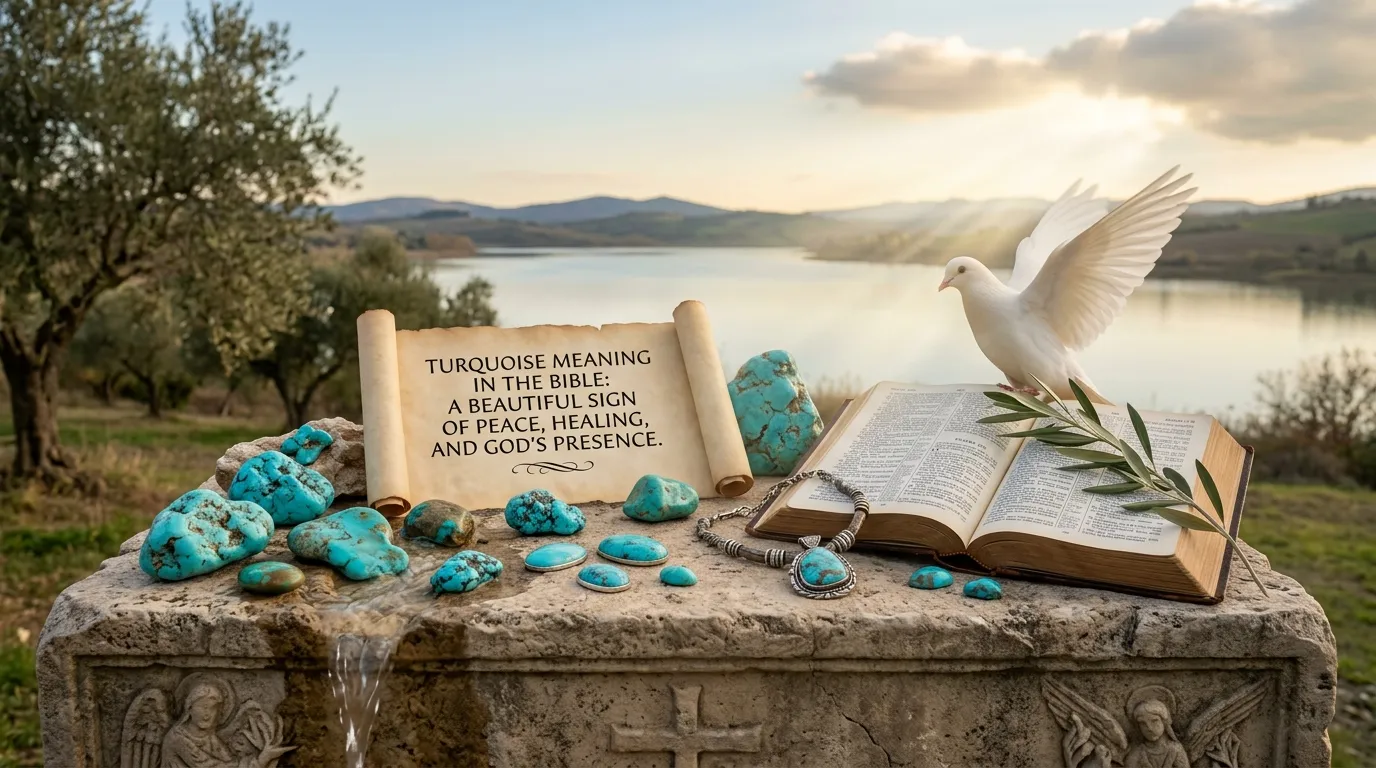
Here is an honest starting point: the English word “turquoise” does not appear in most Bible translations. Open a King James, an ESV, or an NIV and search — you will not find it. What you will find is a family of blue and blue-green stones and fabrics whose exact identities scholars still debate: the tekhelet blue of the tabernacle curtains, the sapphire-like pavement under God’s feet, the sea of glass like crystal. “Turquoise” as a biblical term is largely a modern mineral name applied backward to ancient words.
That admission is not a dismissal. It is the ground rule for everything that follows. What Scripture does give us — richly — is the color: the blue-green of sea and sky, woven through worship, worn by priests, spread under the throne of God. The meaning of turquoise in the Bible is really the meaning of that color, and the color’s theology runs deep.
The Blue of Heaven, Woven Into Worship
The tabernacle — Israel’s traveling sanctuary — was a study in blue. Its curtains were woven with “blue, purple and scarlet yarn” (Exodus 26:1), repeated like a refrain through the construction chapters. The high priest’s robe was entirely blue, with a single opening reinforced so it would not tear (Exodus 28:31-32). The breastplate’s stones were bound with blue cord (Exodus 28:28). Even the covering for the ark during transport was blue cloth (Numbers 4:6).
Blue in the ancient world was the color of the heavens — the dome overhead, the source of rain, the dwelling place of God. To wrap worship in blue was to declare, in textile form, that what happened inside the tabernacle participated in what happened above it. The worshiper under the blue curtains stood, symbolically, under the sky of God’s dwelling.
Turquoise — the stone that looks like a fragment of that sky fallen to earth — inherits this association wherever tradition places it among the breastplate stones. Exodus 28:21 commands that the stones bear “the names of the children of Israel”; the tribes, that is, were presented to God wrapped in heaven’s color. Intercession dressed in blue: earthly names carried into heavenly presence, the gap between them closed by the color of the sky.
The Sea Beneath His Feet
Exodus 24:10 gives one of Scripture’s most arresting images: when Moses and the elders ascended Sinai, “they saw the God of Israel. Under his feet was something like a pavement made of lapis lazuli, as bright blue as the sky.” Many scholars connect this blue pavement with the sapphire tradition; others note its kinship with the turquoise-blue stones of the region. Either way, the image is of God standing — as it were — on solidified sky.
Revelation picks up the image and expands it: “before the throne there was what looked like a sea of glass, clear as crystal” (Revelation 4:6), and later a sea of glass “glowing with fire” (Revelation 15:2). The sea — chaos, danger, the uncontrollable deep in ancient imagination — lies perfectly still and transparent before God’s throne. The blue-green that terrifies sailors in a storm is, in heaven, a floor.
The pastoral force of this is considerable. Whatever feels like a churning sea in your life — the diagnosis, the debt, the estrangement — is, from the throne’s perspective, a sea of glass. Still. Transparent. Under His feet. The color turquoise borrows its calm from this vision: the peace is not in the stone but in the sovereignty the stone’s color recalls.
Still Waters and the Peace That Is a Person
Psalm 23:2-3 — “He leads me beside the still waters. He restores my soul” — gives the color its most beloved setting. The Hebrew pictures waters of rest, untroubled pools in a dry land. Anyone who has seen desert water knows the color: that impossible blue-green against the brown, life announcing itself in pigment.
Jesus claims that peace as His own gift: “Peace I leave with you; my peace I give you” (John 14:27). Not peace as the world gives — circumstantial, fragile, revoked by the next headline — but His peace: the still-water kind, the sea-of-glass kind. Isaiah 41:10 underwrites it with promise: “Fear not, for I am with you… I will strengthen you and help you.” The presence is the peace. The color only reminds.
This is where the turquoise tradition finds its devotional home — not in the mineral but in the meditation. A blue-green stone can serve as a prompt: when you see the color, remember the still waters, remember the sea of glass, remember the promise. Used that way, it is what the old writers called a “memorial” — like the stones of the ephod, a physical prod toward a spiritual reality. The value is entirely in what it recalls.
The Warning: When the Reminder Becomes the Religion
And here the warning must be as clear as the comfort. Psalm 62:8 — “Trust in him at all times, you people; pour out your hearts to him, for God is our refuge” — draws the line Scripture always draws around sacred objects: trust goes to God, not to the reminder.
The step from memorial to idol is short and well-traveled. Israel managed it with the bronze serpent — a God-ordained memorial of healing (Numbers 21:8-9) that, centuries later, had to be destroyed because people were burning incense to it (2 Kings 18:4). The same drift threatens any meaningful object: the stone that reminded you of God’s peace quietly becomes the thing you trust for peace. The cross necklace, the verse card, the turquoise ring — all fine as reminders, all dangerous as reliances.
The test is simple: if losing the object would shake your peace, the object has become the foundation. Still waters do not depend on jewelry. The sea of glass does not crack when a stone is lost. Trust, Psalm 62 says, is poured out to Him — the refuge, not the reminder of the refuge.
Foundations of Blue in the Eternal City
Revelation 21:19 describes the New Jerusalem’s foundations as “decorated with every kind of precious jewel,” and the traditional lists include the blue-green stones among them. Whatever the exact mineral identifications — and honest scholarship admits uncertainty — the city’s foundations carry heaven’s colors into earth’s future. The blue that wrapped the tabernacle, paved the throne room, and colored the still waters ends up load-bearing in eternity.
There is a completion arc here worth tracing: blue began as the color of God’s dwelling place (the sky, the tabernacle curtains), became the color of God’s footstool (the sapphire pavement, the sea of glass), and ends as the color of God’s city’s foundations. Heaven’s color keeps descending — from above, to beneath His feet, to under our feet forever. The trajectory of turquoise-blue in Scripture is the trajectory of grace: God bringing His dwelling down to ours.
So the meaning of turquoise in the Bible, honestly rendered, is the meaning of heaven’s color: worship wrapped in blue, chaos stilled to glass, peace given as a Person, reminders kept as reminders, and a city founded on the colors of the sky. The stone is modern; the color is eternal. Hold the color lightly, hold the promises tightly, and let every blue-green thing you see preach the same sermon the tabernacle curtains preached: heaven is near, the sea is still, and God is your refuge.
The Blue Cord of Remembrance
Blue’s memorial function is explicit in one of the Torah’s most practical commands. “Speak to the Israelites and say to them: ‘Throughout the generations to come you are to make tassels on the corners of your garments, with a blue cord on each tassel. You will have these tassels to look at and so you will remember all the commands of the Lord'” (Numbers 15:38-39).
Every Israelite — not just the priest — wore blue: a cord on each tassel, at the garment’s corners, catching the eye throughout the day. The color of heaven, tied to the hem of ordinary clothing, turning every glance downward into a reminder upward. This is the democratization of the tabernacle’s blue: what wrapped the sanctuary now fringed the citizen. Holiness was not confined to sacred space; it was stitched into daily dress.
The turquoise tradition inherits this logic exactly. A blue-green stone — or any blue thing — functions the way the cord functioned: a visual prod toward remembrance. See the color; remember the commands; remember the still waters; remember the sea of glass. The stone has no power. The cord had no power. The power was always in what the blue recalled — and in the God who commanded the remembering.
The gemological facts — hydrated copper aluminum phosphate, the mines of Sinai and the American Southwest, the sky-blue to green matrix — are covered thoroughly in Wikipedia’s turquoise article. Scripture’s contribution is not mineralogical but theological: a color that runs from the curtains of the tabernacle to the foundations of the New Jerusalem, preaching at every stop that the God of heaven has made peace with earth.










