Have you ever felt that God was asking you to be faithful in a place where no one seemed to notice your work? Maybe you were helping your family, serving at church, encouraging a friend, or simply trying to live for Christ in a difficult season. The story of Titus in the Bible speaks to people in exactly those kinds of moments.
Titus was a trusted coworker of the apostle Paul. He was not one of the twelve apostles, and the Bible does not give us many details about his early life. Yet his faithful service became important to the early Christian church.
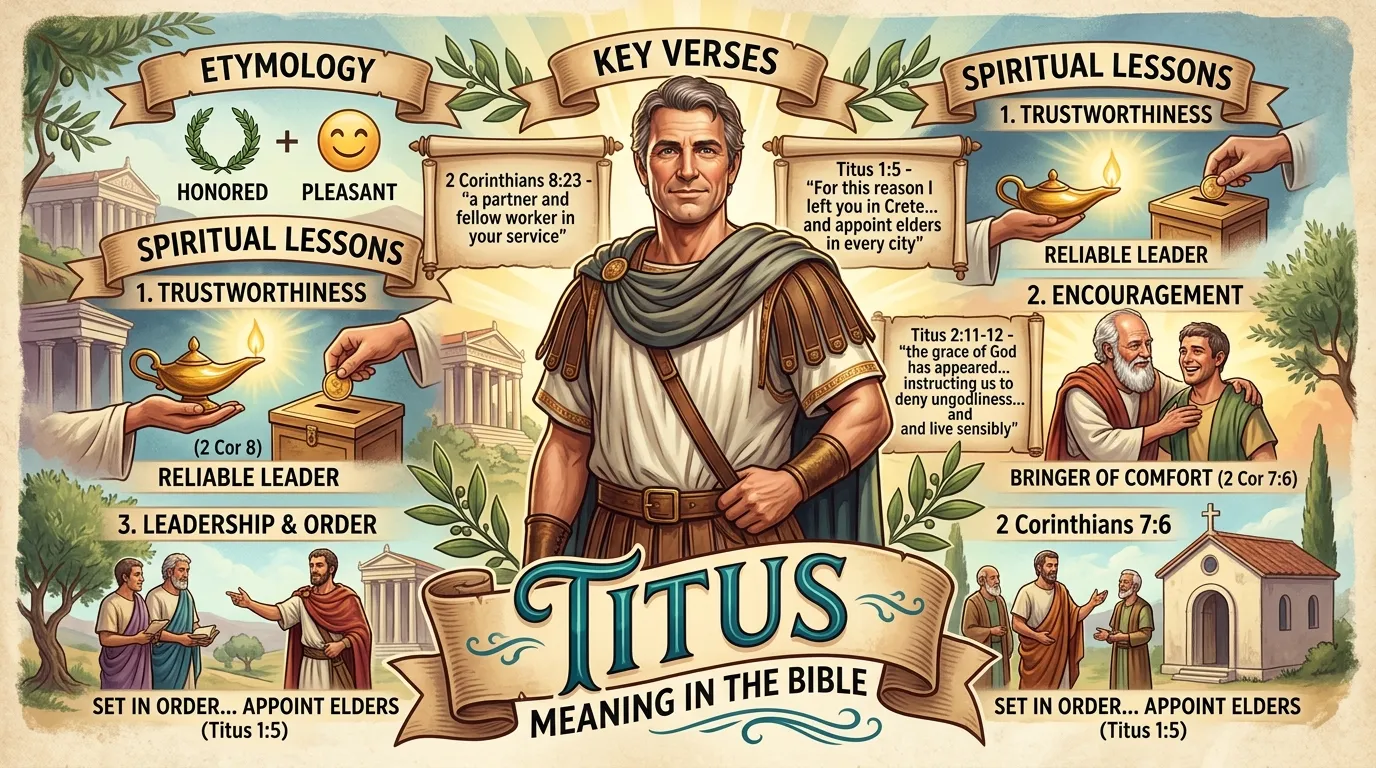
The Titus meaning in the Bible is best understood through his life and ministry. His story points to faithfulness, spiritual maturity, good works, sound teaching, courage, and God’s grace. While the Bible does not give a special spiritual definition of his name, Scripture shows us why Titus became an important example of Christian service.
What Does Titus Mean in the Bible?
Titus was a Greek-speaking Gentile Christian and a close ministry partner of Paul. His name appears several times in the New Testament, especially in Paul’s letters.
The Bible does not directly state, This is what the name Titus means. The name Titus comes into English from the Greek Titos (Τίτος), and its deeper ancient etymology is uncertain. It is also connected with the Latin personal name Titus.
Therefore, it is important not to claim that the Bible gives Titus a specific Hebrew meaning when Scripture does not.
Instead, the strongest biblical understanding comes from who Titus was and what he did for God’s work.
His life is connected with:
- Faithfulness in ministry
- Trust and responsibility
- Spiritual maturity
- Courage
- Good works
- Sound Christian teaching
- Grace and salvation
- Serving others
Paul trusted Titus with difficult assignments. This tells us something powerful: a faithful Christian does not need to be famous to be useful to God.
Titus Meaning in the Bible: His Story and Role
Titus appears as one of Paul’s trusted coworkers. Paul even calls him my true child in our common faith in Titus 1:4.
This does not mean Titus was Paul’s biological son. Paul was describing their spiritual relationship and Titus’s shared faith in Christ.
The opening of the book of Titus says:
Titus 1:4: “To Titus, my true child in our common faith: Grace and peace from God the Father and Christ Jesus our Savior.”
This greeting gives us an important picture of Titus. He was a believer who had grown under Paul’s teaching and had become a trusted servant of Christ.
Paul later left Titus in Crete to help organize the churches there.
Titus 1:5: “This is why I left you in Crete, so that you might set right what was left undone and, as I directed you, appoint elders in every town.”
Titus therefore had a serious responsibility. He was helping establish healthy church leadership and order.
His story reminds Christians that God can use ordinary people for important spiritual work.
Titus and Paul’s Ministry
Titus was more than a name in Paul’s letters. He was actively involved in ministry.
In Galatians 2, Paul describes Titus as a Greek believer who went with him to Jerusalem. Titus became part of an important discussion about Gentile Christians.
Paul explains that Titus was not forced to be circumcised even though some people wanted Gentile believers to follow Jewish practices.
Galatians 2:3: “Yet not even Titus who was with me was compelled to be circumcised, though he was a Greek.”
This event was important because the early church was learning that salvation comes through faith in Jesus Christ, not through keeping the law as a means of earning salvation.
Titus’s story therefore connects with the biblical message of grace and freedom in Christ.
Titus and the Corinthian Church
One of the clearest pictures of Titus appears in Paul’s relationship with the Corinthian church.
Paul sent Titus to Corinth during a difficult period. The church had problems, and Paul was concerned about how the believers would respond to correction.
Titus later returned with encouraging news.
Paul wrote:
2 Corinthians 7:6: “But God, who comforts the downcast, comforted us by the arrival of Titus.”
This verse gives us a beautiful spiritual lesson.
Titus became part of God’s comfort for Paul.
Sometimes God uses another believer to bring encouragement at exactly the right time. A phone call, prayer, kind word, visit, or faithful act can become a blessing when someone is discouraged.
You may never know how much your faithfulness helps another person.
The Spiritual Meaning of Titus
The Bible does not say that the name Titus carries a hidden spiritual code. However, Christians can draw meaningful lessons from the biblical life of Titus.
Titus Represents Faithful Service
Titus was trusted with difficult work.
Paul sent him to help churches and handle sensitive situations. He did not appear to seek attention or personal glory.
His example teaches us that faithfulness matters more than recognition.
A Christian mother caring for her children, a church member serving quietly, a pastor teaching God’s Word, or a friend praying faithfully can all serve God in meaningful ways.
Titus Represents Spiritual Responsibility
Paul left Titus in Crete because work still needed to be completed.
Titus 1:5: “This is why I left you in Crete, so that you might set right what was left undone.”
This reminds us that Christian maturity includes responsibility.
Faith is not only about what we believe. It also affects how we live, serve, speak, and treat other people.
Titus Represents Good Works
The book of Titus strongly connects God’s grace with a changed life.
Paul writes:
Titus 2:11–12: “For the grace of God has appeared, bringing salvation for all people, instructing us to deny godlessness and worldly lusts and to live in a sensible, righteous, and godly way in the present age.”
Notice the order.
God’s grace brings salvation, and God’s grace teaches us how to live.
Good works do not purchase salvation. Instead, good works are a fruit of a life being shaped by God’s grace.
Paul makes this clear again:
Titus 3:5: “He saved us—not by works of righteousness that we had done, but according to his mercy.”
This is one of the most important truths connected with the message of Titus.
We are saved by God’s mercy, not by trying to earn His love.
Titus Meaning in the Bible + Hebrew Meaning
Does Titus Have a Hebrew Meaning?
There is an important distinction to make here.
Titus does not have a Hebrew meaning given in the Bible. Titus is a Greek form of an ancient personal name, generally associated with the Latin name Titus. Its original etymology is not certain.
The New Testament was written in Greek, and Titus is presented as a Greek-speaking Gentile Christian. Scripture does not translate his name into Hebrew or assign it a prophetic meaning.
Some online sources give Titus meanings such as honorable, defender, or similar descriptions. These should be treated carefully because they are not stated as the biblical meaning of Titus.
The safest approach is to separate historical name meaning from spiritual application.
What Scripture clearly teaches is that Titus was a trusted believer who served Christ faithfully.
Why the Hebrew Meaning Question Still Matters
Names in the Bible can sometimes carry important meanings. For example, Matthew 1:21 explains the meaning of the name Jesus in connection with His mission: “because he will save his people from their sins.”
But we should not assume that every biblical name has a spiritual definition revealed by Scripture.
For Titus, the Bible gives us something even more valuable than a speculative name meaning: a real example of Christian faithfulness.
What Does the Book of Titus Teach?
Paul’s letter to Titus focuses on healthy churches and godly Christian living.
The letter contains several major themes.
Sound Doctrine
Paul repeatedly emphasizes the importance of teaching what agrees with the truth.
Titus 2:1: “But you are to proclaim things consistent with sound teaching.”
Christian faith is not based only on feelings. Believers are called to know God’s truth and live according to it.
Godly Character
Titus 1 gives qualifications for church leaders. These include self-control, faithfulness, hospitality, and the ability to encourage others with sound teaching.
This shows that character matters deeply in Christian leadership.
Grace
Titus 2:11 begins with one of the strongest statements about God’s grace:
“For the grace of God has appeared, bringing salvation for all people.”
Grace is not permission to continue in sin. God’s grace teaches believers to live differently.
Good Works
Titus 3:8 says:
“Those who have believed God might be careful to devote themselves to good works.”
The message is simple: faith in Christ should produce a life that blesses others.
What Can Titus Teach Christians Today?
The story of Titus has practical lessons for everyday Christian life.
You Can Be Useful Without Being Famous
Titus was not one of the most publicly recognized leaders in the New Testament.
Still, Paul trusted him.
This is encouraging if you sometimes feel unnoticed. God sees faithful work that other people never see.
Difficult Work Can Be Part of God’s Calling
Titus was sent to deal with church problems and unfinished work.
Not every Christian assignment will feel exciting. Sometimes obedience means having a hard conversation, serving someone who is struggling, correcting a problem, or patiently rebuilding something that has been damaged.
Mature Faith Produces Action
Titus teaches that Christian maturity is visible in daily life.
Ask yourself:
- Am I growing in self-control?
- Do my words encourage others?
- Am I becoming more patient?
- Do I serve people with love?
- Do my choices reflect God’s grace?
- Am I willing to do what is right even when no one praises me?
These questions can turn biblical teaching into practical growth.
Titus Meaning in Dreams: What Could It Mean?
Some people may dream about the name Titus, a person named Titus, or a scene connected with the book of Titus.
The Bible does contain examples of God communicating through dreams. However, not every dream is a message from God.
Ecclesiastes 5:3 notes that dreams can be connected with many cares, while Scripture also gives examples of meaningful dreams. Because of this, Christians should avoid treating every dream as a prophecy.
If Titus appears in a dream, you might prayerfully reflect on biblical themes associated with his life, such as:
- Faithful service
- Spiritual maturity
- Responsibility
- Grace
- Good works
- Sound teaching
- Encouragement
- Finishing unfinished work
These are possible spiritual reflections, not guaranteed interpretations.
A dream should always be tested against Scripture. If an interpretation contradicts God’s Word, it should not be accepted simply because the dream felt powerful.
Seeing Titus in Real Life or Thinking About the Name
You may also repeatedly notice the name Titus in everyday life.
For example, perhaps you meet someone named Titus, hear a sermon about the book of Titus, or suddenly feel drawn to read Paul’s letter.
It is understandable to wonder whether this has a deeper meaning.
Christians can use such moments as an opportunity to pray and study Scripture. But the Bible does not teach that repeatedly seeing a particular name is automatically a divine sign.
Instead of searching for hidden messages, ask a better question:
What is God teaching me through His Word right now?
That keeps your attention on Scripture rather than speculation.
Important Bible Verses About Titus
Several passages help us understand Titus and his ministry.
Titus 1:4
Paul calls Titus “my true child in our common faith.”
This shows the close spiritual relationship they shared.
Titus 1:5
Paul explains that Titus was left in Crete to set things right and appoint elders.
This shows his responsibility and trustworthiness.
2 Corinthians 7:6
Paul says God comforted him through the arrival of Titus.
This highlights Titus’s role as an encourager.
2 Corinthians 8:23
Paul calls Titus his partner and coworker.
This gives us another picture of his value in ministry.
Titus 2:11–12
These verses teach that God’s grace brings salvation and trains believers to live godly lives.
Titus 3:5
Paul explains that God saves us according to His mercy, not because of righteous works we have performed.
Titus 3:8
Believers are encouraged to devote themselves to good works.
Together, these passages give a balanced picture of Christian faith: grace saves us, truth teaches us, and faith produces a changed life.
Is Titus a Good Biblical Name?
Yes. Titus is a biblical name with a strong connection to Christian service.
The Bible does not say that choosing the name Titus gives a child a particular spiritual destiny. However, the person Titus provides a meaningful example of faith, service, responsibility, courage, and spiritual maturity.
Parents who choose the name may find encouragement in the story of a man who faithfully served alongside Paul.
The most important lesson is not the name itself. It is the faithfulness shown by the person who carried it.
What Is the Main Spiritual Lesson of Titus?
The central lesson of Titus is that God’s grace should shape the way we live.
Titus was not presented as a perfect superhero. Instead, Scripture shows a servant who was trusted with real responsibilities in a growing and sometimes troubled church.
His life reminds us that God can work through people who are willing to serve faithfully.
You do not have to have a famous ministry.
You do not have to stand on a large stage.
You do not have to be known by thousands of people.
You can honor God by being faithful in the place where He has called you to serve.
Frequently Asked Questions
Who was Titus in the Bible?
Titus was a Gentile Christian and a trusted coworker of the apostle Paul. Paul sent him to help churches, including the church in Crete. Paul also relied on Titus during his ministry to the Corinthians.
What is the meaning of Titus in the Bible?
The Bible does not directly give the meaning of the name Titus. The name comes from the Greek Titos and is associated with the Latin personal name Titus. Biblically, Titus is best understood through his life as a faithful Christian worker.
Is Titus a Hebrew name?
No. Titus is not presented in Scripture as a Hebrew name. It comes through Greek and is associated with an ancient Latin personal name. There is no specific Hebrew meaning of Titus given in the Bible.
What is the spiritual meaning of Titus?
The Bible does not assign a fixed spiritual meaning to the name Titus. However, Titus’s life can remind Christians of faithfulness, service, spiritual responsibility, grace, encouragement, and good works.
What did Titus do in the Bible?
Titus worked closely with Paul and helped with important church matters. Paul left him in Crete to establish church leadership and correct things that needed attention. Titus also played an important role in Paul’s relationship with the Corinthian church.
What does the book of Titus teach?
The book of Titus teaches about sound doctrine, godly character, grace, salvation, Christian living, church leadership, and good works. It emphasizes that God’s grace changes how believers live.
What does Titus mean in a dream?
The Bible does not give a specific dream interpretation for the name Titus. If the name appears in a dream, Christians can prayerfully consider themes from the biblical Titus, but the interpretation should not be treated as certain. Dreams should always be tested against Scripture.
Final Thoughts
The story of Titus gives us a beautiful picture of quiet faithfulness.
He served when work needed to be done. He carried responsibility when churches needed help. He brought encouragement when Paul was discouraged. Most importantly, his story sits within Paul’s larger message that God’s grace saves us and teaches us to live godly lives.
If you feel unnoticed today, remember Titus.
Your faithful prayer matters.
Your kindness matters.
Your service matters.
Your obedience matters.
You may not see the full result of your faithfulness, but God sees.
The book of Titus points us away from trying to earn God’s love and toward the grace and mercy already given through Jesus Christ. So keep learning God’s Word, keep serving with love, and keep trusting Him.
When you do not know what comes next, pray. When you feel overlooked, remember that God sees you. When you make mistakes, return to His grace. And when God gives you an opportunity to serve, step forward with faith.
Like Titus, you can faithfully serve Christ right where God has placed you.