Imagine standing inside the temple in Jerusalem. Before you is a thick veil. Behind it is the Most Holy Place, the sacred place linked with the presence of God. You cannot simply walk through it. Only the high priest could enter, and even he entered under strict commands from God.
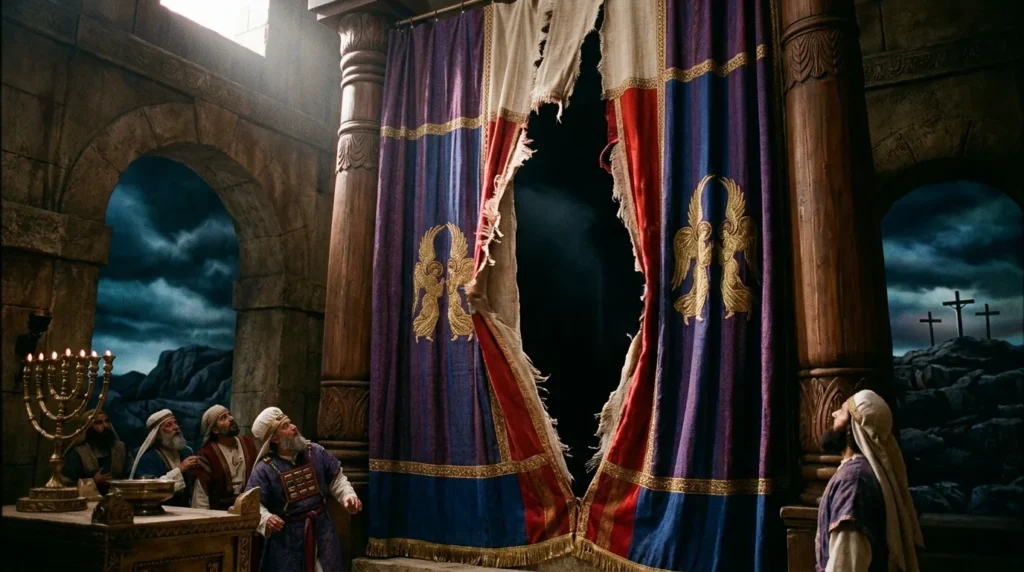
Then the New Testament tells us something amazing. When Jesus died on the cross, the temple veil was torn from top to bottom (Matthew 27:50–51; Mark 15:37–38).
What did that mean?
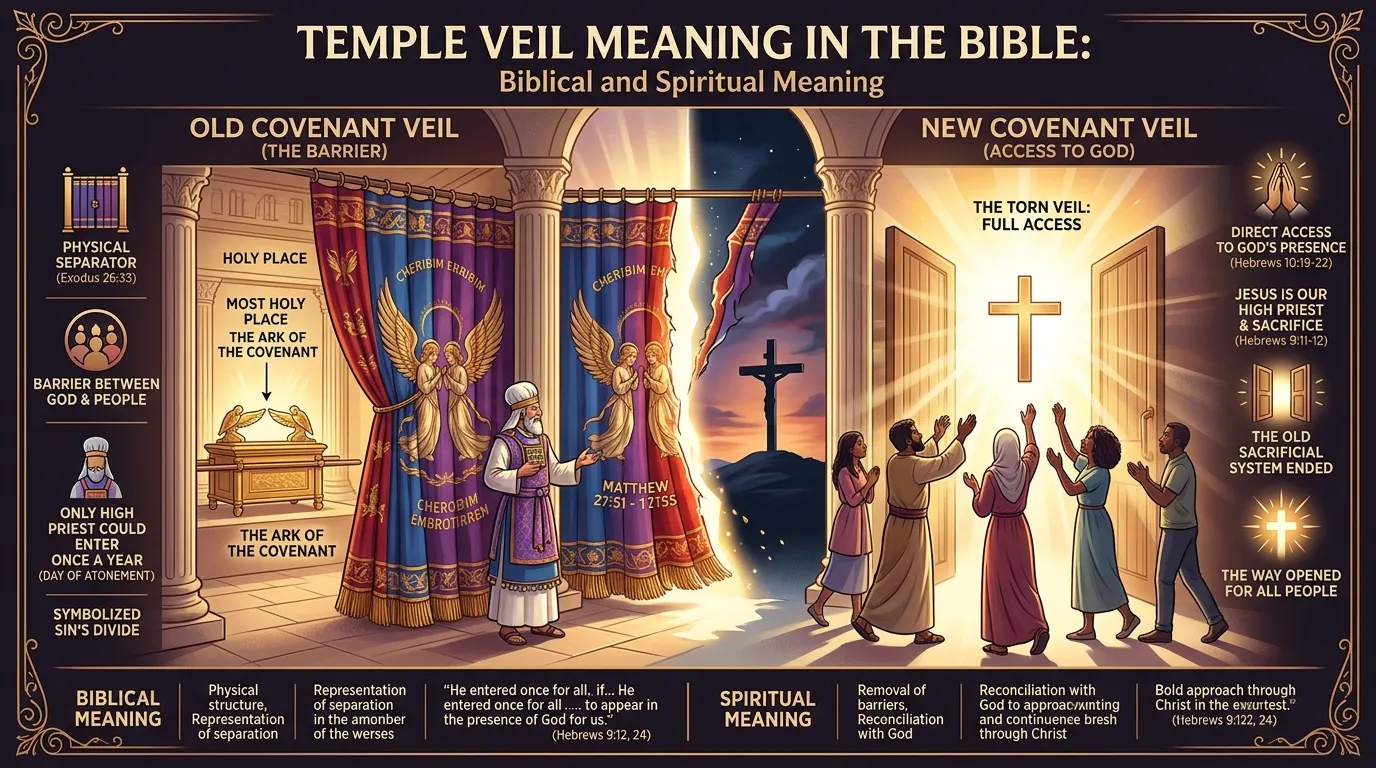
The temple veil meaning in the Bible points to one of the most powerful truths of the Christian faith. Through Jesus Christ, the barrier between sinful humanity and God was opened. What once showed separation now became a sign of access, grace, forgiveness, and hope.
The veil was not just a piece of cloth. It carried deep biblical symbolism. It reminded people that God is holy and that sin separates people from Him. But its tearing at the death of Christ showed that Jesus had made a new way to God.
For Christians, this message brings great comfort. God is not calling His people to remain far away. Through Christ, believers are invited to draw near with faith.
Let us look at what the Bible says about the veil and why its meaning still matters today.
Biblical Meaning of the Temple Veil
The temple veil was a sacred curtain that separated the Holy Place from the Most Holy Place, also called the Holy of Holies.
The idea began with the tabernacle in the wilderness. God commanded Moses to make a veil between the Holy Place and the Most Holy Place.
Exodus 26:33 says that the veil was to separate the Holy Place from the Most Holy Place. Exodus 26:34 also describes the placement of the ark of the covenant behind the veil.
The Most Holy Place represented the special place of God’s presence. It was not an ordinary room. It was sacred.
The veil therefore had an important meaning.
The Veil Represented Separation
First, the veil showed that God is holy.
Human beings are sinful, while God is perfectly holy. The veil was a visible reminder that people could not simply enter God’s holy presence whenever they wished.
Leviticus 16 describes the Day of Atonement. On that day, the high priest entered the Most Holy Place with blood as an offering for sin.
This system taught Israel an important truth: sin has serious consequences, and reconciliation with God requires atonement.
The veil was therefore a symbol of separation between God and humanity.
The Veil Represented God’s Sacred Presence
The veil also protected the sacred space associated with God’s presence.
The ark of the covenant was placed behind the veil. Exodus 25:22 speaks of God meeting with Moses above the mercy seat.
This gives the veil another important meaning. It did not mean that God was absent. Instead, it showed that God was near but holy.
His presence was real, powerful, and worthy of reverence.
The Veil Was Torn When Jesus Died
The most important moment in the biblical story of the veil happens at the death of Jesus.
Matthew 27:50–51 says that Jesus cried out and gave up His spirit, and the curtain of the temple was torn in two from top to bottom.
Mark 15:37–38 and Luke 23:44–46 also describe the event.
Notice the direction: from top to bottom.
Many Christians understand this detail as pointing to God’s action. The tearing of the veil was not presented as an ordinary human act. It happened at the moment of Christ’s death.
The meaning is profound.
Jesus had completed His sacrificial work. The old barrier had been opened.
Jesus Opened the Way to God
The book of Hebrews explains this truth even more clearly.
Hebrews 10:19–22 teaches believers that they can enter God’s presence with confidence through the blood of Jesus.
Hebrews 10:20 describes the new and living way opened through Christ.
This does not mean Christians can treat God casually. It means believers no longer need to depend on the old temple system of repeated sacrifices and priestly access.
Jesus is the mediator who brings us near to God.
This is central to Christian belief.
The temple veil therefore points from the Old Testament system toward the saving work of Christ.
The Veil Points to Forgiveness and Hope
The tearing of the veil is also a message of hope.
People who feel far from God can remember that Christ opened the way.
People who feel guilty can remember God’s offer of forgiveness.
People who are afraid can remember that believers are invited to approach God in prayer.
Hebrews 4:16 encourages Christians to draw near to the throne of grace with confidence.
The veil says, in a powerful symbolic way, the way to God has been opened through Christ.
Temple Veil Hebrew Meaning
There is an important language detail here.
The Old Testament does not originally speak of a “temple veil” in the New Testament sense. The veil concept appears first in the tabernacle, and the Hebrew word commonly used for this sacred veil is פָּרֹכֶת, transliterated paroket.
The basic meaning is veil, curtain, or screen.
The word paroket is used for the curtain that separated the Holy Place from the Most Holy Place.
Exodus 26:31–33 gives instructions for making this veil. It was made with fine linen and special colors and embroidered with cherubim.
The cherubim are significant because they were connected with the holiness and heavenly presence of God.
The temple later followed the same basic sacred pattern. Second Chronicles 3:14 describes a veil in Solomon’s temple made with fine materials and decorated with cherubim.
In the New Testament, which was written mainly in Greek, the word used for the temple curtain is καταπέτασμα, transliterated katapetasma. It can mean a curtain or veil.
So, when studying the temple veil Hebrew meaning, it is helpful to remember that the Old Testament word is paroket, while the New Testament uses the Greek katapetasma.
The language itself points to a physical curtain, but its biblical role carries a much deeper message about holiness, separation, atonement, and access to God.
Spiritual Significance and Symbolism of the Temple Veil
The spiritual meaning of the temple veil becomes especially clear when we look at the cross.
A Symbol of Separation
The veil reminds us that sin creates separation from God.
Isaiah 59:2 says that sins can create separation between people and God.
This is a serious truth, but it is not the end of the story.
A Symbol of God’s Grace
When Jesus died, the veil was torn.
This shows the movement from separation to access.
Christians believe that Jesus paid the price for sin and opened the way for people to come to God through faith.
That is why the veil can become a symbol of grace.
A Symbol of Spiritual Transformation
The torn veil also points toward transformation.
Before Christ, the temple system visibly separated ordinary people from the Most Holy Place.
Through Christ, believers receive a new relationship with God.
Hebrews 10:22 encourages believers to draw near with sincere hearts and faith.
This is more than a change in religious practice. It is a change in how a person relates to God.
A Symbol of Prayer
The veil can also remind Christians of the privilege of prayer.
You do not need to wait for a special priest to speak to God for you.
Through Jesus, you can pray.
You can bring your fear, pain, questions, gratitude, and hopes to God.
When life feels dark, the message of the torn veil can be simple:
You can draw near to God.
Temple Veil in Dreams or Real Life
Some people may see a temple veil in a dream, during prayer, in artwork, or while reading Scripture. The Bible does not give a fixed interpretation for every modern dream involving a veil.
Therefore, it is important not to claim that every dream is a direct divine message.
If someone dreams of a veil, several personal meanings may come to mind. A closed veil might remind a person of feeling distant from God, uncertainty, hidden matters, or a desire for deeper spiritual understanding.
A torn veil might remind a Christian of access to God, freedom, forgiveness, or spiritual awakening.
An important caution is needed, however. These are personal or modern spiritual interpretations, not direct biblical definitions of dreams.
The safest approach is to compare the experience with Scripture, pray for wisdom, and avoid building major beliefs on a dream alone.
James 1:5 encourages believers to ask God for wisdom.
The Bible should remain the foundation for Christian guidance.
Practical Lessons and Faith Insights
The temple veil gives Christians several simple lessons.
Draw near to God. Do not let fear keep you from prayer.
Trust Christ. The torn veil points to the completed work of Jesus.
Take sin seriously. God’s holiness matters.
Receive grace. You do not have to live forever under guilt.
Read Scripture. Let the Bible guide your understanding of spiritual experiences.
Pray for wisdom. When you feel confused, bring your questions to God.
The message is not that every mystery will disappear. It is that God has opened the way for you to seek Him through Christ.
Conclusion
The temple veil meaning in the Bible centers on separation, holiness, atonement, and ultimately access to God through Jesus Christ. The veil once stood between the Holy Place and the Most Holy Place, but when Jesus died, it was torn from top to bottom.
For Christians, this is a beautiful message of grace, forgiveness, hope, and spiritual growth.
If you feel far from God, remember the torn veil. Through Christ, you are invited to draw near. Keep praying, keep reading Scripture, and trust God’s guidance. His presence is not a distant hope. In Christ, the way has been opened.