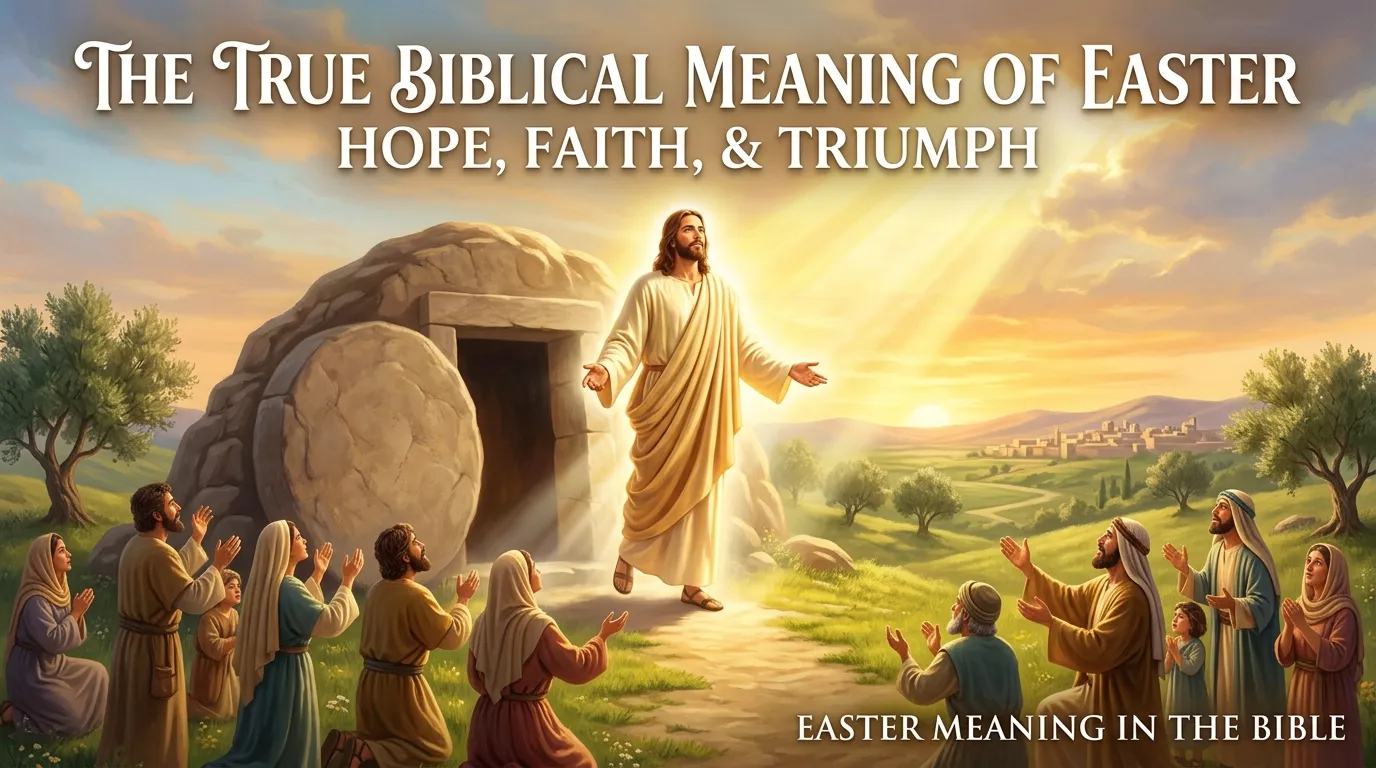
Friday was the execution. Saturday was silence. Sunday was the earthquake. The story of Easter is not a single day; it is three days, and each one matters. Without Friday, there is no atonement. Without Saturday, there is no grief. Without Sunday, there is no hope. The Christian faith stands or falls on the third day — on the claim that a dead man walked out of His tomb, and that His resurrection changes everything.
The Bible does not use the word “Easter” the way modern Christians do. The central biblical event behind Easter is the resurrection of Jesus Christ. Paul summarizes the gospel in one breath: “Christ died for our sins in accordance with the Scriptures, that he was buried, that he was raised on the third day in accordance with the Scriptures” (1 Corinthians 15:3–4). Death, burial, resurrection. That is the whole gospel. Everything else is commentary.
Friday: The Day the Lamb Died
Jesus died at Passover, and the timing was deliberate. Passover was the feast that remembered Israel’s deliverance from Egypt — the night the angel of death passed over houses marked by the blood of a lamb. The New Testament presents Jesus as the fulfillment of that feast: “Christ, our Passover lamb, has been sacrificed” (1 Corinthians 5:7). The lamb’s blood then; the Lamb’s blood now.
On the cross, Jesus bore the judgment for human sin. The Bible’s language is substitutionary: He took our place. “He himself bore our sins in his body on the tree” (1 Peter 2:24). “God shows his love for us in that while we were still sinners, Christ died for us” (Romans 5:8). The cross was not a tragic accident, and it was not a symbol. It was a transaction — the Son of God absorbing the wrath that sin deserved, so that sinners could be forgiven.
Friday is the day that makes Easter more than a spring festival. Without the cross, the resurrection would be a miracle without a meaning — a dead man coming back to life, but for what? The cross gives the resurrection its purpose: the One who rose is the One who died for sins. The empty tomb means something because the cross meant something first.
Saturday: The Day God Was Silent
Saturday is the forgotten day of Easter, and it may be the most relatable. The disciples spent it in hiding, grieving, confused, and afraid. Their leader was dead. Their hopes were buried. The promises they had heard — “the Son of Man must suffer and rise again” — seemed like a cruel joke. God was silent, and the silence was deafening.
Every believer knows Saturday. It is the day between the prayer and the answer, between the diagnosis and the healing, between the loss and the restoration. It is the day when God seems absent and the grave seems final. The Bible does not rush past Saturday. It sits in it. The Psalms are full of Saturday prayers: “How long, O LORD? Will you forget me forever?” (Psalm 13:1). The book of Job is a long Saturday. The exile was a national Saturday.
Saturday teaches that God’s silence is not God’s absence. The disciples could not see it, but God was at work in the silence — preparing the resurrection, holding the universe together, keeping His promise. The tomb was sealed, the guards were posted, and the grave looked permanent. It was not. Saturday is never the end of the story. It only feels like it.
Sunday: The Day Death Died
On the first day of the week, before dawn, women came to the tomb with spices — and found the stone rolled away and the tomb empty. Angels announced: “Why do you seek the living among the dead? He is not here, but has risen” (Luke 24:5–6). Jesus appeared to Mary Magdalene, to the disciples on the road to Emmaus, to Peter, to the Twelve, and eventually to more than five hundred people at once (1 Corinthians 15:6). The resurrection was not a private vision. It was a public event, witnessed, attested, and proclaimed.
The resurrection matters for three reasons. First, it vindicates Jesus. Romans 1:4 says He “was declared to be the Son of God in power according to the Spirit of holiness by his resurrection from the dead.” The cross looked like defeat. The resurrection proved it was victory. Second, it guarantees the believer’s justification. Paul says Jesus “was delivered up for our trespasses and raised for our justification” (Romans 4:25). The resurrection is God’s receipt: the payment was accepted. Third, it guarantees the believer’s future. “Christ has been raised from the dead, the firstfruits of those who have fallen asleep” (1 Corinthians 15:20). His resurrection is the first sheaf of the harvest. Ours will follow.
That is why Paul can say, “If Christ has not been raised, then our preaching is in vain and your faith is in vain” (1 Corinthians 15:14). Christianity is not a philosophy that survives its founder’s death. It is a faith that stands on its Founder’s resurrection. Take away the empty tomb, and there is no gospel. Keep it, and there is no despair that cannot be answered.
What Easter Changes
Easter changes what death means. For the Christian, death is no longer a wall. It is a door. “O death, where is your victory? O death, where is your sting?” (1 Corinthians 15:55). The believer who dies does not cease to exist. He is “away from the body and at home with the Lord” (2 Corinthians 5:8), awaiting the resurrection of the body at Christ’s return. Grief remains — Christians grieve, and they grieve deeply — but they do not grieve “as others do who have no hope” (1 Thessalonians 4:13).
Easter changes what life means. The resurrection is not only a future promise; it is a present power. “If the Spirit of him who raised Jesus from the dead dwells in you, he who raised Christ Jesus from the dead will also give life to your mortal bodies” (Romans 8:11). The same power that emptied the tomb is at work in the believer — breaking addictions, healing wounds, restoring marriages, giving courage to the fearful. The Christian life is resurrection life, lived now.
And Easter changes what the church is. The early church did not gather on Sunday by accident. It gathered on the day of resurrection, every week, to remember the empty tomb. Every Sunday is a small Easter. Every baptism is a participation in death and resurrection: buried with Christ, raised to new life. Every communion is a proclamation of the death and resurrection until He comes. The church is the community of the resurrection — people who have been raised from the death of sin and who live in the hope of the resurrection of the body.
Celebrating Easter Well
Christians have celebrated Easter in many ways — with sunrise services, with fasting and feasting, with eggs and lilies, with baptisms and hymns. The customs vary, and none of them is commanded. What is commanded is the remembering: the death, the burial, the resurrection, and the hope. The best Easter celebration is the one that brings a person back to the tomb, to the cross, and to the risen Christ — and then sends them out to live resurrection life in a world that still feels like Saturday.
The Witnesses: Why the Church Believed
The early church did not believe in the resurrection because it was a comforting idea. It believed because of witnesses — people who saw the risen Jesus and were willing to die for that testimony. Mary Magdalene saw Him in the garden. The disciples on the road to Emmaus walked with Him. Thomas touched His wounds. Peter ate breakfast with Him on the shore. Paul, who had persecuted the church, met Him on the road to Damascus and was transformed. More than five hundred people saw Him at once, most of whom were still alive when Paul wrote about it — an invitation to check the story with living witnesses.
The witnesses’ credibility is strengthened by their reluctance. The Gospels do not portray the disciples as people who expected resurrection. They portray them as frightened, skeptical, and slow to believe. Thomas doubted. The women were afraid. The disciples on the road to Emmaus did not recognize Him. The Gospels record their disbelief with embarrassing honesty — the kind of honesty that forgers do not include. The church’s faith in the resurrection was not born of wishful thinking. It was born of evidence that overcame doubt.
And Easter is not only a day. It is a life. The believer who has been raised with Christ is called to “seek the things that are above” (Colossians 3:1) — to live as a resurrection person in a Good Friday world. That means forgiving as a forgiven person, giving as a person who has received everything, hoping as a person who knows how the story ends, and loving as a person who has been loved at the cost of the cross. The empty tomb is not a museum. It is a mission. Every Christian carries the news that death has been defeated, and every act of love, justice, and mercy is a small resurrection — a sign that the new creation has begun and that the King is coming back to finish it.
The tomb is empty. The stone is rolled away. The angels’ announcement still stands: He is not here. He has risen. That is Easter — not a holiday, but a history, a hope, and a life. For the history and traditions of the celebration, see the article on Easter in Christian practice and culture.










