Every culture has a name for it: spells, curses, hexes, witchcraft, sorcery, black magic. The details vary, but the desire is the same — to get power over what you cannot control. To know the future. To protect yourself. To harm an enemy. To make someone love you. To get money, health, or revenge without waiting on God. The Bible has a clear and consistent word about all of it: the power is real, the source is wrong, and the price is higher than anyone expects.
The Bible does not use the modern phrase “black magic” as a technical term. It uses words like witchcraft, sorcery, divination, mediums, and spiritists — and it forbids them all. The issue is not whether these practices “work.” The issue is where the power comes from, and what it costs to use it. Scripture’s answer is that seeking supernatural power apart from God is a form of idolatry, and it leads away from the one God who can actually help.
What Scripture Forbids — and Why
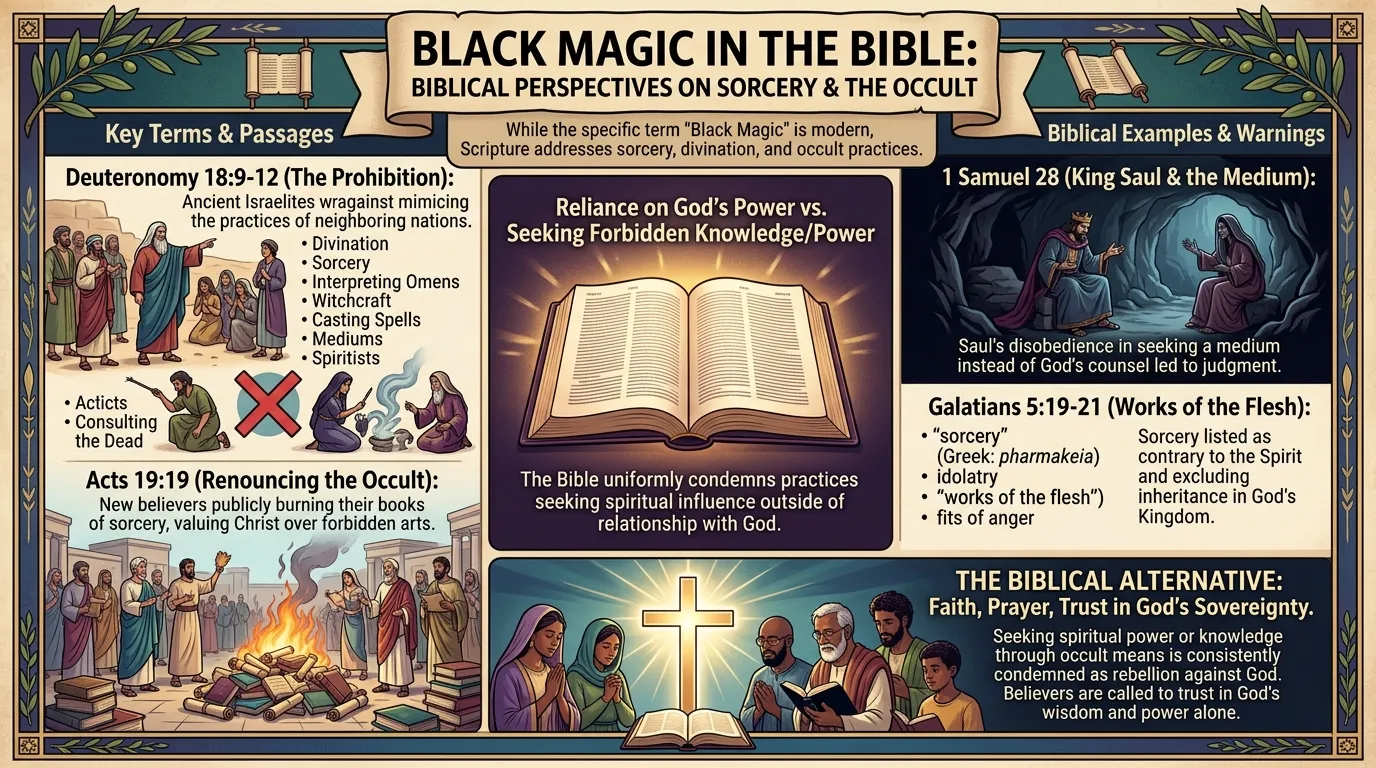
The central prohibition is Deuteronomy 18:10–12: “There shall not be found among you anyone who burns his son or his daughter as an offering, anyone who practices divination or tells fortunes or interprets omens, or a sorcerer or a charmer or a medium or a necromancer or one who inquires of the dead, for whoever does these things is an abomination to the LORD.” The list is comprehensive, and the reason is given in the surrounding verses: God’s people were to listen to Him, not to forbidden sources. The prohibition is not about God being threatened. It is about God protecting His people from trusting what cannot save them.
The New Testament repeats the warning. In Galatians 5:19–21, Paul lists sorcery (pharmakeia) among the “works of the flesh” — alongside idolatry, enmity, jealousy, and fits of anger. Sorcery is not presented as an innocent hobby. It is a pattern of life that conflicts with walking in the Spirit. In Revelation 21:8, sorcerers are listed among those who face judgment. The Bible’s stance is consistent from Moses to John: occult power is forbidden, because it is power sought outside of God.
Why? Because the core issue is not the technique. It is the allegiance. Every occult practice involves seeking guidance, power, or protection from a source other than God. That is the definition of idolatry: trusting something created to do what only the Creator can do. The fortune teller, the spell, the charm, the curse — all of them say, in effect, “God is not enough, or God is not fast enough, so I will go elsewhere.” The Bible calls that a betrayal of the covenant.
Two Biblical Case Studies
Simon the magician. Acts 8 tells of Simon, a man who “amazed the people of Samaria” with his magic and was called “the power of God that is called Great.” When Philip preached the gospel, Simon believed and was baptized. But when he saw the apostles laying hands on people and giving the Holy Spirit, he offered them money: “Give me this power also.” Peter’s response was blistering: “May your silver perish with you, because you thought you could obtain the gift of God with money!” (Acts 8:20). Simon’s sin was treating God’s power as a commodity — something to be bought, controlled, and used for status. That is the heart of magic: power as a possession. The gospel’s heart is the opposite: power as a gift, given by grace, for service.
Saul and the medium. In 1 Samuel 28, King Saul, who had expelled mediums from the land, disguised himself and visited the medium at Endor to summon Samuel’s spirit. The episode is one of the darkest in the Bible. Saul, who had once heard from God through prophets, dreams, and the Urim, had cut himself off from God through disobedience — and in his desperation, he turned to the very practices God had forbidden. The medium’s séance did not save Saul. It confirmed his doom. The story is a warning: when people stop listening to God, they start listening to anything.
Both stories show the same pattern: occult power promises control and delivers bondage. Simon wanted the Spirit’s power and was told his heart was “not right before God.” Saul wanted guidance and got a sentence. The devil’s power is real, but it is never free.
Why People Seek It
It is worth asking why occult practices are so persistent — in ancient Israel, in medieval Europe, and in the modern world of horoscopes, tarot apps, and manifestation trends. The reasons are human and understandable. Fear: the future is uncertain, and people want to know it. Grief: the dead are gone, and people want to hear from them. Powerlessness: life feels out of control, and people want leverage. Curiosity: the supernatural is fascinating. Loneliness: a spirit guide feels like company. Anger: a curse feels like justice.
Scripture does not dismiss these longings. It redirects them. Fear is answered by God’s sovereignty: the future is in His hands, and He is good. Grief is answered by the resurrection: the dead in Christ are with the Lord, and we will see them again. Powerlessness is answered by prayer: the God of the universe invites His children to ask. Curiosity is answered by revelation: God has spoken in Scripture, and what He has revealed is enough. Loneliness is answered by the Spirit’s presence. Anger is answered by God’s justice: “Vengeance is mine, I will repay, says the Lord” (Romans 12:19).
The occult offers a shortcut to each of these. But shortcuts through forbidden territory always lead to the wrong destination. A person who consults a fortune teller for reassurance will find anxiety. A person who casts a spell for control will find bondage. A person who seeks power apart from God will find that the power has a master — and the master is not them.
What About Curses, Demons, and Spiritual Attack?
Many readers ask about black magic because they are afraid — afraid of a curse, a spell, an evil eye, or a demonic attack. The Bible takes spiritual evil seriously, but it does not teach Christians to live in fear of it. The New Testament’s message is that Christ has disarmed the powers of darkness at the cross (Colossians 2:15), that “he who is in you is greater than he who is in the world” (1 John 4:4), and that no curse can override God’s blessing on His people. When Balak hired Balaam to curse Israel, Balaam found he could not: “How can I curse whom God has not cursed?” (Numbers 23:8).
That does not mean believers never face spiritual opposition. They do. But the biblical response is not a counter-spell, a ritual, or a magical object. It is prayer, Scripture, confession, community, and the armor of God (Ephesians 6:10–18). The Christian’s protection is not a charm. It is Christ. A person who is in Christ is under the blood, sealed by the Spirit, and held in the Father’s hand. No curse can reach past that.
For those who have practiced occult things and want to turn away, the Bible’s path is repentance and renunciation: confess the practice as sin, destroy the objects associated with it (as the Ephesian converts burned their magic books in Acts 19:19), and turn to Christ. The converts in Ephesus did not keep their magic books as souvenirs. They burned them — publicly, at great cost — because they understood that you cannot serve two masters.
God’s Alternative: Real Power, Right Source
The Bible does not deny the supernatural. It affirms it — and it points to its true source. The God who forbids sorcery is the God who gives the Holy Spirit, who answers prayer, who heals, who guides, who speaks through Scripture, and who raises the dead. The Christian does not need to seek power in forbidden places, because the greatest power in the universe has already been given freely: the Spirit of God, dwelling in the believer, for the glory of God and the good of others.
The Ephesian Bonfire
The most dramatic response to occult practice in the New Testament happened in Ephesus. Acts 19 describes a city steeped in magic — the Ephesian magic books were famous throughout the ancient world. When the gospel took hold, many who had practiced magic “brought their books together and burned them in the sight of all. And they counted the value of them and found it came to fifty thousand pieces of silver” (Acts 19:19). Fifty thousand silver coins was a fortune — the life savings of many people. The converts did not sell the books, donate them, or keep them as souvenirs. They burned them, publicly, at enormous cost. The bonfire was a declaration: the old life is over, the old power is renounced, and Christ is enough. It remains the model for anyone leaving occult practice behind.
The choice, in the end, is simple: power or God. Magic offers power without God. The gospel offers God — and with Him, everything. The person who chooses God will find that the fears that drove them to magic are answered, the longings that drew them to spells are satisfied, and the power they sought is given — not as a weapon to control others, but as a gift to serve them. For a general survey of these practices and their history, see the article on witchcraft across cultures and centuries.










