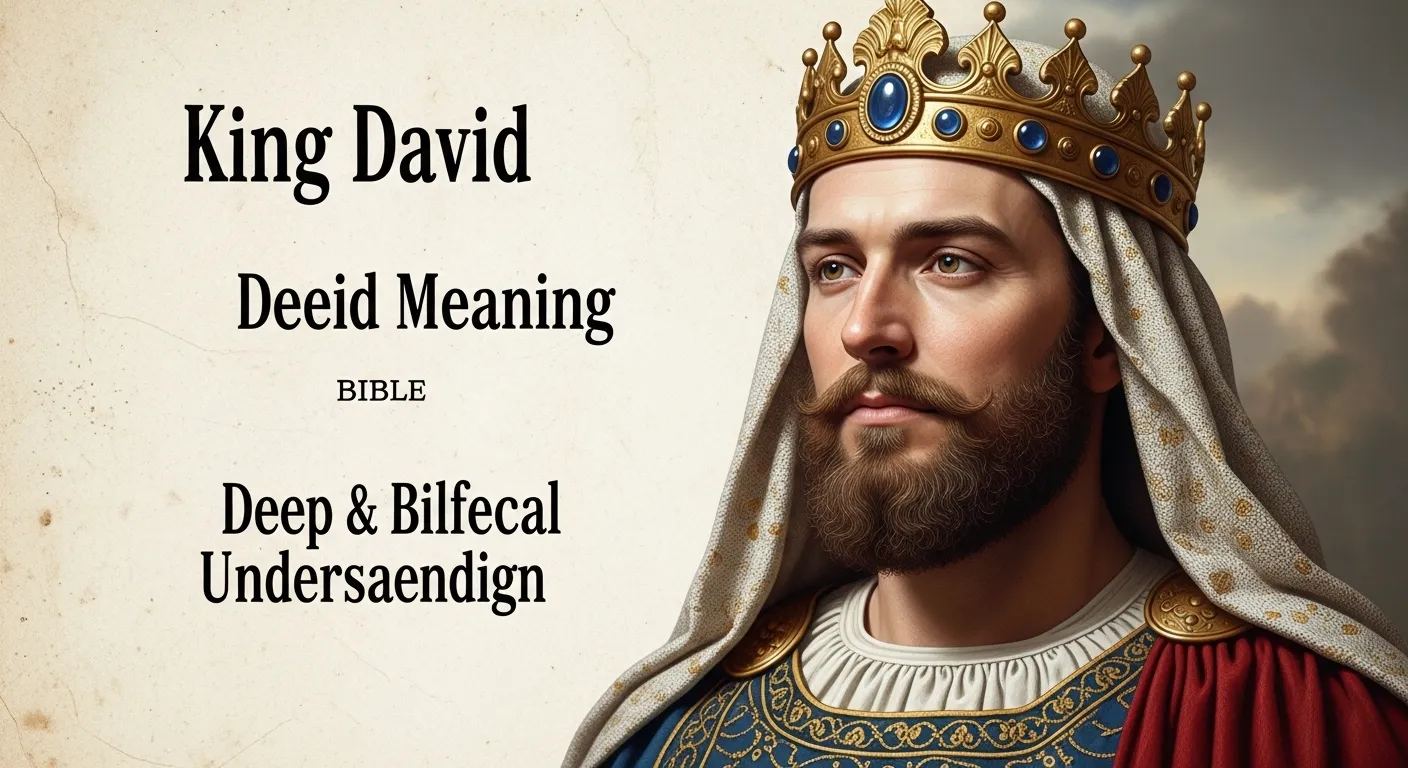
God said it twice, a thousand years apart, and the two sayings frame the whole man. First to Samuel, choosing a king: “I have provided for myself a king among his sons” — literally, “I have seen” — and the explanation: “For the LORD sees not as man sees: man looks on the outward appearance, but the LORD looks on the heart” (1 Samuel 16:1, 7). Then, a millennium later, Paul preaching in Antioch: “I have found in David the son of Jesse a man after my heart, who will do all my will” (Acts 13:22, quoting 1 Samuel 13:14).
“A man after God’s own heart.” It is the most famous epitaph in the Old Testament — and the most misunderstood. It does not mean David was perfect; his sins are recorded in pitiless detail. It does not mean he was always obedient; he committed adultery and murder. It means something deeper and more hopeful: David’s heart was oriented toward God the way a compass needle orients north — deflected at times, even violently, but always swinging back. That orientation — not perfection — is what “after God’s own heart” means. And it is available to anyone.
The Shepherd the Prophet Overlooked
When Samuel came to Bethlehem to anoint the new king, Jesse paraded seven sons — and God rejected all of them. The tall one, the strong ones, the impressive ones: “the LORD has not chosen these” (1 Samuel 16:10). So Samuel asked the question that changed everything: “Are all your sons here?” And Jesse admitted the youngest was “keeping the sheep” (16:11) — not even invited to the sacrifice.
David was so unlikely that his own father didn’t think to call him. But God had been watching the sheep-fields. While David was alone with the flock — killing the lion and the bear (17:34-36), learning to trust God with no audience — heaven was conducting the real interview. “Man looks on the outward appearance, but the LORD looks on the heart” (16:7): the principle of David’s whole life, announced at his anointing. God promotes in private what He will use in public. The years nobody sees are the years that make the king.
Then came Goliath — and David’s famous refusal of Saul’s armor: “I cannot go with these, for I have not tested them” (17:39). He fought the giant with a sling, five stones, and the testimony of the sheep-fields: “The LORD who delivered me from the paw of the lion and from the paw of the bear will deliver me from the hand of this Philistine” (17:37). Past faithfulness is the fuel of present courage. David could face Goliath because he had a history with God — private victories that became public confidence. If you want Goliath-faith, start with lion-faith: trust God in the small, unseen battles, and the big ones will find you ready.
The Singer in the Cave
Between the anointing and the crown lay roughly fifteen years of fugitive life — hunted by a jealous Saul, hiding in caves, leading a band of outcasts. It was the most spiritually productive period of David’s life, because it produced the Psalms.
Read the cave psalms and you hear a man after God’s heart thinking out loud. “Be merciful to me, O God… in the shadow of your wings I will take refuge, till the storms of destruction pass by” (Psalm 57:1) — written “when he fled from Saul, in the cave.” “With my voice I cry out to the LORD… I pour out my complaint before him; I tell my trouble before him” (Psalm 142:1-2) — “when he was in the cave. A Maskil.” No polish. No piety-performance. Complaint, fear, and raw honesty — poured out before Him.
This is the heart God loves: not the heart that never feels despair, but the heart that brings its despair to God instead of away from Him. David’s psalms swing violently — “How long, O LORD? Will you forget me forever?” (Psalm 13:1) to “I will sing to the LORD, because he has dealt bountifully with me” (13:6) — sometimes within six verses. That is not instability; it is worship as processing: feelings laid before God until faith reframes them. The man after God’s own heart was not the man with no dark emotions. He was the man who sang his dark emotions into God’s presence until they turned to praise.
The Sinner on the Roof
Then the chapter no one wants to preach but everyone needs. “In the spring of the year, the time when kings go out to battle, David sent Joab… but David remained at Jerusalem” (2 Samuel 11:1). Idleness. A roof. A bath. A choice — then a cover-up, then a murder: Uriah the Hittite, one of David’s own mighty men, sent to die with his death warrant in his hand (11:14-15).
The Bible does not soften it, and neither should we. The man after God’s own heart committed adultery and murder. If that shocks you, it should — it is meant to. No anointing, no psalm-writing, no Goliath on the résumé exempts anyone from the corrupting power of unrepented sin. David’s fall is Scripture’s loudest warning to the spiritually confident: “let anyone who thinks that he stands take heed lest he fall” (1 Corinthians 10:12).
But the story does not end on the roof. Nathan’s parable — the rich man stealing the poor man’s lamb — drew David’s fury: “the man who has done this deserves to die!” And Nathan’s thunderbolt: “You are the man!” (12:7). David’s response is the difference between Saul and David, between the rejected and the restored: “I have sinned against the LORD” (12:13). No excuses. No blame-shifting. No delay. Five words — and Psalm 51, the Bible’s great anatomy of repentance: “Create in me a clean heart, O God, and renew a right spirit within me” (51:10).
God forgave — “The LORD also has put away your sin” (12:13) — but consequences remained: “the sword shall never depart from your house” (12:10); the child died (12:18). Forgiveness is not the erasure of consequences; it is the restoration of relationship despite them. David’s later years were scarred — a rebellious son, a fractured kingdom — yet he died “in a good old age, full of days” (1 Chronicles 29:28), still the man after God’s heart. Grace does not pretend the fall didn’t happen; it proves the fall doesn’t get the last word.
The King Who Danced
Between the cave and the roof, there is the dance — and it may be the most revealing scene of all. When the ark of God was brought to Jerusalem, “David danced before the LORD with all his might” (2 Samuel 6:14) — leaping and whirling in a linen ephod, undignified, uninhibited. His wife Michal watched from a window “and despised him in her heart” (6:16). When he came home, she met him with sarcasm: “How the king of Israel honored himself today!”
David’s answer is the manifesto of the God-oriented heart: “It was before the LORD… I will make myself yet more contemptible than this, and I will be abased in your eyes” (6:21-22). He chose God’s approval over human dignity — publicly, unapologetically. The man after God’s heart worships before the LORD, not before the audience. Michal’s contempt cost her dearly (6:23); David’s abandon gained him everything. Every believer faces Michal’s window eventually — the moment when wholehearted worship looks foolish to the respectable. Dance anyway.
The Father of the Greater King
David’s story points past David from the start. God’s covenant with him — “your house and your kingdom shall be made sure forever before me” (2 Samuel 7:16) — outgrew every earthly heir and found its “Yes” in Jesus. David himself saw it: “The LORD says to my Lord: ‘Sit at my right hand'” (Psalm 110:1) — and Jesus used that psalm to stump the Pharisees: “If then David calls him Lord, how is he his son?” (Matthew 22:45). The Christ is David’s son and David’s Lord — the greater King the whole story was aiming at.
Matthew opens his Gospel: “The book of the genealogy of Jesus Christ, the son of David, the son of Abraham” (Matthew 1:1). The New Testament’s first sentence about Jesus is about David. And Revelation’s last portrait of Christ is “the Lion of the tribe of Judah, the Root of David” (Revelation 5:5) — and “the root and the descendant of David, the bright morning star” (22:16). David’s story ends where Christ’s begins, and Christ’s story never ends.
So what does King David mean in the Bible? He means that God chooses hearts, not résumés — shepherds over princes. He means that worship is honesty poured out before God — in caves as well as courts. He means that the worst fall is not final for the repentant — the roof does not cancel the anointing when the heart returns. And he means that every earthly king is a placeholder for the heavenly One. Be a person after God’s own heart: oriented north, quick to repent, unashamed to dance — and when you fall, fall toward Him, like David did. For the historical David — the archaeology, the kingdom, and the debates — Wikipedia’s article on David surveys the biblical account alongside the historical evidence.










