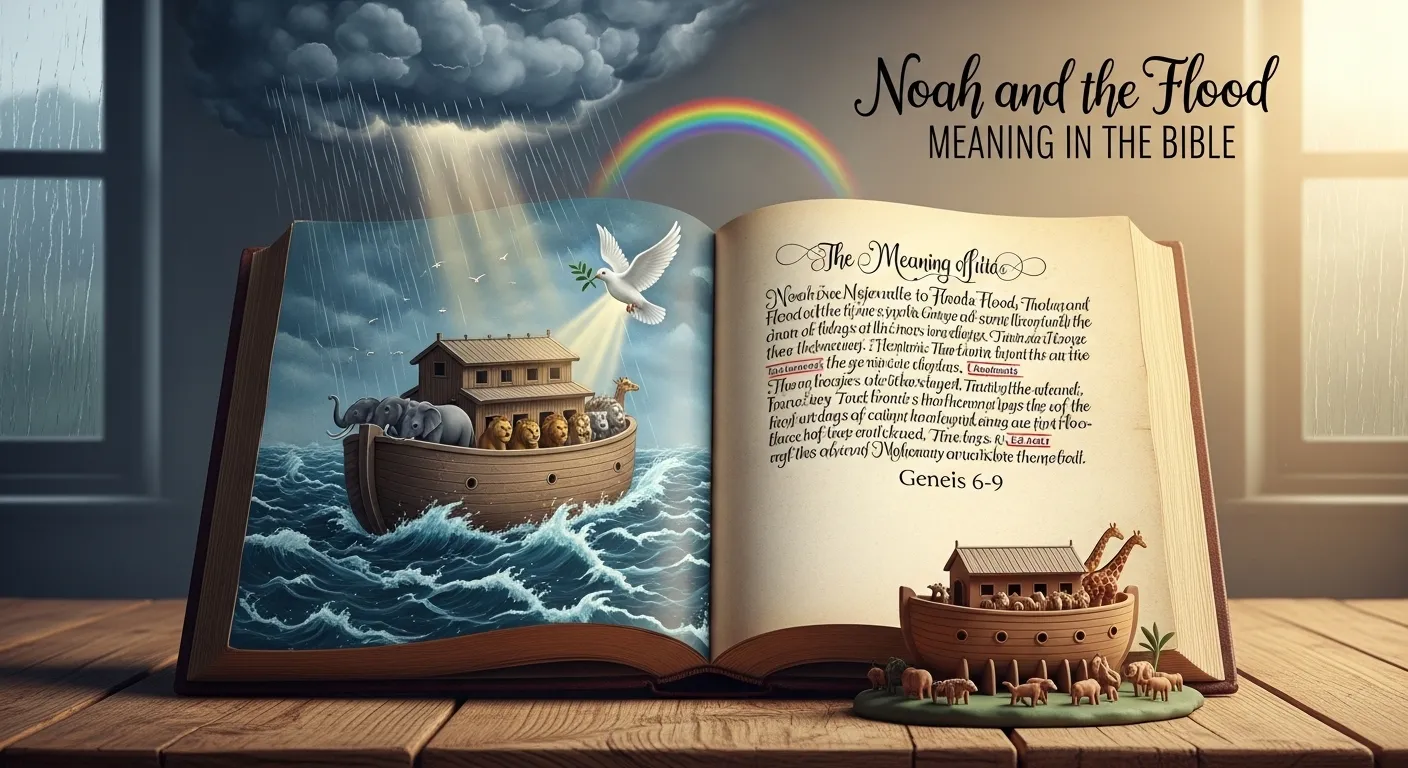
It is the worst verse in the Bible, and the best verse in the Bible, standing side by side. The worst: “The LORD saw that the wickedness of man was great in the earth, and that every intention of the thoughts of his heart was only evil continually” (Genesis 6:5). Total corruption — not some evil, but only evil, continually. And immediately after, the best: “But Noah found favor in the eyes of the LORD” (6:8). Grace, in the darkest chapter of human history. Everything about Noah and the flood flows from the collision of those two verses: judgment so complete it required a flood, and mercy so persistent it built an ark.
One Hundred Twenty Years of Hammering
God’s first word about the coming judgment included a deadline with mercy built in: “My Spirit shall not abide in man forever… his days shall be 120 years” (Genesis 6:3). Whether 120 years marks the countdown to the flood or the new span of human life, the traditional reading is powerful: God announced judgment a century in advance. For 120 years, the world watched a man build a boat where there was no sea — and every hammer blow was a sermon.
Peter confirms it: Noah built “while… God’s patience waited in the days of Noah, while the ark was being prepared” (1 Peter 3:20). The ark took years — and all those years, patience waited. The flood was not a divine temper tantrum; it was a century-long warning that the world ignored. And Noah, Peter adds elsewhere, was “a herald of righteousness” (2 Peter 2:5) — he preached while he built. The ark was not just a rescue vessel; it was a billboard: judgment is coming; God has provided a way; get in.
Hebrews gives Noah’s epitaph: “By faith Noah, being warned by God concerning events as yet unseen, in reverent fear constructed an ark for the saving of his household. By this he condemned the world and became an heir of the righteousness that comes by faith” (Hebrews 11:7). Faith builds arks for rains no one else believes are coming. Noah’s neighbors had never seen rain like this — had perhaps never seen rain at all (the earth was watered by mist, Genesis 2:6, in one reading). He built anyway. That is what faith looks like from the outside: absurd, until the clouds gather.
The Boat That Wasn’t a Boat
God’s specifications were precise: “Make yourself an ark of gopher wood… The length of the ark 300 cubits, its breadth 50 cubits, and its height 30 cubits” (Genesis 6:14-15) — roughly 450 feet long, a vessel built for floating, not sailing. No rudder. No sails. No oars. The ark was not designed to be steered; it was designed to be surrendered — to ride out the storm entirely in God’s hands.
And the detail that preaches loudest: “the LORD shut him in” (Genesis 7:16). Not Noah. Not his sons. God closed the door. The same hand that shuts the door of salvation keeps it shut against the storm — “no one will snatch them out of my hand” (John 10:28) is the New Testament echo. When God seals His people in, the seal holds.
Inside were eight souls (1 Peter 3:20) and representatives of every kind of land animal and bird (Genesis 6:19-20; 7:2-3 — seven pairs of the clean, for sacrifice and food). The ark was a floating seed-bank of creation — God preserving not just humanity but the whole web of life He had called good. Judgment, yes — but judgment with a greenhouse attached. Even in unmaking the world, God was planning its remaking.
Forty Days, One Hundred Fifty Days
The flood’s timeline is given with almost journalistic precision — and the precision matters, because it shows God was never in a hurry, even in judgment. The rain fell forty days and forty nights (7:12). The waters “prevailed on the earth 150 days” (7:24). The ark rested on Ararat in the seventh month (8:4); the mountain tops appeared in the tenth (8:5). Noah waited forty more days, then sent the raven — which “went to and fro until the waters were dried up” (8:7) — and then the dove, three times: first returning empty, then with the olive leaf (8:11), then not returning at all (8:12).
The dove’s olive leaf is the Bible’s first sign of peace after judgment — new life, tender and green, where only water had been. (It is no accident the Spirit later descends “like a dove” at Jesus’ baptism — the same emblem of new creation, new beginning.) And the whole slow calendar — over a year in the ark (8:13-14) — teaches what every sufferer needs: God’s deliverances have their own timetable, and waiting inside the ark is still being saved. Noah was safe long before he was out. So are you.
The First Thing Noah Did on Dry Land
When the earth was dry and God said “Go out” (8:16), Noah’s first act was not to build a house, plant a field, or take a census. “Then Noah built an altar to the LORD and took some of every clean animal and some of every clean bird and offered burnt offerings on the altar” (Genesis 8:20). After a year of confinement, his first free act was worship — costly worship, from the precious clean animals he had carefully preserved.
And God responded — in His heart: “I will never again curse the ground because of man… Neither will I ever again strike down every living creature as I have done” (8:21). The sacrifice did not change God’s mind as much as it moved God’s heart — the sweet savor of grateful worship answering the grief of Genesis 6:6 (“it grieved him to his heart”). The flood began with God’s grieved heart; it ended with God’s resolved heart. Worship is what stands between the two.
Then came the covenant — the first covenant in the Bible, made “with you and your offspring after you, and with every living creature” (9:9-10): “never again shall all flesh be cut off by the waters of the flood” (9:11). And the sign: “I have set my bow in the cloud” (9:13). God’s war-bow, hung in the sky, pointed away from the earth. Every rainbow since is a weapon retired — heaven’s promise that judgment-by-water will never happen again. (The final judgment, Peter notes, will be by fire — 2 Peter 3:7. The bow stays hung; the warning stands.)
The Flood in the New Testament
Jesus Himself made Noah’s flood a prophecy of His return: “For as were the days of Noah, so will be the coming of the Son of Man. For as in those days before the flood they were eating and drinking, marrying and giving in marriage, until the day when Noah entered the ark, and they were unaware until the flood came and swept them all away, so will be the coming of the Son of Man” (Matthew 24:37-39).
Note what Jesus emphasizes: not the wickedness of Noah’s generation but its distraction. Eating, drinking, marrying — ordinary life, pursued as if it were all there is, “unaware until the flood came.” The danger Jesus warns about is not spectacular sin but comfortable obliviousness — life so full of the normal that there is no room for the eternal. Noah’s generation was not destroyed for eating and drinking; it was destroyed while eating and drinking, having ignored a 120-year warning.
And Peter draws the flood’s deepest line — to baptism: “eight persons, were brought safely through water. Baptism, which corresponds to this, now saves you” (1 Peter 3:20-21). The flood waters buried the old world and bore up the ark; baptism buries the old self and raises the new (Romans 6:4). Every baptism is a miniature flood — judgment and salvation in the same water. The ark, Peter implies, was always pointing to Christ: there is one vessel, one door, one way through the waters — and outside it, no safety.
So what does Noah and the flood mean? Judgment is real, warning is long, grace builds arks, and the door is still open. “While it is still called ‘today'” (Hebrews 3:13) — the 120 years have become two thousand, and God’s patience still waits while the ark is being prepared. Get in. For the flood narrative’s place in ancient literature and its enduring cultural footprint, Wikipedia’s article on the Genesis flood narrative offers a thorough survey of the text and its interpretations.










