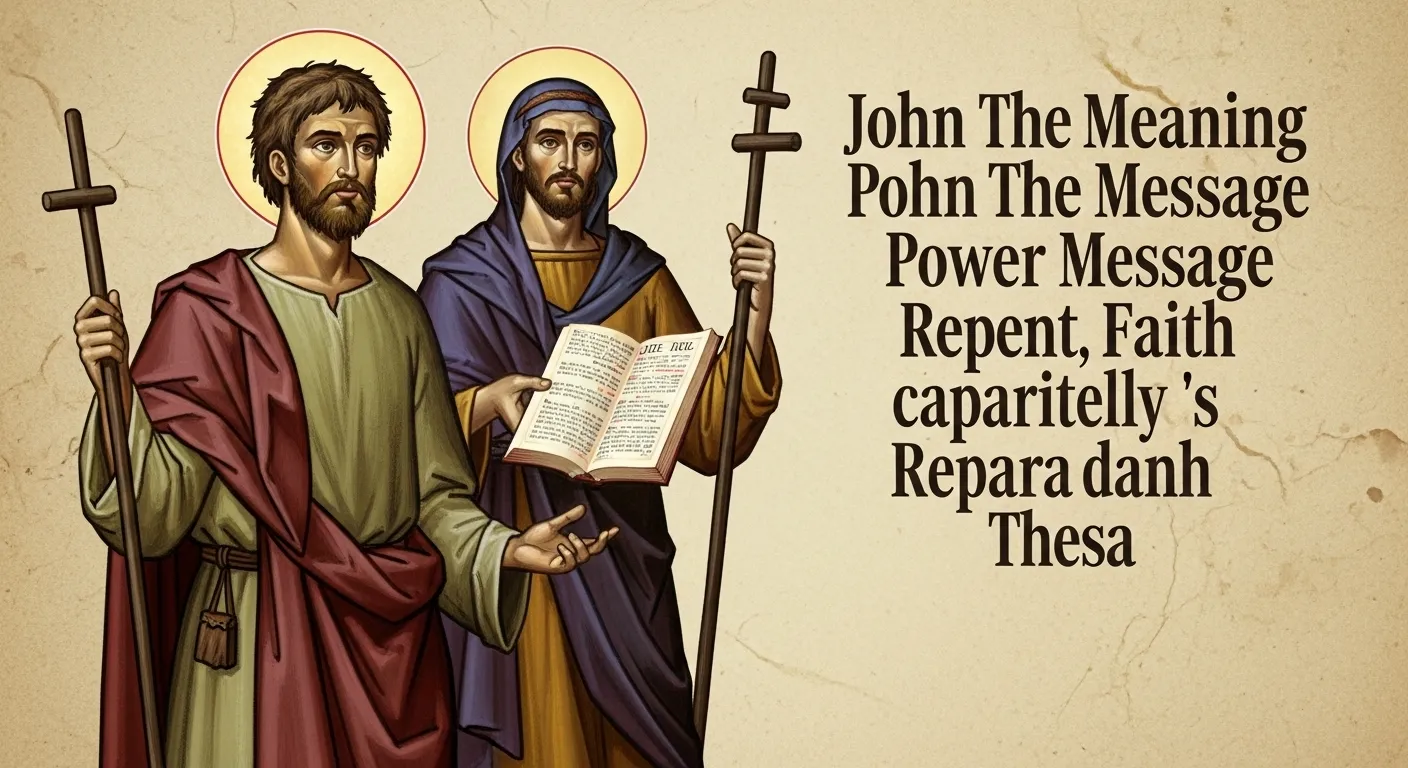
He wore camel’s hair and ate locusts. He called the religious elite a brood of vipers to their faces. He baptized the Son of God and then watched his own followers leave him to follow Jesus — and called it his joy. John the Baptist is the strangest great figure in the New Testament: the last of the Old Testament prophets and the first of the New Testament witnesses, a man whose entire life was a pointing finger. “He must become greater; I must become less” (John 3:30) — no one in Scripture understood his own assignment better, and no one fulfilled a supporting role more greatly.
Jesus paid him the highest tribute ever given to a human being: “among those born of women there has not risen anyone greater than John the Baptist” (Matthew 11:11). Then He added the sentence that reframes everything: “yet whoever is least in the kingdom of heaven is greater than he.” John stood on the threshold between the ages — the greatest of the old, the least of the new. His life is the bridge, and its meaning is found in what bridges are for: being crossed.
The Child of Promise
John’s story begins, like Isaac’s and Samuel’s and Samson’s, with a barren womb and an angelic announcement. Zechariah, an aging priest, is burning incense in the temple when Gabriel appears: “Your wife Elizabeth will bear you a son, and you are to call him John” (Luke 1:13). The angel’s job description is extraordinary — the boy will be great, filled with the Holy Spirit from birth, and will “go on before the Lord, in the spirit and power of Elijah, to turn the hearts of the parents to their children” (Luke 1:17), fulfilling Malachi’s final prophecy (Malachi 4:5–6).
Zechariah doubts — “How can I be sure of this?” — and is struck mute until the child’s birth (Luke 1:20). When the baby arrives and Zechariah confirms the name John (“the Lord is gracious”) on a writing tablet, his tongue is loosed and he prophesies the Benedictus, calling his eight-day-old son “prophet of the Most High” who will “go on before the Lord to prepare the way for him” (Luke 1:76). Before John can speak, his calling is spoken over him. Before he chooses his mission, his mission has chosen him.
The detail that he was “filled with the Holy Spirit even before he was born” (Luke 1:15) — and leaped in Elizabeth’s womb when Mary arrived carrying Jesus (Luke 1:41) — marks John as unique in salvation history. The forerunner recognized the King before either of them was born. Some callings are like that: formed in secret, long before the public ever sees them.
The Voice in the Wilderness
“In those days John the Baptist came, preaching in the wilderness of Judea” (Matthew 3:1). His wardrobe was deliberate: camel’s hair and a leather belt — the uniform of Elijah (2 Kings 1:8). His diet was deliberate: locusts and wild honey — the food of the desert poor. His location was deliberate: the wilderness, where Israel had been formed and where the prophets said God would speak tenderly to His people again (Hosea 2:14). Everything about John was a visual sermon before he opened his mouth. He looked like the past so people would recognize the future.
His message had two edges, and he never dulled either. To the crowds: “Repent, for the kingdom of heaven has come near” (Matthew 3:2) — the same first sermon Jesus would preach (Matthew 4:17). Repentance, for John, was not a feeling but a turn, verified by “fruit in keeping with repentance” (Matthew 3:8): share your tunics, don’t extort, be content with your wages (Luke 3:10–14). To the Pharisees and Sadducees who came to watch: “You brood of vipers! Who warned you to flee from the coming wrath?” (Matthew 3:7). He saw through religious tourism instantly. Lineage meant nothing — “God can raise up children for Abraham” from stones (Matthew 3:9). The axe was already at the root.
His baptism was the sign of it all. Jews did not baptize Jews — baptism was for Gentile converts. By calling Israel itself to be baptized, John was saying something explosive: the whole nation needed to start over like pagans. It was a national humiliation and a national hope in one act. And the crowds came — “people went out to him from Jerusalem and all Judea and the whole region of the Jordan. Confessing their sins, they were baptized by him in the Jordan River” (Matthew 3:5–6). The wilderness revival was real, massive, and — John insisted — only the preparation. “I baptize you with water for repentance. But after me comes one who is more powerful than I… He will baptize you with the Holy Spirit and fire” (Matthew 3:11).
The Baptism of Jesus: The Forerunner’s Finest Hour
Then Jesus came from Galilee to be baptized, and John tried to deter Him: “I need to be baptized by you, and do you come to me?” (Matthew 3:14). It is the only recorded moment of John’s confusion — the forerunner suddenly unsure of the order of things. Jesus’ answer — “Let it be so now; it is proper for us to do this to fulfill all righteousness” (Matthew 3:15) — is one of the most profound sentences in the Gospels. Jesus did not need repentance; He needed solidarity. He was baptized not because He was a sinner but because He had come to stand with sinners.
What happened next validated John’s entire ministry: the heavens opened, the Spirit descended like a dove, and the Father’s voice declared, “This is my Son, whom I love; with him I am well pleased” (Matthew 3:17). John would later testify, “I saw the Spirit come down from heaven as a dove and remain on him… I have seen and I testify that this is God’s Chosen One” (John 1:32–34). The forerunner’s job was to identify the King, and he did it — publicly, unmistakably, on the record.
And then John did the hardest thing a leader ever does: he let go. When his disciples complained that everyone was going to Jesus instead, John answered with the sentence that should be engraved over every ministry, every platform, every ego: “He must become greater; I must become less” (John 3:30). He called himself the friend of the bridegroom, whose joy is complete when the bridegroom gets the bride (John 3:29). Decrease as joy. Obscurity as fulfillment. It is the most countercultural leadership philosophy ever articulated, and John lived it to the end.
The Prison: When the Greatest Had Questions
John’s end is Scripture’s honest portrait of faith under pressure. He had denounced Herod Antipas for marrying his brother’s wife — the prophet’s fearlessness extended to kings — and Herod threw him in prison (Mark 6:17–18). There, in a dungeon, the man who had baptized the Messiah and heard the Father’s voice sent disciples to ask Jesus: “Are you the one who is to come, or should we expect someone else?” (Matthew 11:3).
The question has comforted doubting believers for two thousand years. If John the Baptist — the greatest born of women — could have questions in prison, then questions are not the opposite of faith. Jesus did not rebuke him. He sent back evidence: “Go back and report to John what you hear and see: The blind receive sight, the lame walk… and the good news is proclaimed to the poor” (Matthew 11:4–5) — a catalogue of Isaiah’s messianic prophecies coming true. Then, to the crowds, Jesus paid the tribute: no greater born of women. He praised John to others while John could not hear it — the way God often speaks of His faithful servants.
John was beheaded at a birthday party, his head served on a platter to satisfy a grudge (Mark 6:21–28). It seems like the most pointless death in the New Testament — no final words recorded, no vindication in his lifetime. But Jesus had already given the verdict, and history has confirmed it: the forerunner finished his race. He prepared the way, identified the Lamb — “Look, the Lamb of God, who takes away the sin of the world!” (John 1:29) — and decreased into glory.
The meaning of John for the reader is the meaning of every life lived for Someone else: prepare the way, tell the truth, point to Jesus, and find your joy in His increase. You do not need to be the bridegroom. It is enough — it is everything — to be the friend who rejoices at His voice. For the historical sources on John’s life beyond the Gospels, including the Jewish historian Josephus, the Wikipedia article on John the Baptist gathers the biblical, historical, and traditional accounts in one survey.










