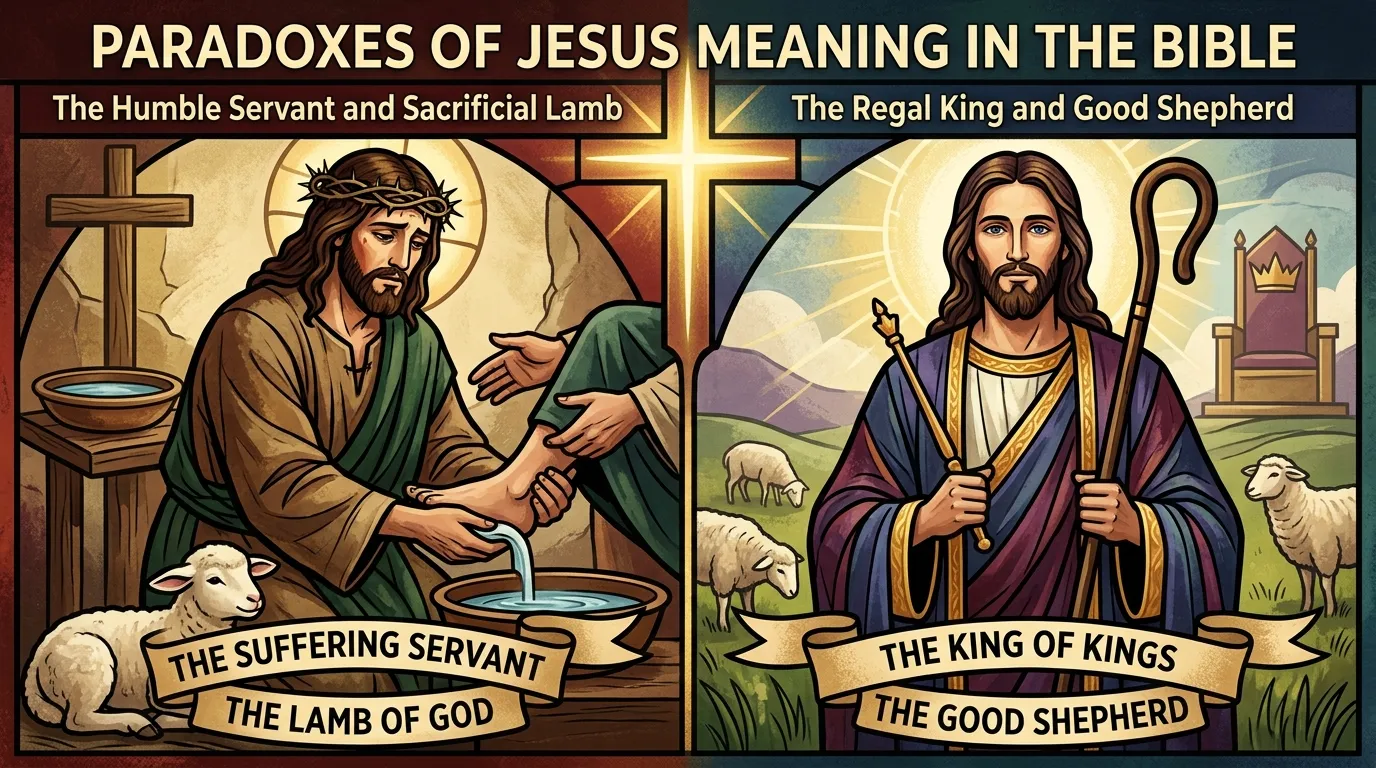
Imagine hearing Jesus say, “The last will be first” or “Whoever wants to save their life will lose it.” At first, these words may sound confusing. Why would Jesus teach something that seems to go against normal human thinking?
These statements are called paradoxes of Jesus. The phrase paradoxes of Jesus meaning in the Bible points to His teachings that seem opposite or impossible at first, yet reveal a deeper truth about God’s kingdom. Jesus often used this kind of teaching to turn people’s thinking upside down and show them what faith, love, humility, and true greatness really mean.
A paradox is not a contradiction. A contradiction says two things that cannot both be true. A biblical paradox may sound impossible on the surface but becomes meaningful when we understand the spiritual truth behind it.
Jesus used these powerful sayings to teach His followers that God’s ways are often different from the world’s ways. His paradoxes invite us to look beyond appearances and trust God’s wisdom.
What Are the Paradoxes of Jesus in the Bible?
The paradoxes of Jesus are teachings that contain an apparent opposite or surprising truth. They challenge ordinary human ideas about success, strength, wealth, leadership, suffering, and life.
For example, Jesus said:
- “The last will be first, and the first will be last” (Matthew 20:16).
- “Whoever wants to save their life will lose it” (Matthew 16:25).
- “Blessed are those who mourn” (Matthew 5:4).
- “Love your enemies and pray for those who persecute you” (Matthew 5:44).
- “Whoever wants to become great among you must be your servant” (Matthew 20:26).
These teachings are not meant to confuse believers. Instead, they reveal a different way of living under God’s rule.
Jesus shows that true greatness is not always visible, strength can appear through weakness, and life with God cannot always be measured by worldly success.
Biblical Meaning of the Paradoxes of Jesus
The central biblical meaning of Jesus’ paradoxes is that God’s kingdom operates according to values that often differ from human expectations.
Jesus did not simply give strange sayings. He used them to teach deep truths about the Father, salvation, discipleship, love, humility, and eternal life.
The First Will Be Last
In Matthew 20:1–16, Jesus tells the parable of workers who receive the same wage even though they worked different lengths of time.
He ends with the statement:
“So the last will be first, and the first last” (Matthew 20:16).
The lesson is connected to God’s generosity and grace. God’s gifts are not earned through human status or personal comparison.
This does not mean hard work has no value. Rather, Jesus warns against believing that our position makes us more worthy of God’s grace than someone else.
Losing Your Life to Find It
Jesus says in Matthew 16:24–25 that anyone who wants to follow Him must deny themselves, take up their cross, and follow Him.
He then says that whoever wants to save their life will lose it, but whoever loses their life for His sake will find it.
This paradox describes Christian surrender.
Jesus is not teaching that physical life has no value. He is teaching that a person who makes self-preservation, comfort, or personal ambition their highest goal can miss the deeper life God offers.
Following Christ means giving Him first place.
Blessed Are Those Who Mourn
One of Jesus’ most surprising statements appears in the Beatitudes:
“Blessed are those who mourn, for they will be comforted” (Matthew 5:4).
Mourning normally feels like the opposite of blessing. Yet Jesus connects mourning with God’s comfort.
The passage does not say that suffering is good in itself. Scripture consistently shows God’s compassion toward people who hurt.
Instead, Jesus reminds us that God is near to the brokenhearted and brings comfort in places where human strength is not enough.
Psalm 34:18 similarly says that the Lord is close to the brokenhearted.
For a Christian going through grief, this paradox can become deeply comforting. Tears do not mean God has abandoned you.
The Meek Will Inherit the Earth
Jesus says:
“Blessed are the meek, for they will inherit the earth” (Matthew 5:5).
In a world that often celebrates power, loudness, and control, meekness may look like weakness.
Biblical meekness, however, is not cowardice. It points toward humility, gentleness, and controlled strength.
Jesus Himself was described as “gentle and humble in heart” (Matthew 11:29).
The paradox teaches that God’s kingdom does not measure strength in the same way the world does.
Greatness Comes Through Servanthood
Jesus gave another powerful paradox when His disciples argued about greatness.
He said:
“Whoever wants to become great among you must be your servant” (Matthew 20:26).
Jesus then pointed to His own mission, saying that the Son of Man came “not to be served, but to serve, and to give his life as a ransom for many” (Matthew 20:28).
This is one of the clearest examples of Jesus redefining greatness.
A worldly view may say that great people are those who control others. Jesus teaches that greatness in God’s kingdom is expressed through humble service.
A Christian parent serving a child, a church member helping someone in need, or a believer quietly caring for an elderly neighbor can reflect this teaching.
The Weak Can Become Strong
Paul explains a similar kingdom principle in 2 Corinthians 12:9. After describing his struggle, he records Christ’s words:
“My grace is sufficient for you, for my power is made perfect in weakness.”
Paul responds by saying he will boast about his weaknesses so that Christ’s power may rest on him.
The biblical point is not that weakness itself is desirable. Rather, human weakness can become a place where dependence on God’s grace becomes clear.
This is important when life does not go according to plan.
You may feel weak because of fear, disappointment, failure, or uncertainty. Yet Scripture reminds believers that they do not have to depend entirely on their own strength.
Loving Your Enemies
Perhaps one of Jesus’ hardest paradoxes is found in the Sermon on the Mount.
He teaches:
“Love your enemies and pray for those who persecute you” (Matthew 5:44).
Human instinct often says to hurt those who hurt us. Jesus calls His followers to respond differently.
This does not mean Christians must approve of evil, remain in unsafe situations, or refuse appropriate justice. Instead, Jesus commands His followers to reject personal hatred and seek the good of others while trusting God with judgment.
Romans 12:19–21 develops this theme by telling believers not to repay evil for evil and to overcome evil with good.
Christian love is not weakness. It is a deliberate response shaped by God’s character.
Jesus and the Paradox of Giving
Jesus also taught that “It is more blessed to give than to receive” (Acts 20:35).
These words are recorded by Paul as part of Jesus’ teaching, even though they do not appear in the four Gospels.
The principle fits Jesus’ broader teaching about generosity.
The world may tell us that happiness comes from gaining more. Jesus repeatedly points His followers toward generosity, compassion, and storing treasures in heaven (Matthew 6:19–21).
Giving does not guarantee financial wealth or an easy life. The deeper lesson is that generosity frees the heart from making possessions the center of life.
Paradoxes of Jesus + Hebrew Meaning
The phrase paradoxes of Jesus is an English description, not a specific Hebrew biblical phrase.
Jesus lived and taught within a Jewish setting, and His teachings were deeply connected to the Hebrew Scriptures and Jewish thought. However, the New Testament was written primarily in Koine Greek, not Hebrew.
The Greek word often associated with the idea of a paradox is paradoxon, related to something unexpected or contrary to common expectation. The biblical writers use various Greek words and expressions rather than presenting one special Hebrew term for all of Jesus’ paradoxical sayings.
This distinction matters because it is easy to claim that a particular Hebrew word is the secret meaning of Jesus’ paradoxes when Scripture does not make that claim.
A sound biblical approach is to study Jesus’ words in their immediate context and compare them with the wider teaching of Scripture.
Why Did Jesus Teach in Paradoxes?
Jesus often taught in ways that made people stop and think.
His words could challenge pride, expose wrong motives, and invite deeper faith.
Jesus Challenged Worldly Values
People often measure success through money, influence, appearance, or social position.
Jesus challenged these standards.
In Matthew 6:19–21, He tells His followers not to store up treasures on earth but to store up treasures in heaven.
The message is simple: what matters most to God may not be what receives the most attention from the world.
Jesus Exposed the Human Heart
Paradoxical teachings also reveal our motives.
For example, loving an enemy is difficult because it challenges our desire for revenge. Serving others is difficult because pride wants recognition.
Jesus’ teachings expose these struggles and call us toward transformation.
Jesus Pointed to God’s Wisdom
Paul writes in 1 Corinthians 1:25 that the foolishness of God is wiser than human wisdom.
Paul is not saying God is actually foolish. He is contrasting God’s wisdom with human judgment.
The cross itself demonstrates this surprising pattern. What looked like defeat became central to God’s work of salvation.
The Cross Is the Greatest Biblical Paradox
The death of Jesus on the cross is perhaps the deepest paradox in the Christian faith.
Jesus, who Christians confess as the Son of God, willingly suffered and died.
From a human viewpoint, the cross looked like defeat.
Yet the New Testament presents Christ’s death and resurrection as central to God’s saving work. First Corinthians 1:18 calls the message of the cross “the power of God” to those who are being saved.
Then came the resurrection.
What appeared to be the end became the foundation of Christian hope.
The cross shows that God can bring redemption out of what appears to be loss.
This does not mean every painful event automatically has a good earthly outcome. Scripture gives believers hope without pretending that suffering is easy.
What Do Jesus’ Paradoxes Mean Spiritually?
Spiritually, the paradoxes of Jesus can encourage believers to trust God when circumstances do not make sense.
They remind us that faith is not always about having every answer.
Sometimes faith means saying, “I do not understand this, but I will continue to trust God.”
These teachings can point believers toward:
- Humility instead of pride
- Service instead of self-promotion
- Forgiveness instead of revenge
- Faith instead of fear
- Generosity instead of greed
- Eternal hope instead of temporary success
- Dependence on God’s grace instead of self-reliance
These are biblical applications, not secret codes hidden in Jesus’ words.
Paradoxes of Jesus in Dreams: What Could They Mean?
Some people may dream about Jesus saying something strange, contradictory, or paradoxical.
A dream can feel deeply meaningful. However, the Bible does not teach that every dream is a divine message.
Scripture contains examples of God communicating through dreams, such as Joseph’s dreams in Genesis 37 and Joseph’s dreams in Matthew 1–2. At the same time, Ecclesiastes 5:3 connects dreams with the activity of the mind.
Therefore, Christians should be careful.
If you dream about a paradoxical teaching from Jesus, consider what Scripture actually says rather than assuming the dream contains a supernatural prediction.
Ask:
- Does the message agree with Scripture?
- Does it point toward Christ?
- Does it encourage obedience, humility, love, and truth?
- Could the dream reflect something I am currently thinking or experiencing?
- Am I turning the dream into a prediction that Scripture does not support?
Scripture should test our interpretations, not the other way around.
What Jesus’ Paradoxes Can Teach Us Today
Jesus’ teachings become especially meaningful when applied to ordinary life.
When You Feel Like a Failure
You may feel unsuccessful because another person seems further ahead.
Jesus’ teaching about the first and last reminds us that God’s kingdom is not built on human comparison.
Your worth before God does not depend on winning every competition.
When Someone Hurts You
Loving an enemy can feel impossible.
Start with prayer. Ask God to help you release revenge and respond wisely.
Forgiveness may be a process, and forgiveness does not erase healthy boundaries or the need for justice.
When You Feel Weak
Remember Paul’s words in 2 Corinthians 12:9.
You do not need to pretend that everything is fine. You can bring your weakness honestly before God.
Grace is not reserved for people who have everything together.
When You Want Recognition
Jesus’ teaching about servanthood gives a different definition of success.
Ask yourself whether you are serving because you love God and people or because you want praise.
Sometimes the most meaningful Christian work happens where nobody applauds.
Are Jesus’ Paradoxes Contradictions?
No. A biblical paradox is not necessarily a contradiction.
A contradiction would require two statements that cannot both be true in the same sense and context.
Jesus’ paradoxes usually become clearer when we understand the context and the spiritual principle He is teaching.
For example, losing your life for Christ does not mean believers should seek physical death. In context, Jesus is speaking about denying self and following Him faithfully.
Likewise, being last does not mean laziness is rewarded. Jesus is challenging pride and worldly ideas about status.
Context protects us from misreading difficult Bible verses.
How Should Christians Respond to Jesus’ Paradoxes?
When a teaching of Jesus seems confusing, do not rush to find a hidden meaning.
Instead:
- Read the surrounding passage.
- Compare the teaching with other Scriptures.
- Look at what Jesus was addressing.
- Consider the original audience.
- Pray for wisdom.
- Avoid interpretations that Scripture does not support.
- Apply the clear biblical principle to daily life.
James 1:5 encourages believers to ask God for wisdom.
That is a beautiful response when Scripture challenges us.
Frequently Asked Questions
What is the main meaning of Jesus’ paradoxes?
The main meaning is that God’s kingdom often operates according to values that differ from worldly expectations. Jesus used surprising statements to teach humility, faith, love, sacrifice, service, grace, and dependence on God.
What is the greatest paradox of Jesus?
The cross is arguably the greatest paradox in Christianity. Jesus’ apparent defeat through crucifixion became central to the Christian message of salvation, followed by His resurrection and victory over death.
Why did Jesus use paradoxes in His teaching?
Jesus used surprising statements to make people think deeply, challenge false assumptions, reveal spiritual truth, and call His listeners to genuine faith and obedience.
Does Jesus’ paradox about losing your life mean literal death?
In Matthew 16:24–25, Jesus connects losing one’s life with denying self, taking up the cross, and following Him. The teaching concerns surrendering one’s life to Christ rather than making self-preservation or personal ambition the highest goal.
Do Jesus’ paradoxes apply to Christians today?
Yes. Their principles remain highly relevant. Christians can apply Jesus’ teachings about humility, service, forgiveness, generosity, faith, and love in family life, work, church, friendships, and difficult relationships.
Can Jesus’ paradoxes appear in dreams?
A person may dream about Jesus or biblical teachings, but Scripture does not say that every dream is a message from God. Dreams should be approached carefully and tested against Scripture rather than treated as certain prophecy.
Final Thoughts
The paradoxes of Jesus meaning in the Bible invite us to see life through God’s kingdom rather than through human expectations.
The last can become first. The humble can be honored. Servants can become great. Weakness can become a place where God’s grace is clearly seen. Enemies can become the focus of prayer instead of revenge.
Most importantly, the cross reminds us that God’s work may look very different from what we expect.
When you face a season that does not make sense, you do not have to pretend that you understand everything. Bring your questions to God. Open His Word. Pray for wisdom. Keep your eyes on Christ.
The paradoxes of Jesus are not invitations to chase secret meanings. They are invitations to trust God’s wisdom, follow Christ faithfully, love others deeply, and rest in God’s grace.
When God’s way seems upside down, remember that His wisdom is greater than ours. Keep walking with Him, even when you cannot yet see the whole path. God remains faithful, and His grace is sufficient for every step.