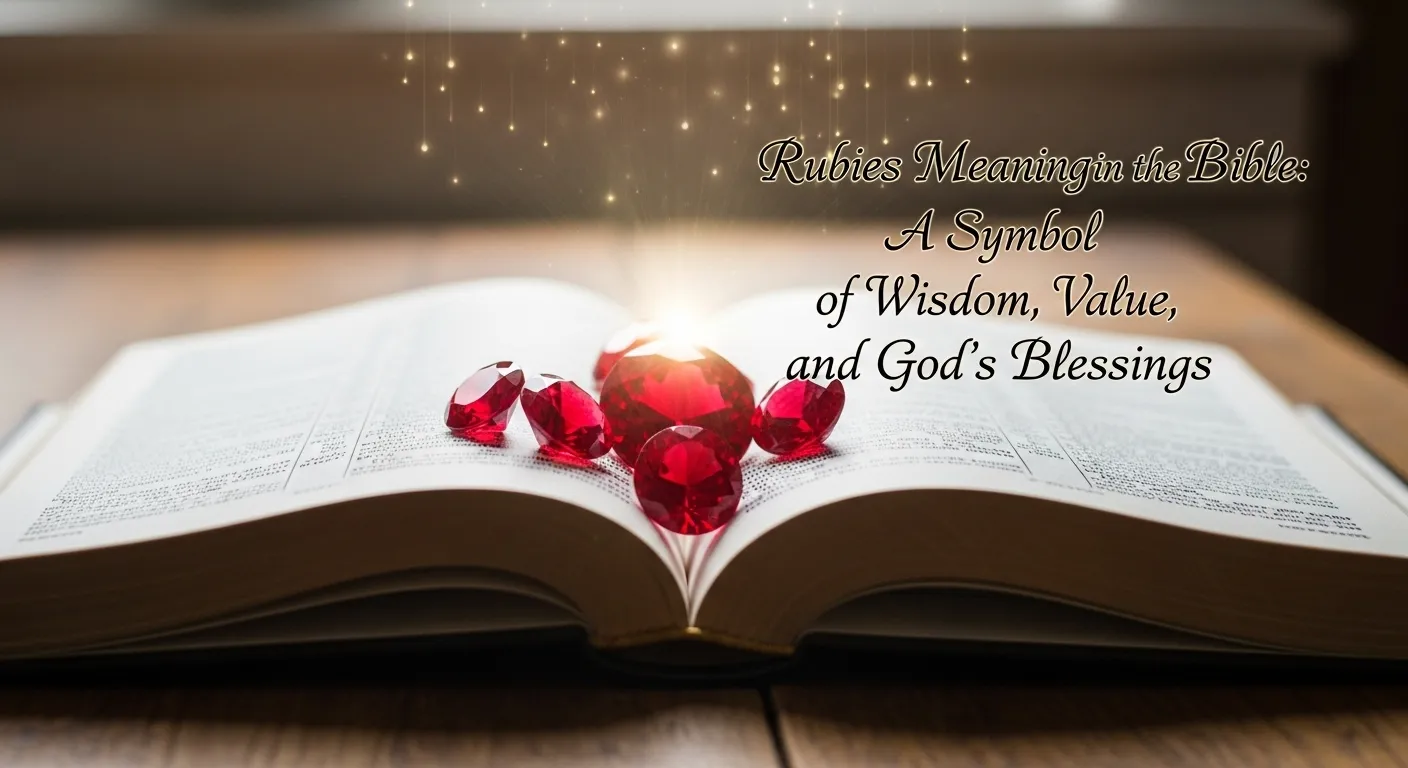
Wisdom is better than rubies. The sentence appears three times in Scripture’s wisdom literature, in slightly different forms, and each time it is making the same devastating comparison: the most coveted red stone of the ancient world, weighed against wisdom — and found light. “For wisdom is better than rubies, and all the things that may be desired are not to be compared to it” (Proverbs 8:11). The meaning of rubies in the Bible is not really about a gemstone at all. It is about the scale on which God weighs worth — and what happens when everything we treasure gets placed on it.
The stone itself: ruby is red corundum, colored by chromium, one of the hardest natural substances on earth. The Hebrew word usually translated “ruby” is peninim, which some scholars think referred to red coral or carnelian rather than true ruby — the ancients were less precise than gemologists. The identification matters less than the function: in every passage, rubies stand for concentrated, portable, universally recognized value. They are the ancient world’s shorthand for “the best stuff.”
Weighed Against Wisdom — and Found Wanting
Proverbs 8:11 is the thesis verse: “For wisdom is better than rubies.” Proverbs 3:15 says it of wisdom personified: “She is more precious than rubies; nothing you desire can compare with her.” Job 28:18, surveying the whole treasure house of the ancient world, concludes that wisdom’s price is “above rubies.” Three witnesses, one verdict.
The comparison is deliberately extreme. Rubies were not costume jewelry. They were the concentrated wealth of kings, the reserve currency of the ancient Near East, the thing you grabbed when the city was falling. To say wisdom is better than rubies is to say: the thing you would trade everything for in a crisis is worth less than the thing you neglect in ordinary time. It is a complete inversion of human priorities, stated as economic fact.
The reason is practical, not mystical. Wisdom compounds; rubies do not. A ruby sits in a vault. Wisdom governs a life — it guides decisions, shapes character, preserves from folly, and produces the “long life… riches and honor” of Proverbs 3:16. The stone is static wealth; wisdom is productive wealth. The Bible’s economics are unsentimental: invest where the returns are eternal.
Weighed Against a Woman — and Found Wanting
Proverbs 31:10 applies the scale to a person: “A wife of noble character who can find? She is worth far more than rubies.” The most famous woman in the wisdom literature is priced above the most famous stone — and the pricing is the point. Her worth is not in what she owns or how she looks but in what she is and does: she works, she provides, she speaks wisdom, she fears the Lord.
The verse has been misused as a burden — a checklist no real woman can meet. Read rightly, it is a celebration: the poem’s final word is that “a woman who fears the LORD is to be praised” (31:30), and the praise is for character, not performance. Her value exceeds rubies because character, unlike stones, cannot be mined, bought, or counterfeited. It can only be formed — “charm is deceptive, and beauty is fleeting” (31:30), but the fear of the Lord endures.
For the reader, the scale works personally: what in your life is “worth far more than rubies”? The question reframes every priority. Careers end. Portfolios crash. Beauty fades. The things that outlast rubies are the things no market can price: faithfulness, wisdom, love, a life feared toward God.
Princes Redder Than Rubies
Lamentations 4:7 contains the strangest ruby reference in Scripture: “Her princes were brighter than snow and whiter than milk, they were more ruddy in body than rubies.” The context is the siege of Jerusalem — the poet is describing the city’s young noblemen before the catastrophe, radiant with health and privilege.
The image is deliberately physical: these were young men who glowed — well-fed, well-kept, the picture of vitality. Rubies, the reddest precious thing the poet knew, become the standard for their ruddiness. And then the next verse reverses it: “But now they are blacker than soot” (4:8) — starved, wasted, unrecognizable. The ruby comparison makes the fall steeper. The reddest thing in the treasury could not preserve them; the glory that was only skin-deep vanished with the food supply.
The meaning is a warning about the fragility of outward glory. Health, wealth, status, beauty — the things that make people “redder than rubies” — are real blessings, but they are not foundations. When the siege comes, only what is within survives. The princes’ tragedy was not that they were blessed but that their blessing had no root. Rubies on the surface; nothing underneath.
The Red Stone at the Throne
Revelation 4:3 describes the One on the throne as having “the appearance of jasper and ruby” — or, in older translations, jasper and sardius, a red stone of the ruby family. The throne room’s center is ringed with red glory: the clear radiance of jasper alongside the deep red of sacrifice, judgment, or royalty.
Here the scale inverts. Everywhere else, rubies are weighed and found wanting. At the throne, the ruby-like glory is not the thing being weighed — it is part of the weight by which everything else is measured. The red stone that could not buy wisdom in Proverbs becomes, in Revelation, an aspect of the One whose wisdom orders all things. The symbol’s meaning depends entirely on its setting: in human hands, rubies are treasure; on the throne, ruby-glory is the Treasure.
This is the Bible’s consistent logic with precious things: they are good as creation, glorious as symbols, and bankrupt as saviors. The ruby at the throne does not need to be weighed against wisdom, because the One on the throne is wisdom — “in whom are hidden all the treasures of wisdom and knowledge” (Colossians 2:3).
Living Above the Ruby Standard
So what does a Christian do with rubies? The wisdom books give a practical answer: live by the scale, not by the stone. Price things the way God prices them. When Proverbs says wisdom is better than rubies, it is not making a poetic comparison — it is giving investment advice. Put your energy where the returns are permanent: in the fear of the Lord, in character, in love, in the things that outlast the vault.
The Proverbs 31 woman is the model: worth far more than rubies because her worth is in who she is, not what she owns. The Job 28 seeker is the model: digging for wisdom like miners dig for treasure, refusing to stop at the gemstone layer. The Christian reader’s task is the same: to hold rubies — and everything rubies represent — loosely, and to hold wisdom tightly. The stone is beautiful. The fear of the Lord is better.
The Wider Scale: Wisdom Against Every Jewel
The pattern across the wisdom books is total: no material treasure, however fine, however abundant, outranks the fear of the Lord and its fruits. Gold, silver, jewels, rubies — the ancient world’s reserve currencies, all weighed, all found light. And the scale works in both directions. Just as wisdom outranks every jewel, folly is priced below them: “Like a gold ring in a pig’s snout is a beautiful woman who shows no discretion” (Proverbs 11:22). Beauty without wisdom is jewelry on livestock — value in the wrong setting, wasted by the wearer.
The cumulative message is a complete economics of the soul. There are appreciating assets (wisdom, discretion, the fear of the Lord) and depreciating ones (everything else). The wise investor — the Proverbs 31 woman, the Proverbs 8 student, the Job 28 seeker — puts capital where it compounds eternally. Rubies hold their price. Wisdom raises it.
Gemologists define ruby as red corundum, colored by chromium, second only to diamond in hardness — Wikipedia’s ruby article gives the full mineral profile. Scripture never disputes the stone’s worth; it simply keeps putting heavier things on the scale. Wisdom outweighs it. Character outweighs it. And on the throne at the center of everything, the ruby-like glory is not the treasure being measured — it is the Treasure by which everything else is measured.










