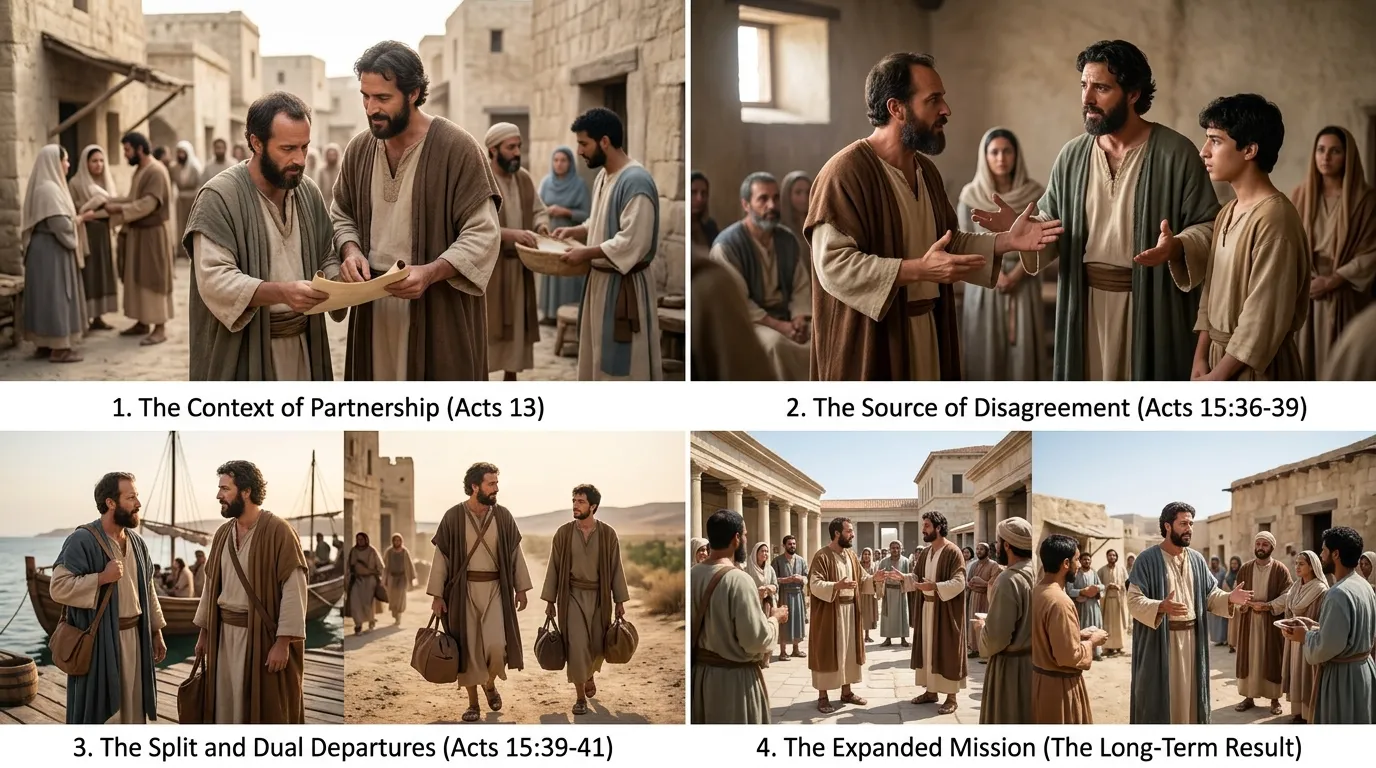
Two men who had carried the gospel through danger together reached a point where they could no longer travel the same road. The parting of Paul and Barnabas in Acts 15:36–41 is one of the most human moments in the New Testament. It does not feature villains. It features two faithful servants who loved Christ, loved the churches, and still disagreed so sharply that they separated. The passage is brief — only six verses — yet it speaks to anyone who has ever watched a good partnership fracture over a judgment call that both sides believed was right.
To understand the split, we have to remember what these two men had already been through together. Barnabas had vouched for Paul when the Jerusalem believers were afraid of him. Acts 9:27 records Barnabas bringing Paul to the apostles and telling them how Paul had met the Lord on the road to Damascus and had preached boldly in His name. Later, when the church in Antioch began to grow, Barnabas went to Tarsus to find Paul and bring him into the work (Acts 11:25–26). They traveled together on the first missionary journey, preached in Cyprus and Asia Minor, faced opposition, and returned to report what God had done through them. This was not a casual acquaintance. It was a partnership forged in shared risk.
The Proposal That Exposed the Fault Line
After the Jerusalem Council settled the question of whether Gentile believers had to be circumcised, Paul proposed a return visit. “Let us go back and visit the believers in all the towns where we preached the word of the Lord and see how they are doing,” he said (Acts 15:36). It was a shepherd’s proposal — not a new campaign but a follow-up, a check on the young churches they had planted. Barnabas agreed with the plan. The disagreement was not about the mission. It was about the personnel.
Barnabas wanted to take John Mark with them. Paul did not. The reason is stated plainly in Acts 15:38: Mark had deserted them in Pamphylia and had not continued with them in the work. On the first journey, Mark had left the team at Perga and returned to Jerusalem (Acts 13:13). Luke gives no explanation for the departure, and the silence has invited centuries of speculation — homesickness, fear, illness, disagreement over strategy. Whatever the cause, Paul read it as a pattern he could not risk repeating on a demanding journey, and Barnabas read it as a failure that deserved a second chance.
Two Good Instincts in Collision
It is tempting to declare a winner. The text refuses to do so. Paul’s instinct was stewardship: the work was hard, the churches were young, and the team had to be dependable. A missionary journey in the first century was not a conference tour. It meant long walks, hostile crowds, unreliable lodging, and real physical danger. Paul had reason to want proven companions. Barnabas’s instinct was restoration: the man known as the “son of encouragement” (Acts 4:36) saw people not only as they were but as they could become. He had once done for Paul exactly what he now wanted to do for Mark — stand beside someone others had written off.
Both instincts are biblical. The church needs Pauls who guard the mission and Barnabases who restore the worker. When those two goods collide without a resolution, the result can be painful even when nobody is acting from malice. Luke’s word for the disagreement is paroxysmos, a sharp irritation or contention — the same root from which we get “paroxysm.” This was not a polite difference of opinion. It was heated. Honest Bible reading does not smooth that over. Faithful people can argue fiercely, and the argument itself is not proof that one side has abandoned God.
One Team Becomes Two Missions
The outcome was separation. Barnabas took Mark and sailed for Cyprus. Paul chose Silas and traveled through Syria and Cilicia, strengthening the churches. Luke notes that Paul was “commended by the believers to the grace of the Lord” (Acts 15:40), and the same grace presumably covered Barnabas’s departure. Neither man quit. Neither man started a rival gospel. The single missionary team became two teams, and the gospel reached more places because of it. Cyprus received a visit. Syria and Cilicia received a visit. The map of the mission grew larger through a disagreement.
This is one of the passage’s most practical lessons: God is not limited by our unity. Unity is precious, and Scripture commands believers to pursue it, but when two faithful people cannot agree on a prudential matter, God can still work through both paths. The split did not end the mission; it multiplied it. That is not an excuse for casual division — Paul and Barnabas did not divide over doctrine, and they did not denounce each other — but it is a comfort for anyone who has watched a partnership end and wondered whether God’s work ended with it.
What Happened to Mark Afterwards
The rest of the New Testament quietly vindicates Barnabas’s patience without condemning Paul’s caution. Mark reappears in Paul’s letters as a valued coworker. In Colossians 4:10, Paul calls him a comfort and tells the church to welcome him. In Philemon 24, Mark is listed among Paul’s fellow workers. Most strikingly, in 2 Timothy 4:11, near the end of his life, Paul writes, “Get Mark and bring him with you, because he is helpful to me in my ministry.” The young man who once walked away became useful to the very apostle who had once refused to take him. Restoration took years, and it took someone willing to invest in the meantime. Barnabas was that someone.
There is also a later hint that the relationship between Paul and Barnabas was not permanently broken. Paul mentions Barnabas warmly in 1 Corinthians 9:6, speaking of their shared right to material support as apostles. The split was a season, not a life sentence. Time, grace, and the shared work of the gospel can do what a single heated argument cannot.
Reading Your Own Disagreements Through Acts 15
Most Christian conflict is not about heresy. It is about judgment calls: who to trust, when to risk, how fast to move, which opportunity to take. Acts 15 gives several principles for those moments. First, keep the disagreement about the decision, not about the person’s character or salvation. Luke records no accusation that either man was unfaithful. Second, do not let a disagreement over method become a disagreement over the gospel. Both men kept preaching the same Christ. Third, leave room for God to use both paths. Sometimes the answer to “which way is right?” is “both, for now.” Fourth, invest in people others have given up on. The church’s future Marks may be sitting in the shadow of an earlier failure, waiting for a Barnabas.
Finally, the passage invites humility about our own verdicts. Paul was right that the work was demanding. Barnabas was right that Mark could grow. Both were partly right, and both acted on incomplete knowledge. When we look back on our own sharp disagreements, we often discover the same thing: we were not choosing between good and evil but between two goods, and we could not see the whole picture. The grace of God, which the believers commended Paul to, is wide enough to cover our misjudgments too.
The Cyprus Mission: What Barnabas and Mark Did Next
Barnabas and Mark sailed to Cyprus, and the choice of destination is worth pausing over. Cyprus was Barnabas’s home — he was a Levite from Cyprus (Acts 4:36) — and it was where the first missionary journey had begun. Barnabas was taking Mark back to familiar ground, to a place where he had connections, credibility, and a network of believers. This was not a retreat. It was a strategic assignment matched to Mark’s stage of growth. A wise mentor does not throw a recovering worker into the hardest assignment available. He places him where he can succeed, be known, and rebuild.
Cyprus also had a symbolic weight. The first journey had started there with a confrontation with a sorcerer and the conversion of a proconsul. Returning there with Mark was a way of saying: the mission continues, and you are part of it. Church tradition holds that Barnabas later died as a martyr in Cyprus, and that Mark carried his work forward. Whether or not the details are certain, the pattern is clear: Barnabas invested his remaining ministry in a young man others had dismissed, and the investment paid off for generations.
There is a lesson here for every church leader. Your legacy is not only the sermons you preach or the programs you build. It is the people you develop — especially the ones who failed. Barnabas’s greatest contribution to the church may not be his own preaching. It may be Mark. The man who believed in a deserter gave the church a Gospel writer. When you invest in someone who has failed, you may be investing in the person who will carry the gospel further than you ever could.
For readers who want the wider historical backdrop of Barnabas’s life and ministry, the encyclopedia entry on Barnabas gathers the early sources in one place.










